The Digital Family Agroecology Laboratory, of the Landless Rural Workers Movement (MST), was recognized by the National Development and Reform Commission (CNDR) of China as one of ten Artificial Intelligence (AI) initiatives developed by the Chinese that can benefit the world. Brazil is the only Latin American country represented in the selection, which includes experiences in the United Arab Emirates, Indonesia, Malaysia, Egypt, Djibouti and Chile.
Carried out in partnership with the University of Brasília (UnB), the Agricultural University of China (UAC) and the International Association for Popular Cooperation (Baobab), the project is part of the publication China’s AI to Benefit the World (2026)which brings together case studies on technology applications in different areas.
The set of initiatives was announced at the World Conference on Artificial Intelligence (CMIA), in Shanghai, from July 17th to 20th, following President Xi Jinping’s speech at the creation session of the World Organization for Cooperation in Artificial Intelligence (WOMCI), of which Brazil became part along with 28 other countries.
To the Brazil in factthe MST leader, Glaucia Back, considered the milestone as “a recognition of the importance of Brazilian peasant agriculture for the Chinese”.
The publication of the ten case studies is an initiative of the CNDR, one of the main bodies in the Chinese government structure, responsible for coordinating the country’s strategic economic planning, preparing the Five-Year Plans and translating the government’s goals into concrete projects.
The Ministry of Education, the Ministry of Science and Technology and the National Data Administration of China participated in the edition.
Digital Laboratory
The Digital Family Agroecology Laboratory is part of the Brazil-China Center for Research, Development and Promotion of Technology in Mechanization for Family Farming. The space was opened in November 2024, with the participation of the Ministry of Education of China and the Ministry of Agrarian Development and Family Farming of Brazil.
At the launch, João Pedro Stedile, from the national directorate of the MST, highlighted the challenges of Brazilian family farming, which brings together more than 5 million farmers.
“Hunger cannot be combated just by distributing basic food baskets, but by producing healthy food. Farmers are the ones who produce food,” he said. “The Chinese are more than our friends, they are our companions”, said the leader in reference to Sino-Brazilian partnerships.
Big data in settlements
The Laboratory platform, developed by the Chinese state-owned company Sinomach Digital, integrates sensors installed in the fields to monitor temperature, soil humidity and the presence of pests, as well as machinery with real-time tracking.
The data is transmitted by base stations of the BeiDou satellite positioning system, developed by China — equivalent to GPS — and reaches the manager’s cell phone or computer. With a few clicks, it is possible to activate the irrigation of a plot or adjust the operation of equipment kilometers away. In China, this platform already monitors more than 2 million tractors and benefits tens of millions of farmers.
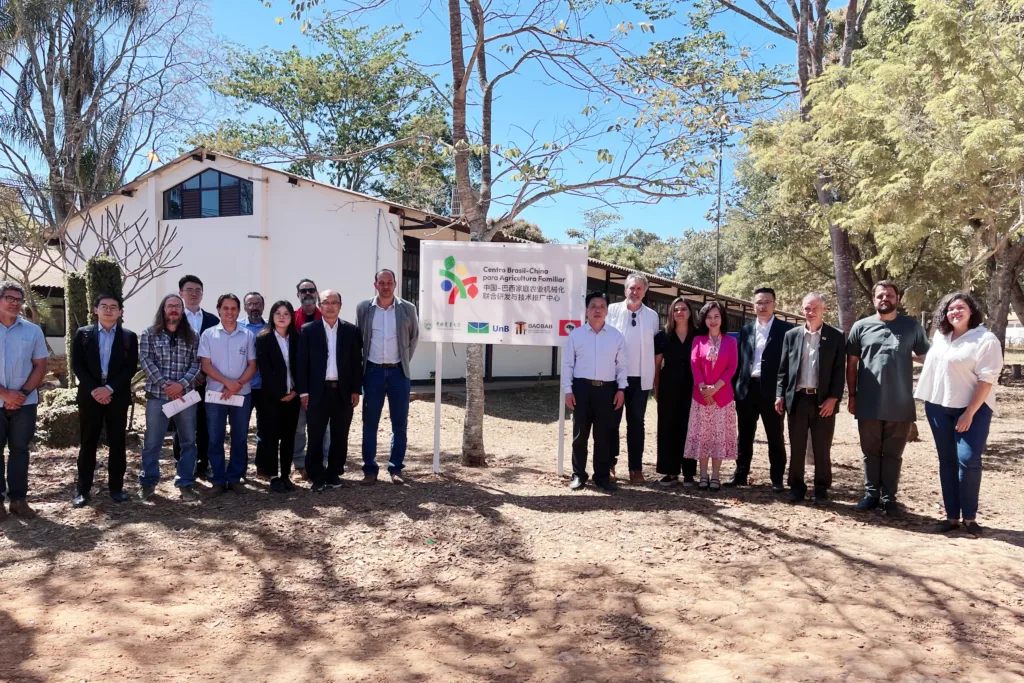
The UnB experimental area is located at Fazenda Água Limpa (FAL), with around 20 hectares on the outskirts of Brasília. The laboratory’s researchers develop AI algorithms to interpret the growth characteristics of corn and vegetable crops and generate personalized planting plans based on the soil, climate and pest control conditions of each field, according to the publication. The data is stored and analyzed in the UnB Technological Scientific Park (PCTec), on the Darcy Ribeiro campus.
Results
In large-scale corn cultivation in Brazil, the Sino-Brazilian team’s technological solutions can increase production efficiency by almost 200%, according to the publication. The program has already benefited more than a thousand farmers, according to Sinomach Digital.
In an interview with CCTVWang Yuhang, general manager of Sinomach Digital, stated that “there is an imbalance in the development of the Global South” and that the program seeks to “contribute to reducing this difference”. The model is already being replicated in Thailand and Belarus, according to the company.
Next Steps
The strategy of the Digital Family Agroecology Laboratory is integrated into a broader perspective of digitalization of Popular Agrarian Reform, “which has been taking shape on the ground in settlements”, explains Baobab coordinator for Brazil, Bárbara Loureiro.
In addition to this partnership, the MST and Sinomach Digital are also building the Intelligent Agricultural Machinery Service Center, in conjunction with the Ministry of Agrarian Development and Family Agriculture (MDA), the National Supply Company (Conab), the National Institute of Colonization and Agrarian Reform (Incra) and the Federal University of São Carlos (UFSCar).
The initiative will work in two areas: 100 hectares of the Cooperativa Agroindustrial de Produção e Comercialização (Copacon), in the Eli Vive settlement, in Londrina (PR), and 20 hectares of Cooperativa da Terra, in Itapeva (SP), mainly focused on the production of corn and beans.
“These are technologies that until recently were reserved for agribusiness. Now, managed by the cooperatives themselves, they are now focused on the production of healthy food and the massification of agroecology”, assesses MST director Gláucia Back.
The initiative results from a Memorandum of Understanding signed between the National Union of Popular Agrarian Reform Cooperatives of Brazil (Unicrab), Sinomach Digital and Embrapa in July 2025, which seeks to boost mechanization, digitalization and the use of artificial intelligence in family farming.
“We want to promote, through Unicrab’s network of cooperatives, smarter, more inclusive and sustainable agriculture”, concludes Loureiro.
Source: www.brasildefato.com.br