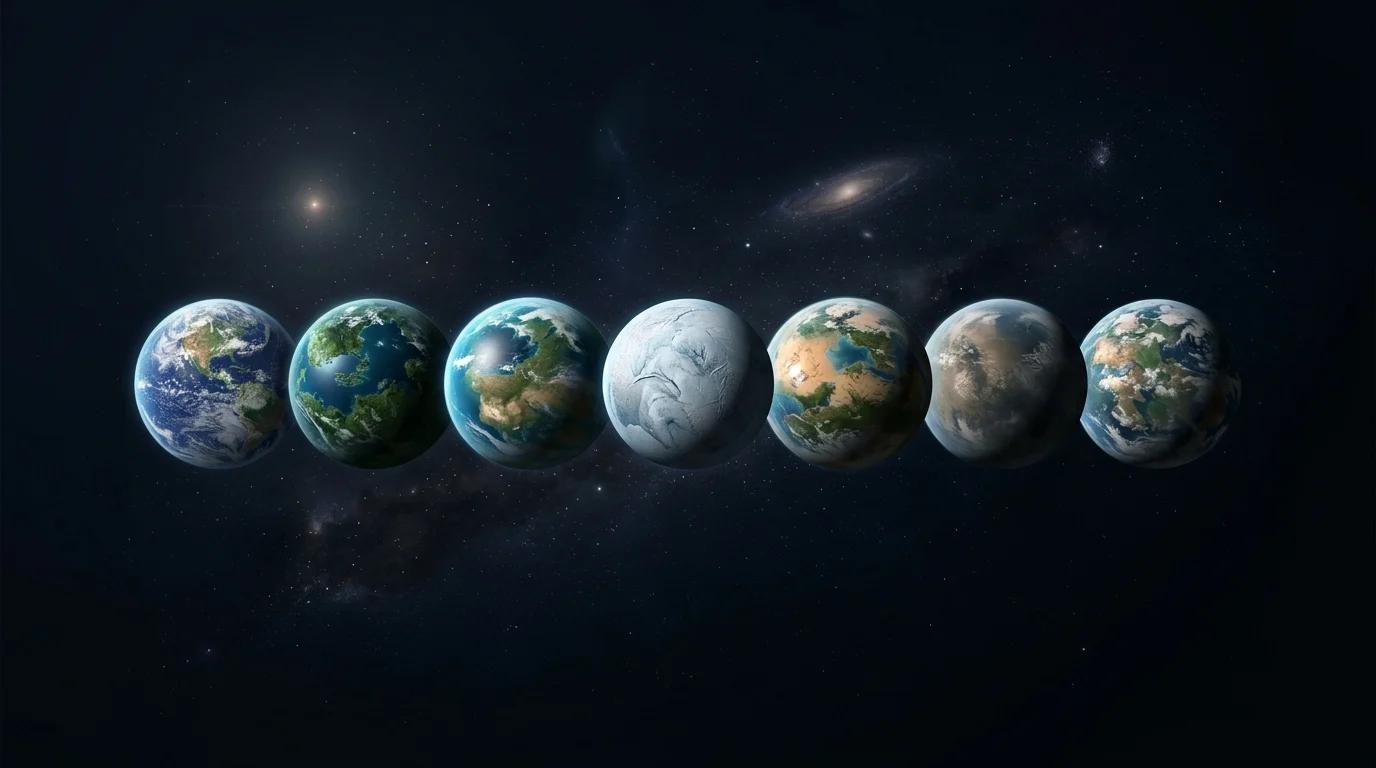
For thousands of years, humanity looked at the night sky and wondered whether life existed beyond Earth. What was once the subject of mythology and science fiction has become one of the most active fields in modern astronomy. Thanks to increasingly powerful telescopes and sophisticated detection methods, scientists have discovered thousands of planets orbiting distant stars. Among them are a handful of intriguing worlds that may possess conditions suitable for life.
The search for habitable planets is not simply about finding a place where humans could survive. Researchers are looking for environments that could support liquid water, maintain stable temperatures, and possibly host biological processes similar to those found on Earth. While no known exoplanet perfectly matches our world, several candidates have emerged as particularly promising.
These planets are located many light-years away, making human travel impossible with current technology. Nevertheless, they offer valuable clues about how common life-friendly environments may be throughout the universe.
Here are seven of the most fascinating planets that scientists believe could potentially support human life.
🚀 What Makes a Planet Habitable?
Before exploring the candidates, it is important to understand what astronomers mean by “habitable.”
A habitable planet is generally one that exists within its star’s habitable zone, often called the Goldilocks Zone. This is the region where temperatures may allow liquid water to exist on the planet’s surface. If a planet is too close to its star, water may evaporate. If it is too far away, water could freeze permanently.
Scientists also examine several other factors, including:
- Atmospheric composition
- Planetary size and mass
- Surface temperature
- Geological activity
- Magnetic field strength
- Star stability
- Presence of water
Although life elsewhere could differ dramatically from life on Earth, these criteria provide a useful starting point.
🌟 1. Proxima Centauri b
Perhaps no exoplanet has generated more excitement than Proxima Centauri b.
Discovered in 2016, this planet orbits Proxima Centauri, the closest star to our Solar System. Located approximately 4.24 light-years away, it is practically our cosmic neighbor.
The planet is believed to be slightly larger than Earth and resides within its star’s habitable zone. Because of its proximity, it has become a prime target for future observation missions.
Scientists estimate that Proxima Centauri b receives roughly the same amount of stellar energy as Earth receives from the Sun. This raises the possibility that liquid water could exist on its surface.
However, there are significant challenges. Proxima Centauri is a red dwarf star known for intense stellar flares. These eruptions can bombard nearby planets with radiation, potentially stripping away atmospheres and making life difficult.
Despite these concerns, researchers continue to study the planet because of its extraordinary location and Earth-like characteristics.
Key Facts
- Distance from Earth: 4.24 light-years
- Mass: Approximately 1.3 Earth masses
- Star Type: Red dwarf
- Potential for liquid water: Possible
🌊 2. TRAPPIST-1e
The TRAPPIST-1 system transformed the field of exoplanet research when astronomers discovered seven Earth-sized planets orbiting a single star.
Among them, TRAPPIST-1e stands out as one of the most promising.
Located about 40 light-years from Earth, the planet has a rocky composition and resides comfortably within the habitable zone of its parent star. Models suggest it could possess oceans, continents, and a dense atmosphere.
One reason scientists are particularly interested in TRAPPIST-1e is its density. Measurements indicate that it may have a composition remarkably similar to Earth’s, including a substantial iron core.
The system’s compact nature also allows astronomers to study its planets more easily than many other exoplanets. Future observations may reveal atmospheric gases that could indicate biological activity.
Key Facts
- Distance from Earth: About 40 light-years
- Size: Nearly identical to Earth
- Composition: Rocky
- Habitability potential: High
🔭 3. Kepler-452b
Often referred to as “Earth’s Cousin,” Kepler-452b is one of the most famous potentially habitable worlds ever discovered.
Detected by NASA’s Kepler Space Telescope in 2015, the planet orbits a star very similar to our Sun. It lies approximately 1,400 light-years away in the constellation Cygnus.
Kepler-452b is significantly larger than Earth, measuring about 60 percent wider in diameter. This suggests it may belong to a category known as super-Earths.
The planet receives a similar amount of energy from its star as Earth receives from the Sun. Because the star is older than our Sun, researchers speculate that life, if it exists there, may have had even more time to evolve.
One major uncertainty is whether Kepler-452b is a rocky world or a mini-Neptune with a thick gaseous envelope. Additional observations will be necessary to answer that question.
Key Facts
- Distance from Earth: Around 1,400 light-years
- Size: 1.6 times Earth’s radius
- Star similarity: Very close to the Sun
- Habitability potential: Strong candidate
🌎 4. Kepler-186f
Kepler-186f made history as the first Earth-sized planet discovered within the habitable zone of another star.
Located roughly 500 light-years away, the planet orbits a red dwarf star and has attracted considerable attention from scientists.
Its size is remarkably close to Earth’s, increasing the possibility that it possesses a rocky surface. While little is known about its atmosphere, theoretical models suggest it could support liquid water under the right conditions.
The discovery represented a major milestone because it demonstrated that Earth-sized planets in habitable zones are not rare exceptions.
Although its environment remains largely mysterious, Kepler-186f continues to rank among the most compelling candidates for habitability.
Key Facts
- Distance from Earth: About 500 light-years
- Size: Slightly larger than Earth
- Surface: Likely rocky
- Scientific importance: Historic discovery
☀️ 5. TOI-700 d
TOI-700 d is one of the newest additions to the list of potentially habitable exoplanets.
Discovered by NASA’s Transiting Exoplanet Survey Satellite, commonly known as TESS, this planet orbits a relatively quiet red dwarf star approximately 100 light-years away.
Its location within the habitable zone immediately caught scientists’ attention. Climate simulations suggest that if the planet has an atmosphere similar to Earth’s, temperatures could allow liquid water to remain stable across large portions of the surface.
The relatively calm behavior of its host star is another positive factor. Unlike some red dwarfs that produce frequent radiation bursts, TOI-700 appears less active, potentially improving conditions for long-term habitability.
Researchers have used advanced climate models to explore possible weather patterns on the planet, making it one of the most extensively studied exoplanets discovered in recent years.
Key Facts
- Distance from Earth: About 100 light-years
- Discovery mission: TESS
- Atmosphere: Unknown
- Habitability potential: Encouraging
🪐 6. LHS 1140 b
LHS 1140 b has become a favorite among astronomers searching for signs of life.
Located approximately 49 light-years from Earth, this super-Earth orbits within the habitable zone of a red dwarf star. It is significantly more massive than Earth and may possess a dense atmosphere capable of retaining heat and protecting surface water.
Scientists believe the planet could contain vast oceans. Some studies even suggest it might be an ocean world covered largely by water.
Its host star appears relatively stable, reducing concerns about destructive stellar radiation. This stability improves the chances that an atmosphere could survive over billions of years.
Recent observations using advanced telescopes have increased interest in the possibility that the planet may have a substantial atmosphere, making it one of the most promising targets for future research.
Key Facts
- Distance from Earth: About 49 light-years
- Type: Super-Earth
- Water potential: Significant
- Research interest: Extremely high
🌌 7. K2-18 b
K2-18 b may be one of the most intriguing exoplanets ever discovered.
Located approximately 120 light-years away, the planet resides within the habitable zone of its star. What makes it especially notable is that scientists have detected water vapor in its atmosphere.
This was a groundbreaking discovery because atmospheric water is considered one of the most important ingredients for life as we know it.
K2-18 b is much larger than Earth and may belong to a category known as Hycean planets. These worlds are believed to have hydrogen-rich atmospheres and potentially vast global oceans.
Observations conducted with modern space telescopes have revealed complex atmospheric chemistry that continues to fascinate researchers. While no evidence of life has been found, K2-18 b remains among the most promising locations in the search for extraterrestrial biology.
Key Facts
- Distance from Earth: About 120 light-years
- Atmosphere: Contains water vapor
- Type: Possible Hycean world
- Scientific significance: Very high
🧬 Could Humans Actually Live on These Planets?
The distinction between a planet that could support life and a planet where humans could comfortably live is enormous.
Even the most promising candidates present major challenges.
Many orbit red dwarf stars that emit powerful radiation. Others may have atmospheric pressures far beyond what humans can tolerate. Some could be covered entirely by oceans, while others may experience extreme weather patterns unlike anything seen on Earth.
Additionally, gravity could differ substantially from Earth’s. Higher gravity might make movement difficult, while lower gravity could create long-term health issues.
For humans to settle on these worlds, advanced technologies would likely be required, including:
- Artificial habitats
- Radiation shielding
- Atmospheric processing systems
- Sustainable food production
- Medical adaptation technologies
At present, the possibility of direct colonization remains theoretical.
🔬 How Scientists Search for Signs of Life
The search for life extends far beyond finding planets in habitable zones.
Modern astronomers analyze planetary atmospheres for biosignatures, chemical indicators that may suggest biological activity.
Potential biosignatures include:
- Oxygen
- Methane
- Ozone
- Water vapor
- Carbon dioxide combinations
On Earth, many of these gases are produced or influenced by living organisms. Detecting similar patterns elsewhere could provide compelling evidence that life exists beyond our planet.
The newest generation of observatories is designed specifically for this purpose. By studying how starlight passes through planetary atmospheres, scientists can identify chemical compounds with unprecedented precision.
Every new observation brings humanity closer to answering one of the oldest questions ever asked: Are we alone?
🌠 The Future of Interstellar Exploration
Although these planets are incredibly distant, technological progress continues at a remarkable pace.
Projects involving advanced propulsion concepts, laser-driven spacecraft, and autonomous probes are being explored by scientists worldwide. While interstellar travel remains beyond current capabilities, future generations may possess technologies that make journeys to nearby star systems possible.
Even if humans never physically visit these planets, increasingly sophisticated telescopes will continue to reveal details about their atmospheres, climates, and potential biospheres.
Future discoveries may identify worlds even more Earth-like than those known today.
📖 Conclusion
The discovery of potentially habitable planets represents one of the most important scientific achievements of the modern era. Each new world expands our understanding of the universe and challenges long-held assumptions about humanity’s place within it.
Proxima Centauri b, TRAPPIST-1e, Kepler-452b, Kepler-186f, TOI-700 d, LHS 1140 b, and K2-18 b are among the strongest candidates currently known. None has been confirmed to host life, and each presents significant uncertainties. Yet together they demonstrate a remarkable truth.
Earth may not be unique.
As astronomers continue scanning the cosmos, the chances of finding a truly Earth-like world grow stronger every year. Whether life exists on one of these planets or on a world yet to be discovered, the search itself is reshaping humanity’s understanding of the universe.
The next great discovery may already be waiting among the stars.