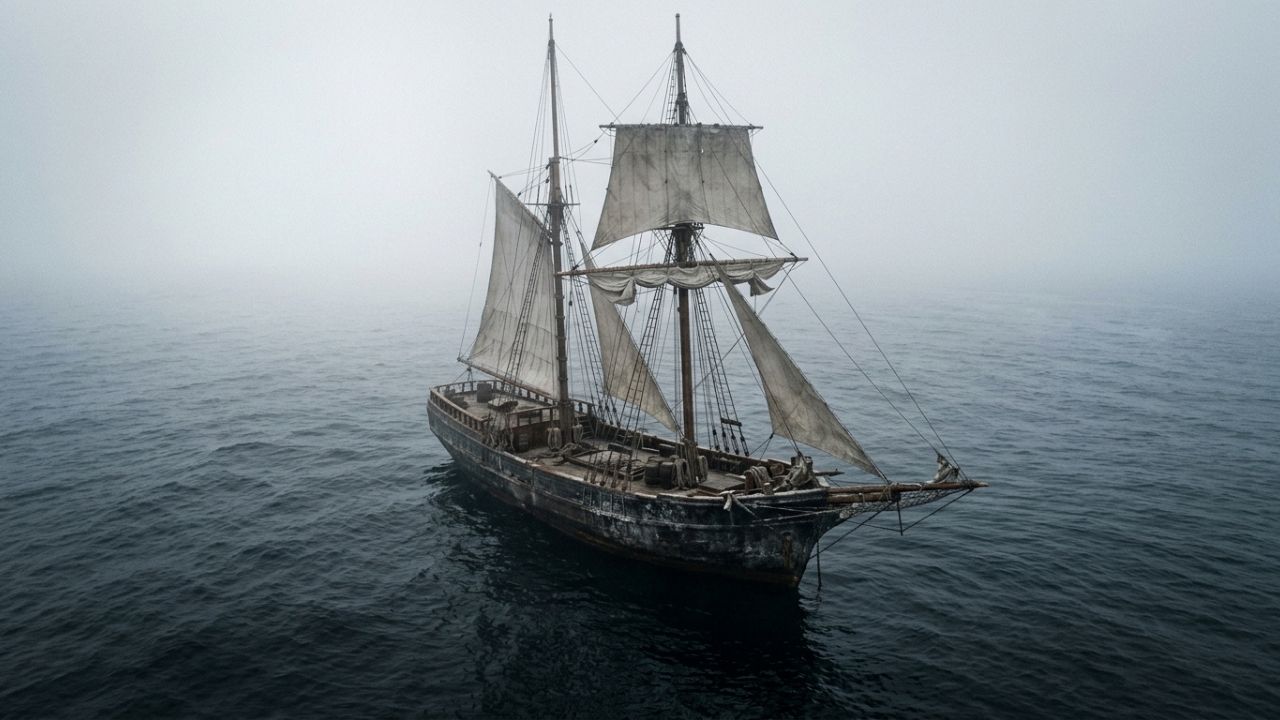
In December 1872, a merchant vessel was discovered drifting across the Atlantic Ocean with no one aboard. Its cargo remained largely intact, the ship was still seaworthy, and the fate of its captain, family, and crew was unknown. More than 150 years later, the disappearance of those aboard the Mary Celeste continues to fascinate historians, maritime researchers, and readers drawn to one of the sea’s most enduring mysteries.
The ocean has always inspired stories of unexplained disappearances. Ships vanish in storms, sailors become separated from their vessels, and wreckage occasionally emerges years after a disaster. Yet few maritime incidents have acquired the lasting reputation of the Mary Celeste, a merchant brigantine found abandoned in the Atlantic in 1872.
What made the discovery extraordinary was not simply that everyone aboard had disappeared. It was the condition of the vessel itself. The ship had not sunk, its cargo had not been stolen, and investigators found no convincing evidence of a violent struggle. The lifeboat was missing, suggesting that those aboard had left voluntarily or under circumstances that made remaining on the vessel seem dangerous.
The fate of the people who abandoned the ship remains unknown. Although numerous explanations have been proposed, no theory has conclusively established what happened during the vessel’s final hours with its crew aboard.
A Merchant Ship Sets Sail
The story began with a commercial voyage from New York to Genoa, Italy. The vessel, originally named the Amazon, was built in Nova Scotia in 1861. Following several changes of ownership and a series of misfortunes, the ship was renamed Mary Celeste.
By 1872, the vessel was under the command of Captain Benjamin Spooner Briggs, an experienced American mariner. Briggs was regarded by people who knew him as a responsible and capable captain. He was also a family man, and on this voyage he brought his wife, Sarah Elizabeth Briggs, and their young daughter, Sophia Matilda Briggs.
The Mary Celeste departed New York on November 7, 1872, carrying a commercial cargo of industrial alcohol intended for delivery in Italy. The vessel had a crew of seven men in addition to the captain and his family, bringing the total number of people aboard to ten.
The voyage was expected to take the ship across the Atlantic, following established maritime routes toward the Mediterranean. Nothing in the departure itself suggested that the journey would become one of the most discussed disappearances in nautical history.
Another vessel, the Dei Gratia, was also crossing the Atlantic under the command of Captain David Morehouse. Its crew would eventually make the discovery that turned the Mary Celeste into an international mystery.
The Discovery of an Abandoned Ship
On December 4, 1872, by the calendar then in use, the Dei Gratia encountered the Mary Celeste drifting in the Atlantic, roughly 400 nautical miles east of the Azores. The date is sometimes given as December 5 in modern accounts because of differences in timekeeping and reporting.
The vessel appeared to be moving without effective control. Its sails were damaged or improperly set, and its movements raised concerns among the sailors watching from the Dei Gratia.
Captain Morehouse sent members of his crew to investigate. When they boarded the Mary Celeste, they found no captain, passengers, or sailors. The ship had become a vessel without a living crew, but it had not been abandoned in the sense of being a wreck.
The discovery was deeply unsettling. The Mary Celeste remained afloat and was capable of being navigated. Some water had accumulated in the lower part of the vessel, but the conditions did not immediately suggest that the ship was on the verge of sinking.
Personal belongings and much of the ship’s equipment remained aboard. The cargo was largely present, and there was no obvious sign that pirates had systematically removed valuable goods.
The most significant absence was the ship’s lifeboat. It appeared that those aboard had departed in it, leaving the larger vessel behind.
Why would an experienced captain abandon a seaworthy ship in the middle of the Atlantic? And why had no one from the lifeboat ever been heard from again?
Those questions became the foundation of the Mary Celeste mystery.
What Investigators Found on Board
The condition of the vessel offered clues, but none provided a definitive explanation.
The ship’s cargo consisted of 1,701 barrels of industrial alcohol, according to the subsequent investigation. When the cargo was examined, nine barrels were found empty. Because the shipment involved alcohol, researchers have considered whether leakage, vapor, or an explosion risk might have influenced the decision to abandon the ship.
The cargo was not, however, simply a collection of drinking spirits. It consisted of industrial alcohol, and the precise characteristics of the shipment matter when evaluating theories about fire or fumes.
The ship’s navigation equipment and documents were also important to investigators. Some navigational instruments were missing, and the vessel’s chronometer and sextant were reported absent. The ship’s papers were incomplete, although the captain’s daily journal survived and provided information about the voyage.
The final recorded entry in the journal was dated November 25, 1872, when the Mary Celeste was near Santa Maria Island in the Azores. The vessel was therefore discovered days after its last recorded position, leaving a substantial period during which events aboard could not be reconstructed with certainty.
Accounts of the ship’s interior have sometimes exaggerated the degree to which everything was perfectly arranged. The Mary Celeste was not necessarily an untouched floating museum. It had experienced a difficult passage, and some equipment showed signs of exposure to the elements.
Nevertheless, the evidence did not reveal a clear cause of abandonment. There was no confirmed massacre, no conclusive proof of piracy, and no surviving witness to describe the captain’s final decision.
Theory One: Fear of an Explosion
One of the most frequently discussed explanations concerns the cargo of industrial alcohol.
Alcohol vapor can be flammable under appropriate conditions, and a leaking barrel or accumulation of vapor could create a dangerous environment. If Captain Briggs believed that an explosion was imminent, he might have ordered everyone into the lifeboat as a precaution.
Researchers have proposed that a small explosion or a sudden release of vapor could have frightened the crew without leaving the sort of extensive damage expected from a major blast. The captain might then have intended to remain close to the ship, perhaps keeping the lifeboat attached by a line until it was safe to return.
If the line broke, or if the weather deteriorated, the occupants of the smaller boat could have been separated from the vessel.
This scenario explains several elements of the mystery, including the missing lifeboat and the lack of obvious structural damage. It also offers a possible reason why a captain would abandon a ship that still appeared seaworthy.
However, there is no conclusive evidence that an explosion occurred. No definitive blast damage was documented, and the surviving records do not establish that the alcohol cargo reached a dangerous concentration.
The theory remains plausible as a possible explanation for the decision to leave the ship, but the events that would have followed remain speculative.
Theory Two: A Sudden Storm or Dangerous Sea Conditions
The Atlantic can become treacherous with little warning, particularly for a sailing vessel carrying cargo across a long ocean route.
A storm, heavy seas, or a combination of adverse conditions could have convinced the captain that the Mary Celeste was in immediate danger. If the ship’s pumps were not keeping up with incoming water, or if the crew believed the vessel was taking on more water than it could safely tolerate, abandoning ship might have seemed necessary.
The discovery of water in the lower part of the Mary Celeste has led some researchers to consider whether the captain misjudged the seriousness of flooding.
A faulty or inaccurate sounding measurement could also have contributed to a mistaken assessment of the vessel’s condition. In the age of sail, captains sometimes had to make critical decisions with limited information and without modern electronic instruments.
Under this theory, Briggs could have ordered his family and crew into the lifeboat to avoid what he believed was an imminent sinking. The ship might then have survived conditions that its captain had judged too dangerous.
Yet this explanation also has limitations. The Mary Celeste remained afloat and was later brought into port. Although a ship’s survival does not prove that it was safe at the time of abandonment, the available evidence does not establish that a storm forced everyone to leave.
Without a surviving witness or a detailed account of the weather and conditions aboard during the missing period, the theory cannot be confirmed.
Theory Three: Piracy or an Attack at Sea
Piracy is another explanation often associated with abandoned vessels. A violent encounter could theoretically account for the disappearance of everyone aboard, particularly if attackers wanted to avoid leaving witnesses.
However, the Mary Celeste presented little direct evidence of a successful pirate attack. Its cargo remained largely intact, and there was no clear indication that valuable goods had been systematically stolen.
The absence of an obvious struggle also weakens the case for a conventional boarding by hostile attackers, although it does not make every form of violence impossible.
Another problem is motive. The industrial alcohol cargo had commercial value, but a successful attack would normally offer some incentive for taking the shipment or other property. Leaving the ship and cargo largely untouched would require additional assumptions.
The piracy theory has therefore remained part of popular discussion rather than an established historical explanation.
A related suggestion is that someone aboard the Mary Celeste might have attacked the others during a dispute. But no reliable evidence establishes a mutiny, a murder, or a confrontation that could explain the disappearance of all ten people.
Such possibilities are dramatic, but dramatic possibilities should not be confused with documented facts.
Theory Four: A Failed Attempt to Escape the Ship
One of the more practical explanations combines several of the previous ideas.
Captain Briggs may have believed that the Mary Celeste faced a temporary but serious danger, such as a leak, a problem with the cargo, or a possible fire. Rather than abandoning the vessel permanently, he may have ordered everyone into the lifeboat with the intention of staying nearby.
This would explain why the ship’s navigation instruments were missing. If the captain planned to navigate a smaller boat or return to the ship later, taking essential equipment would have been sensible.
The plan could have depended on a line connecting the lifeboat to the Mary Celeste. If the line broke in rough weather, the people in the smaller boat might have been carried away by wind and currents.
A lifeboat offers little protection against prolonged exposure to the open Atlantic. Even experienced sailors would have faced enormous challenges if separated from their main vessel without adequate shelter, water, and provisions.
The Mary Celeste might then have continued drifting while the people aboard the lifeboat disappeared into the ocean.
This theory is compelling because it does not require a spectacular event. A reasonable precaution, followed by a sudden change in weather or a broken line, could have produced a disaster.
Nevertheless, the crucial details remain unverified. No lifeboat carrying the missing passengers and crew was recovered, and no confirmed evidence identifies the exact circumstances under which it became separated from the ship.
How a Maritime Mystery Became a Legend
The Mary Celeste became internationally famous partly because of a literary account published in 1884 by Arthur Conan Doyle, who later became known for creating Sherlock Holmes.
Doyle’s short story, titled J. Habakuk Jephson’s Statement, presented a fictionalized version of an abandoned ship inspired by the Mary Celeste. Although the story was not intended as a factual report, it helped popularize the image of a vessel discovered in an almost supernatural condition.
As the story circulated, details were embellished and repeated. Later retellings often portrayed the ship as perfectly preserved, with meals still on tables and personal belongings arranged exactly as they had been left. Some versions introduced bloodstains, mysterious messages, or other dramatic clues unsupported by the historical record.
These additions made the story more entertaining, but they also obscured the distinction between the real ship and the fictional accounts inspired by it.
The phrase “ghost ship” became closely associated with the Mary Celeste. The label was understandable, given the absence of everyone aboard, but it encouraged readers to imagine supernatural explanations where ordinary maritime hazards might have been sufficient.
The actual mystery is compelling without such embellishments. Ten people vanished from a vessel that survived, and the evidence needed to determine what happened was never recovered.
The Salvage Trial and Questions of Suspicion
After the Mary Celeste was brought to Gibraltar, the circumstances of its abandonment attracted official attention.
Because the vessel had been found by another merchant ship, investigators examined whether its discovery and salvage involved wrongdoing. Captain Morehouse and the crew of the Dei Gratia had taken considerable risks in bringing the abandoned ship to safety, and salvage claims could be financially significant.
The legal proceedings examined the condition of the vessel and the circumstances under which it had been found. Officials considered the possibility of foul play, but the inquiry did not establish that the Dei Gratia crew had murdered the missing sailors or deliberately abandoned the vessel.
The investigation nevertheless contributed to the mystery’s reputation. Suspicion and speculation surrounded the incident, while the lack of definitive evidence prevented investigators from reconstructing the disappearance.
The salvage process also demonstrated an important feature of nineteenth-century maritime life. When a ship was found abandoned, rescuing the vessel could involve substantial danger and expense, while the legal right to compensation depended on complicated rules and evidence.
The case remained unresolved, leaving later generations to reinterpret the surviving records.
Why the Mary Celeste Mystery Still Matters
The enduring fascination with the Mary Celeste lies in the gap between what investigators know and what they cannot prove.
The ship was real. Its voyage was documented. It was found abandoned, and the lifeboat was missing. Captain Briggs, his family, and the crew were never conclusively accounted for.
Beyond those facts, many details remain uncertain.
Modern readers may be tempted to look for a single extraordinary explanation, but maritime disasters frequently result from a sequence of ordinary decisions and unexpected events. A captain may make a precautionary judgment under pressure, a line may break, and a small boat may be overwhelmed by conditions that the larger vessel survives.
That possibility is no less tragic than a dramatic conspiracy. It is simply harder to reconstruct without witnesses.
The case also highlights the limitations of historical investigation. Investigators in 1872 lacked modern satellite tracking, electronic communications, comprehensive weather data, and the forensic methods available today. Once the people aboard disappeared, the evidence necessary to explain their final hours was largely lost.
The ocean preserved the ship but concealed the fate of its occupants.
Conclusion: A Mystery Without a Definitive Answer
More than a century and a half after its discovery, the Mary Celeste remains one of the world’s most famous abandoned ships. Its story continues to inspire books, documentaries, and theories because the available evidence supports several possibilities without conclusively proving any of them.
An explosion scare involving the alcohol cargo, dangerous sea conditions, a mistaken assessment of flooding, or a failed attempt to escape a perceived emergency could help explain why the vessel was abandoned. None, however, fully resolves the disappearance of all ten people.
The most responsible conclusion is also the least sensational: the Mary Celeste was found abandoned, but the fate of its captain, family, and crew remains unknown.
Its mystery endures because the ship itself survived long enough to become evidence of a tragedy, while the people who could have explained what happened vanished without a trace.
In the end, the Mary Celeste is more than a ghost-ship legend. It is a reminder of the dangers faced by sailors in the age of sail, the difficult decisions made far from shore, and the limits of what history can recover when the witnesses are lost at sea.