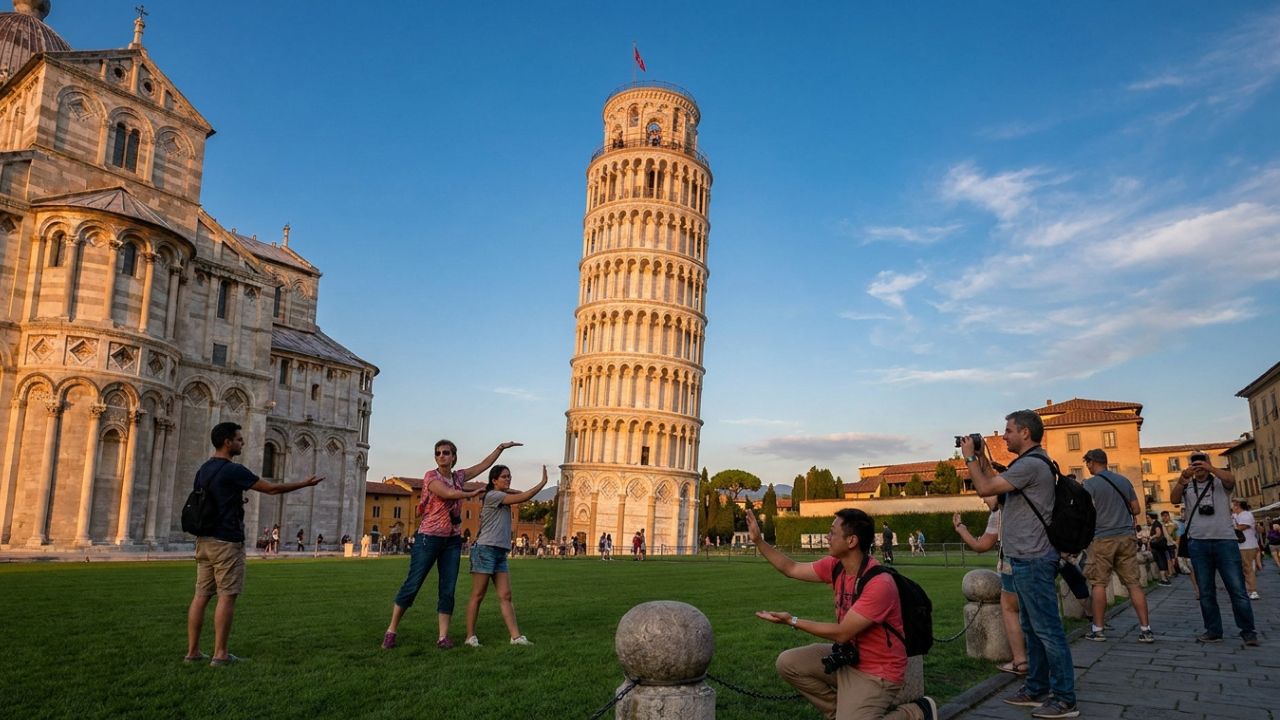
The Leaning Tower of Pisa is one of the world’s most recognizable landmarks. Every year, millions of tourists travel to Italy to see the famous structure, often posing for playful photographs that make it appear as though they are holding the tower upright. At first glance, the building seems like an accident waiting to happen. Its dramatic tilt raises an obvious question: why hasn’t it collapsed?
Despite leaning at an angle that would make most modern engineers uncomfortable, the tower has remained standing for more than 850 years. The explanation is a remarkable combination of medieval construction techniques, unusual soil conditions, modern engineering interventions, and a stroke of historical luck.
Far from being a construction failure that somehow survived, the Leaning Tower of Pisa has become one of history’s greatest engineering lessons.
🏗️ A Tower That Was Never Supposed to Lean
Construction of the Leaning Tower of Pisa began in 1173. The structure was designed as the freestanding bell tower for the Pisa Cathedral, located in what is now known as the Piazza dei Miracoli, or Square of Miracles.
At the time, Pisa was one of Europe’s wealthiest maritime republics. The city wanted to showcase its prosperity by building an impressive religious complex featuring a cathedral, baptistery, cemetery, and an elegant bell tower.
Everything seemed to go according to plan during the early stages of construction. Builders completed the foundation and began raising the white marble tower.
Then the unexpected happened.
By the time workers reached the third floor, the building had already started leaning noticeably toward one side.
Instead of standing perfectly vertical, the tower slowly sank into the ground unevenly.
🌍 The Real Culprit Was Underground
Contrary to popular belief, the problem was not poor craftsmanship.
The biggest issue lay beneath the tower.
The foundation is surprisingly shallow, measuring only about three meters (roughly ten feet) deep. That might have been sufficient on solid rock, but Pisa sits on soft ground composed of clay, sand, and marine sediments deposited over thousands of years.
These layers compress unevenly under heavy loads.
As the massive marble tower became taller and heavier, one side of the foundation sank faster than the other.
This process is known as differential settlement.
Instead of the entire structure sinking uniformly, only one side moved downward, creating the famous tilt.
Ironically, the soil that caused the leaning would later become one of the main reasons the tower survived.
⏳ Construction Delays Became an Unexpected Blessing
Most major medieval buildings were completed over decades, but the Leaning Tower of Pisa experienced unusually long interruptions.
Construction stopped several times because of wars involving Pisa and neighboring Italian states.
These delays lasted for decades.
Although frustrating for medieval builders, the pauses allowed the ground beneath the tower to compress gradually before additional weight was added.
If construction had continued without interruption, engineers believe the rapid increase in weight might have caused the tower to collapse centuries ago.
Instead, nature effectively gave the structure time to stabilize between construction phases.
Sometimes, history’s greatest engineering success comes from unexpected delays.
⚖️ Builders Tried to Correct the Lean
When construction resumed, medieval architects quickly realized that the tower was no longer vertical.
They attempted to compensate.
Upper floors were built slightly taller on one side than the other, creating a subtle curve throughout the structure.
This correction did not eliminate the lean.
Instead, it produced the tower’s distinctive banana-like shape that careful observers can still notice today.
Rather than standing perfectly straight, the tower gently bends as it rises.
This unusual geometry actually helps distribute some of the structural forces more effectively.
🧱 A Surprisingly Strong Design
Although its foundation was problematic, the tower itself was built with remarkable quality.
The structure consists primarily of white marble, supported by thick masonry walls that gradually become thinner toward the top.
At the base, the walls measure approximately four meters thick.
This enormous mass gives the tower exceptional strength under compression.
Stone performs extremely well when squeezed by weight.
Unlike materials that easily bend or stretch, marble can support tremendous vertical loads.
Even while leaning, most of the forces inside the tower remain compressive rather than tensile.
That characteristic has played a major role in its long-term survival.
🌊 Soft Soil Actually Helps Protect the Tower
It seems counterintuitive, but the same soft soil that caused the leaning also reduces certain risks.
During earthquakes, rigid ground transfers seismic energy more directly into buildings.
Soft ground behaves differently.
It absorbs and dissipates part of the vibration before it reaches the structure.
Scientists refer to this phenomenon as dynamic soil-structure interaction.
Because the Leaning Tower of Pisa rests on relatively flexible soil, seismic waves lose some of their destructive energy before reaching the building.
This effect may explain why the tower has survived several significant earthquakes that damaged nearby structures.
📐 The Lean Became Dangerous
Although the tower survived for centuries, its tilt gradually increased.
By the late twentieth century, engineers became increasingly concerned.
The tower leaned more than 5.5 degrees from vertical.
Its highest point extended several meters beyond the center of its foundation.
Small additional movements could potentially trigger catastrophic failure.
As monitoring equipment became more sophisticated, experts realized that intervention was necessary.
Closing the monument to visitors became unavoidable.
👷 One of the Most Delicate Engineering Projects Ever Attempted
Beginning in 1990, an international team of engineers launched an ambitious stabilization project.
Their challenge was extraordinary.
They needed to reduce the lean without damaging one of the world’s most famous monuments.
Traditional methods, such as straightening the tower with heavy machinery, would have risked cracking or collapsing the structure.
Instead, engineers developed an elegant solution.
They carefully removed small amounts of soil from beneath the higher side of the foundation.
This controlled excavation allowed gravity to slowly pull the tower back toward a safer position.
The process required exceptional precision.
Only tiny quantities of soil were removed at a time.
The tower moved by mere millimeters during each stage.
Counterweights, steel cables, and extensive monitoring systems ensured that every adjustment remained within safe limits.
The project lasted more than a decade.
📊 The Tower Is Now More Stable Than It Has Been for Centuries
The stabilization effort successfully reduced the tower’s lean by approximately 45 centimeters at the top.
Its angle decreased significantly while preserving the iconic appearance that visitors expect.
Perhaps more importantly, engineers halted the continuous movement that had threatened the structure for generations.
Today, experts estimate that the tower should remain stable for at least another two centuries, assuming regular monitoring and maintenance continue.
Modern technology transformed an increasingly dangerous monument into one that is considerably safer while maintaining its historical authenticity.
🛎️ More Than Just a Tourist Attraction
The Leaning Tower of Pisa stands about 56 meters (184 feet) tall on its highest side.
It contains seven bells, each tuned to a different musical note.
Visitors who climb the spiral staircase experience an unusual sensation.
Because the tower leans, gravity feels subtly different throughout the ascent.
Walking upward is noticeably easier on one side and slightly more challenging on the other.
The structure’s unique geometry creates an experience unlike climbing any conventional tower.
🔬 Scientists Continue Studying the Tower
Researchers from around the world continue using the Leaning Tower of Pisa as a natural laboratory.
Its centuries-long history provides invaluable information about soil mechanics, structural engineering, foundation behavior, earthquake resistance, and long-term building performance.
The monument has influenced the design of skyscrapers, bridges, offshore platforms, and other structures built on challenging terrain.
Lessons learned from Pisa continue shaping modern engineering practices across the globe.
🌎 A Global Symbol of Engineering and Perseverance
What began as an embarrassing construction mistake eventually became Italy’s most famous architectural icon.
Instead of hiding the flaw, generations embraced it.
Today, the Leaning Tower of Pisa represents much more than a tilted building.
It symbolizes human adaptability, engineering innovation, and the ability to solve seemingly impossible problems.
Its survival demonstrates that successful engineering is not always about creating perfect conditions.
Sometimes, it involves understanding imperfections, adapting to them, and working with nature rather than against it.
More than eight centuries after construction began, the Leaning Tower of Pisa continues to challenge expectations. It reminds visitors that even history’s greatest mistakes can become its greatest masterpieces. Millions of people still gaze upward in amazement, wondering how such a dramatic structure remains standing. The answer lies not in a single miracle but in a remarkable combination of geology, physics, architecture, patience, and modern engineering that has kept one of humanity’s most beloved monuments safely leaning instead of falling.