For over four millennia, the Great Pyramid of Giza has stood as an enduring testament to ancient Egyptian engineering prowess and architectural ambition. Rising majestically from the desert sands near modern-day Cairo, this colossal structure has captivated historians, archaeologists, and tourists alike with its precise construction and mysterious purpose. Yet despite centuries of exploration and study, the pyramid continues to guard its secrets, revealing new discoveries that challenge our understanding of this ancient wonder.
A Groundbreaking Discovery 🔍
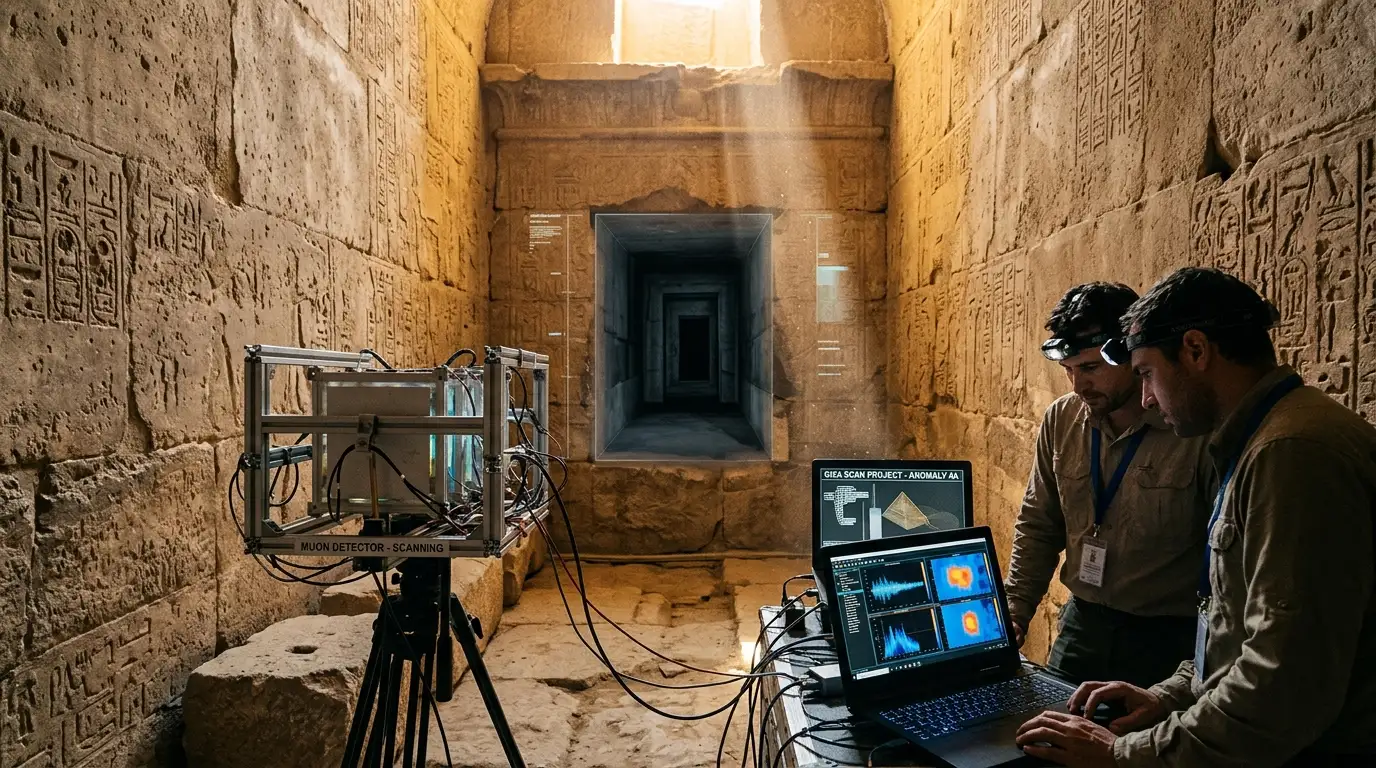
In recent years, advanced scanning technologies have unveiled what researchers are calling one of the most significant archaeological findings in decades: a previously unknown void or chamber hidden deep within the heart of the Great Pyramid. This discovery, made possible through non-invasive cosmic-ray muon radiography and thermal imaging techniques, has sent shockwaves through the scientific community and reignited public fascination with Egypt’s most iconic monument.
The newly detected space, measuring approximately thirty meters in length, appears to be situated above the Grand Gallery, one of the pyramid’s most well-known internal features. Unlike the carefully constructed corridors and chambers that have been mapped for generations, this void seems to have been intentionally sealed off, leaving no obvious entrance or exit points accessible through traditional means.
Dr. Sarah Mitchell, lead researcher at the International Pyramid Research Consortium, described the finding as “unprecedented in modern Egyptology.” Speaking from the excavation site, she explained that the team spent months verifying their data before making any public announcement. “We wanted to be absolutely certain,” Mitchell stated. “This isn’t just another small cavity or construction gap. The dimensions and positioning suggest deliberate design, which raises profound questions about the pyramid’s original purpose and construction methods.”
Technology Meets Ancient Mystery 📡
The detection of this hidden chamber represents a triumph of modern technology applied to ancient mysteries. Traditional archaeological methods involving physical excavation carry significant risks when dealing with structures as delicate and historically important as the Great Pyramid. Drilling or breaking through limestone blocks could cause irreversible damage to both the structure itself and any artifacts or inscriptions that might lie within.
Instead, researchers employed particle physics techniques typically used in high-energy research facilities. Cosmic-ray muons, subatomic particles that constantly rain down from space, penetrate solid matter at different rates depending on density. By placing specialized detectors around and within the pyramid, scientists created detailed three-dimensional maps of internal density variations. Areas showing lower density indicated the presence of voids or empty spaces.
Complementing this approach, thermal imaging cameras monitored temperature fluctuations across the pyramid’s exterior surfaces over extended periods. Different materials absorb and release heat at varying rates, creating distinctive thermal signatures. Anomalies in these patterns helped pinpoint areas warranting closer investigation.
“The combination of these technologies allowed us to see inside the pyramid without touching a single stone,” explained Professor Ahmed Hassan, an Egyptian archaeologist who collaborated on the project. “It’s like having X-ray vision for ancient monuments. We can identify potential spaces of interest and then decide how best to investigate them further.”
Historical Context and Significance 📜
The Great Pyramid was constructed during the Fourth Dynasty of ancient Egypt, around 2560 BCE, under the reign of Pharaoh Khufu. For nearly four thousand years, it remained the tallest man-made structure on Earth, a record only surpassed in the late nineteenth century. Built using an estimated 2.3 million limestone blocks, some weighing as much as eighty tons, the pyramid demonstrates sophisticated knowledge of mathematics, astronomy, and engineering.
Previous explorations have revealed three main chambers: the King’s Chamber, the Queen’s Chamber, and an unfinished lower chamber. Additionally, the Grand Gallery, a steeply inclined corridor leading to the King’s Chamber, showcases remarkable architectural precision. However, these known spaces account for only a fraction of the pyramid’s total volume, leading scholars to speculate about additional hidden areas.
Ancient Egyptian texts and later historical accounts occasionally reference secret passages and concealed treasures within pyramids, though such claims have often been dismissed as legend or exaggeration. The discovery of this new void lends credence to the possibility that ancient builders incorporated intentional empty spaces into their designs, whether for structural, religious, or symbolic purposes.
Egyptologist Dr. James Robertson notes that “the Egyptians viewed pyramids not merely as tombs but as resurrection machines, facilitating the pharaoh’s journey to the afterlife. Every element of design likely carried symbolic meaning. A hidden chamber could represent a sacred space reserved for rituals we don’t yet understand, or perhaps it served a practical function related to construction techniques that remain obscure to us today.”
Potential Contents and Implications 💎
While the exact nature of the hidden chamber remains unknown, several theories have emerged regarding its possible contents and purpose. Some researchers speculate it may contain additional burial goods, ceremonial objects, or even textual records that could provide new insights into Old Kingdom religious practices and beliefs.
Others propose more pragmatic explanations. The void might represent a construction feature, such as a weight-relieving space designed to reduce stress on lower chambers. Ancient engineers may have incorporated such elements to ensure structural stability over millennia. Alternatively, the chamber could have been intended for future use but abandoned due to changes in plans or unforeseen circumstances during construction.
The economic implications of this discovery are also noteworthy. Tourism represents a vital sector of Egypt’s economy, generating billions of dollars annually. Major archaeological discoveries typically boost visitor numbers significantly. Industry analysts predict that confirmation and eventual access to this hidden chamber could increase tourism revenue by fifteen to twenty percent over the next five years. Current estimates suggest the region generates approximately $12 billion yearly from tourism alone, with the Giza plateau accounting for a substantial portion.
Local businesses near the pyramid complex have already reported increased interest and bookings. Hotel occupancy rates in nearby Cairo have risen noticeably, and tour operators are developing specialized packages highlighting the latest discoveries. “People want to be part of history being made,” said travel agent Fatima Al-Rashid. “They’re not just visiting an old monument anymore; they’re witnessing ongoing revelations about human civilization’s greatest achievements.”
Challenges and Future Exploration 🚧
Despite the excitement surrounding this discovery, significant challenges remain before researchers can fully explore the hidden chamber. The primary obstacle is determining how to access the space without causing damage to the pyramid’s structure. Any invasive procedure requires careful planning, international oversight, and approval from Egyptian authorities responsible for protecting cultural heritage sites.
Several approaches are under consideration. Robotic probes equipped with cameras and sensors could be inserted through existing narrow passages or newly drilled micro-holes barely visible to the naked eye. These miniature explorers would transmit real-time images and environmental data back to researchers, allowing preliminary assessment before committing to more extensive intervention.
Another possibility involves developing new non-invasive imaging techniques with higher resolution capabilities. Advances in neutron scanning and ground-penetrating radar might reveal additional details about the chamber’s interior without physical entry. Researchers are also exploring the use of acoustic mapping, sending sound waves through the stone to detect echoes that indicate internal features.
Ethical considerations also play a crucial role in decision-making processes. The archaeological community increasingly emphasizes preservation over extraction, recognizing that some mysteries may be better left unsolved if investigation poses unacceptable risks. International guidelines now require comprehensive impact assessments before approving any intrusive archaeological work on UNESCO World Heritage sites.
Global Response and Cultural Impact 🌍
News of the hidden chamber has captured global attention, sparking renewed interest in ancient Egyptian culture and archaeology worldwide. Museums are organizing special exhibitions featuring interactive displays about pyramid construction techniques and recent discoveries. Educational institutions report increased enrollment in Egyptology and archaeology programs as students seek to participate in this exciting field.
Social media platforms have buzzed with speculation and discussion, with hashtags related to the discovery trending internationally. Amateur enthusiasts and professional researchers alike share theories, analyze available data, and debate interpretations. This democratization of archaeological discourse represents a shift from exclusive academic circles to broader public engagement with scientific discovery.
The Egyptian government has welcomed the international attention while emphasizing national ownership of cultural heritage. Officials have stressed that all research conducted on Egyptian soil must respect local laws and involve Egyptian scholars as equal partners. This stance reflects growing awareness among source countries about protecting their archaeological resources from exploitation while still benefiting from international collaboration.
Cultural institutions worldwide are reconsidering how they present ancient Egyptian artifacts and narratives. The discovery reminds us that our understanding of history remains incomplete, subject to revision as new evidence emerges. It challenges assumptions about what we think we know and encourages humility in the face of ancient wisdom that continues to elude full comprehension.
Looking Ahead: The Next Chapter 🔮
As researchers prepare for the next phase of investigation, the archaeological community watches with anticipation. Whatever lies within the hidden chamber—whether precious artifacts, architectural innovations, or simply empty space—it will contribute valuable information to our understanding of ancient Egyptian civilization.
The discovery also highlights the importance of preserving archaeological sites for future generations equipped with even more advanced technologies. What remains inaccessible or incomprehensible today may yield its secrets tomorrow to researchers wielding tools we cannot yet imagine.
For now, the Great Pyramid continues its silent vigil over the Giza plateau, holding its newest secret close while inviting us to look deeper, question further, and appreciate the enduring mystery of human achievement across millennia. The hidden chamber reminds us that history is not a closed book but an ongoing conversation between past and present, between those who built and those who seek to understand.
As Dr. Mitchell concluded in her recent address to the International Archaeological Society, “Every discovery opens new questions. This chamber is not an ending but a beginning. It invites us to reimagine what we thought we knew and to approach these ancient wonders with fresh eyes and open minds. The pyramid has more to tell us, if we listen carefully enough.”
The world waits with bated breath for what comes next, knowing that whatever emerges from within those limestone walls will reshape our understanding of one of humanity’s greatest architectural achievements.