Published 05/26/2026 14:31 | Edited 05/26/2026 14:50
There is something deeply political in Vallecas, and perhaps this starts long before football. Before Rayo Vallecano even existed, the neighborhood was already a territory of workers, migrants, popular resistance and labor organization. Officially incorporated into Madrid only in the 20th century, Vallecas grew rapidly during the Spanish industrialization processes, receiving thousands of poor families from different regions of the country and consolidating an identity strongly linked to urban social struggles.
For decades, Vallecas became one of the most important working-class neighborhoods in the Spanish capital. There, union movements, clandestine organizations, neighborhood associations and popular forms of social resistance were concentrated during the dictatorship of Francisco Franco. This political memory still runs through the streets of the neighborhood, the anti-fascist murals, the republican flags hanging in the windows, the popular social centers and the banners of international solidarity spread among small bars, residential buildings and squares.
But there is also another dispute very present in Vallecas, perhaps one of the most important in contemporary Madrid. The fight for housing. As in other popular areas of the city, the neighborhood has been facing the impacts of real estate speculation, brutal increase in rents and the gradual expulsion of historic residents for years. Popular movements, local collectives and social organizations maintain frequent mobilizations against evictions and against the transformation of parts of the Spanish capital into territories subject exclusively to tourist and financial logic.
This social dimension helps explain Rayo Vallecano. Founded in 1924, the club grew as a sporting expression in a historically marginalized region within the Spanish capital itself. While Real and Atlético represented the economic, institutional and central power of Madrid, Rayo built its identity from the working-class periphery. That’s why, in Vallecas, the club was never just about football. It became an emotional, political and cultural extension of the community.
Vallecas’s own trajectory bears deep marks of Francoist violence. After the Spanish Civil War, the region became one of the popular territories hardest hit by political repression, the persecution of republicans and the structural poverty imposed by the dictatorship. This collective memory permeates, to this day, the stands of Rayo Vallecano, where republican flags, anti-fascist symbols and references to popular resistance appear as a natural part of the fans’ identity.
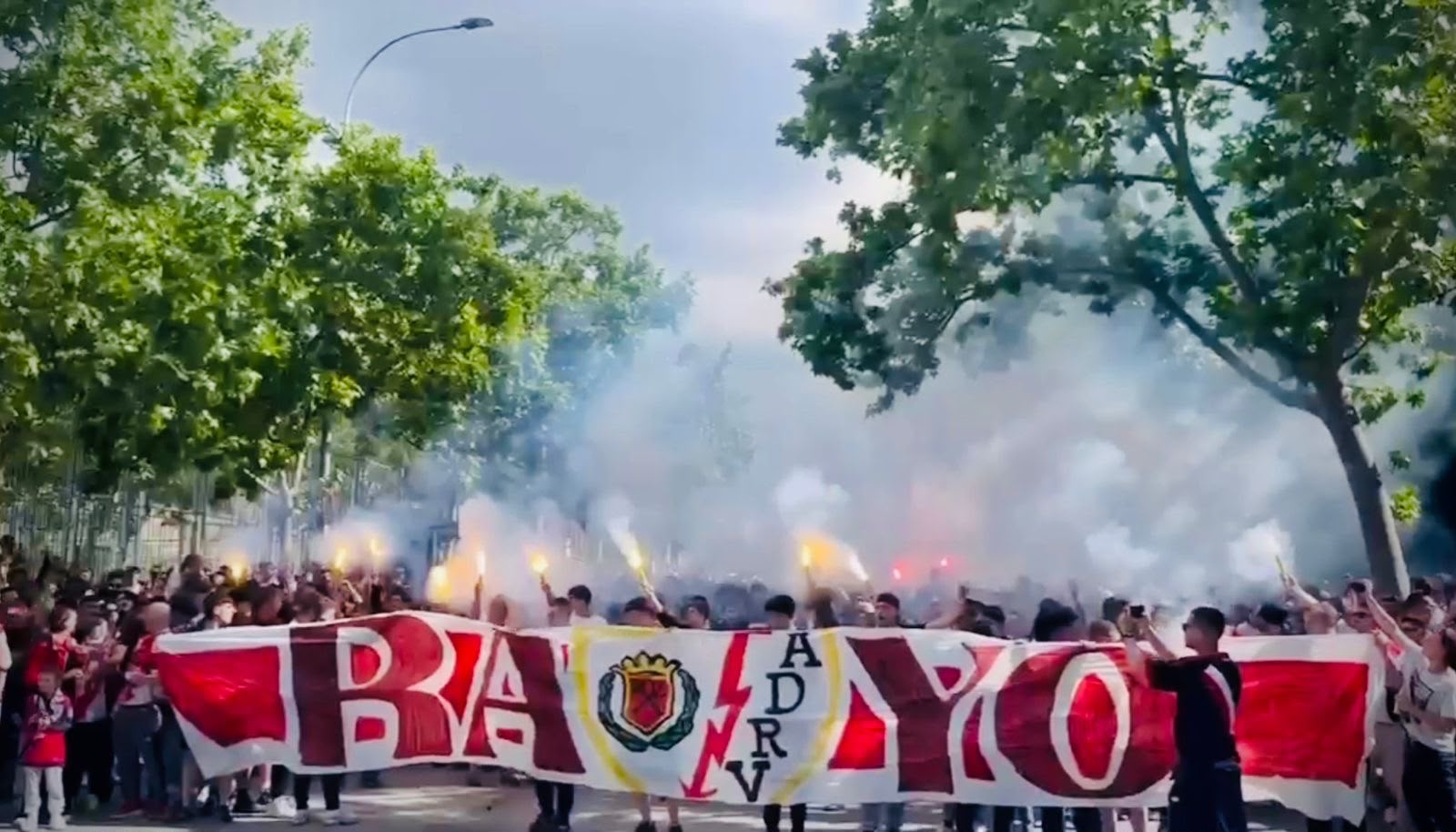
The current Vallecas Stadium, opened in 1976, in the final context of the Spanish dictatorship and democratic transition, became one of the most symbolic spaces of popular European football. There, anti-fascism does not appear as an occasional aesthetic on the sidelines. It is part of the territory’s social memory. The flags of Palestine appeared prominently in different sectors of the stadium and nearby streets, as did the Spanish republican flags. In Vallecas, political symbols do not appear as episodic decoration, but as a daily expression of collective belonging.
A large part of this identity was also built by the organized fans, the “Piratas” of Vallecas. Created in the 1990s, the Bukaneros became one of the best-known anti-fascist fans in Europe. Far beyond supporting the team, they participated in campaigns against evictions, solidarity collections for working families, actions to support refugees, mobilizations against the extreme right and initiatives to defend public services and affordable housing. Over the years, they helped to consolidate Rayo Vallecano’s image internationally as a team deeply linked to the social struggles of its territory.
I arrived at Vallecas Stadium and before the match, the atmosphere around the stadium already revealed that something different from conventional European football was happening there. The bars were packed, entire families occupied the sidewalks, street vendors shared space with elderly people calmly following the movement of the neighborhood, and children walked around wearing Rayo t-shirts as if participating in a collective ritual built over time.
It was the last night in Vallecas before the trip to Germany, where the team will compete in the 2026 Conference League final on May 27th, and the feeling shared among the fans was that the entire neighborhood wanted to participate in that historic moment. On the field, Rayo won 2-0, but, in many moments, the result seemed secondary to the atmosphere created in the stands.
During the match, the fans repeated the names of their idols almost as a collective reverence. There was no cold distance produced by football as a global industry. There was recognition, identification and belonging. Captain Óscar Trejo, who played his last game in Vallecas before leaving the club, was honored at several moments during the game and, with each touch of the ball, the stadium reacted as if celebrating someone who represents much more than sporting performance.
At the end of the match, no one seemed willing to leave the stadium. For more than half an hour, the fans remained in the stands singing, applauding and paying homage to the players still on the field. In one of the most symbolic moments of the night, all the athletes wore Óscar Trejo’s number 8 shirt, while the captain slowly began his Olympic lap alongside his family, amid almost deafening screams coming from the stands. The tribute ended with the fans, in a gesture that seemed to summarize the club’s own history. Because, in Vallecas, Rayo is even much bigger than its leaders.
In the stands, I sat next to a woman over 80 years old, resident of Vallecas, who spoke of Rayo not just as a football team, but as a living memory. For her, the club carried something of the republican resistance, the worker’s dignity and the anti-Franco memory preserved in Madrid’s popular neighborhoods. During the conversation, he enthusiastically said that he will travel to Germany to follow the decision.
Honestly, I’ve never seen this anywhere else in the world. There is an almost magical connection in Vallecas between residents and the club. A relationship that completely goes beyond the logic of sports entertainment and transforms football into a community language, affective memory and collective identity.
There, sport still preserves something rare in the contemporary European scene. The team continues to function as a social meeting point, collective memory and common language between different generations. The stadium does not appear isolated from everyday life. It mixes with the streets, small businesses, popular bars and the urban experience of a community that continues to recognize part of its historical identity in Rayo.
While Spanish sports news revolves almost entirely around the Real Madrid and Barcelona axis, Rayo continues to exist as a cultural resistance within contemporary European football. A neighborhood club, without major global sponsors, without the support of the mainstream Madrid press and often despised by richer and more powerful opponents.
Vallecas decided to say no to corporate football, to large pasteurized arenas and even to the logic of naming rights, which transformed so many stadiums around the world into commercial brands without territorial identity. While much of contemporary football abandoned historic neighborhoods to occupy sports complexes financed by financial conglomerates, Rayo remained where it always was, in the middle of the neighborhood, squeezed between residential buildings, small bars and narrow streets. The Vallecas Stadium does not offer corporate luxury. Offers proximity.
Perhaps no image explains this better than this weekend’s scenario, when the stadium appeared completely full days before the farewell towards the European final, confirming something that modern football often tries to hide. There are still clubs supported by real popular belonging.
But perhaps there is also another symbolic element running through this story. While Vallecas collectively celebrated its popular identity, capital also seemed to be playing its last game there. In football increasingly dominated by financial conglomerates, investment funds, billion-dollar television rights and business structures far from local communities, the simple survival of a club like Rayo Vallecano already sounds like an act of historic resistance.
The current season is perhaps the most symbolic of the team’s trajectory. With a much lower budget than the Spanish giants, a limited squad and constant structural difficulties, the club reached the final of the 2026 Conference League supported much more by collective identity, competitive intensity and a visceral relationship with the neighborhood than by international stars or millionaire investments.
In a football dominated by financial capital, global brands and the growing commodification of sport, Vallecas continues to demonstrate that communities can still resist, that belonging can still survive the market and that popular memory can still occupy space within contemporary football. Perhaps this is exactly what Rayo Vallecano represents today, the victory of the community over capital.
And perhaps that’s why Karl Marx’s phrase about the Paris Commune seems to make so much sense in Vallecas. Because, deep down, Rayo Vallecano dared to take the skies by storm. Go Rayo!
Source: vermelho.org.br