Published 05/27/2026 13:49 | Edited 05/27/2026 13:52
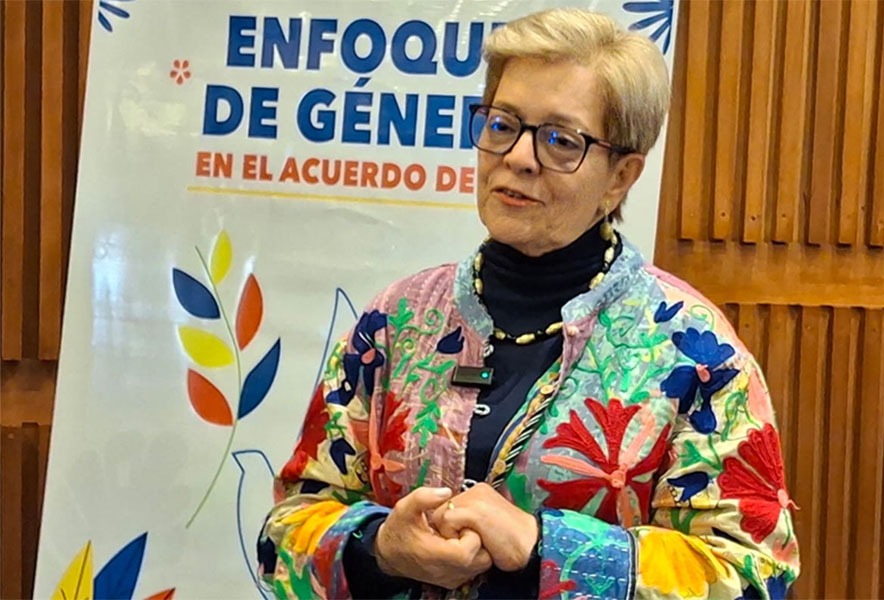
“The construction of peace and social reforms are our great triumph as they mean the dignification of work, the valorization of the popular, solidarity and community economy, placing collective interests above the greed of capital”, stated the former Minister of Labor of Colombia, Gloria Inés Ramírez Río, in the 8th International Verification Mission of the Implementation of the Gender Perspective in the Peace Agreement.
At the meeting that brought together dozens of female leaders, this Monday (25), in the auditorium of the Gabriel Garcia Marquez Cultural Center, in Bogotá, the communist leader, former senator, former president of the Colombian Federation of Educators (Fecode) and former director of the Unitary Workers’ Central (CUT) highlighted “the relevance of the gender approach to evaluate the Peace Agreement” signed in November 2016 between the government and the Revolutionary Armed Forces of Colombia (FARC). According to the Truth Commission, more than 450,000 lives were lost in more than half a century of conflict.
The fact, Gloria Inés pointed out, is that violence impacted women differently, “leaving many mothers widows and orphans”. “They, more than ever, need support from the State and alternatives to move forward, without depending on charity or subjected to extreme poverty”, he pointed out.
Faced with this reality, under the responsibility of the International Democratic Federation of Women (Fdim), the United Nations (UN-Women) – dedicated to promoting gender equality and female empowerment – and Sweden, the Mission aims to accompany the historic Agreement.
We will have three moments, explained Gloria Inés: “the first is the reflection on the popular economy, gender and peace and, above all, the space for women; the second will be the visit to the territories, where we will go to the Sumapaz region – located in the rural area of Bogotá – observing the natural reserve areas and their impact on the transformation of women’s daily lives; and the third will be listening to all the institutions that were created with the Peace Agreement, which are related to monitoring and monitoring”. In this way, he said, a report will be made and recommendations will be made to improve the measures.
The visit to Sumapaz, as several female leaders described, has great meaning as it encompasses decades of agrarian disputes, sociopolitical and armed violence for territorial control of this strategic area. The place is home to the largest paramo – a high mountain ecosystem, above the forest line and below the perpetual snow – in the world, which works like “living sponges”, absorbing and slowly releasing water to the center of the country, being a vital reserve of biodiversity.
“Work should not be exploitation and old age should not be abandonment”
Gloria Inés has reiterated in her statements that advances achieved are essential, such as the “labor, social security and agrarian reforms” initiated by President Gustavo Petro, in 2022, which give security and credibility in the vote for Iván Cepeda and Aida Quilcué next Sunday (31) to “deepen the transformations in the second government of change”.
Initiatives such as the Social Security reform (Law 2381 of 2024), noted the leader, provided the country with a multipolar system to expand coverage, strengthen pensions and guarantee a decent income for millions of elderly people who have worked their entire lives without retiring. ‘This is the deep meaning of the reforms: that work should not be exploitation and old age should not be abandonment. In other words, dignified and decent work for everyone and old age with dignity”, he stressed.
From a women’s point of view, Gloria defended the existence of a national assistance system, without which there cannot be gender equality in the job market. “Women cannot continue to bear the burden of unpaid work that sustains the economy,” said Gloria, especially when this work contributes 20% of the Gross Domestic Product (GDP).
According to the former minister, the Historic Pact government represented transformations that placed work at the center of democracy. “For decades, we were told that, to create jobs, we had to make labor cheaper, eliminate rights, make work more flexible, reduce working hours and weaken unions. We demonstrated that development cannot be built on precariousness.”
“Law 2466 of 2025 strengthened job security, expanded protection against abusive outsourcing, recognized the rights of National Employment Service apprentices, advanced guarantees for digital platforms, gradually reestablished payment for night shifts, Sundays and holidays, and reaffirmed that the employment contract must be the rule when subordination is required. The Sunday bonus, for example, increased from 75% to 80% in July 2025, it will reach 90% in July 2026 and 100% in July 2027”, he explained.
“Advance in collective bargaining and employment policy for women and young people”
According to the communist leader, a second progressive government must adopt a comprehensive policy against informality, “because Colombia still has more than half of its employed population working in the informal sector”. “It is necessary to advance on five main tasks: genuine formalization in rural and urban areas; strong and localized labor inspections; effective protection for domestic, rural, community and care workers; freedom of association with collective bargaining; collective rights, free from anti-union violence; and an employment policy for women and young people.”
The fact is that the labor reform restored rights that left fascists and neoliberals with their hair on end, confronting the candidacies of billionaire Abelardo de la Espriella and Paloma Valencia, faithful follower of the former president and genocidal Álvaro Uribe (2002-2010).
The vexing efforts of the hegemonic media
Because of this, reproducing the interests of financial capital, transnational corporations and landowners, the hegemonic media has committed itself in a sickening and shameful way in this final stretch of the campaign to confront the country with the most bizarre lies about Iván Cepeda and Isso Quilcué, recognized fighters for human rights, who had family members murdered by paramilitaries and the Army, but were – and continue to be – unbreakable pillars of the Peace Agreement.
The climate of extreme radicalization leads some people to completely lose any sense of ridicule, openly advocating the murder of opponents, as the taxi driver who took me to the event blatantly stated. When defending the current government’s peace policy, I was confronted by an angry tone saying that “peace is built on bones, on corpses”. He assumed, hysterically, that faced with a new victory for progressive forces, “something would need to be done”.
He denied the information – more than proven – by the Colombian Special Jurisdiction for Peace about the 7,827 victims of extrajudicial executions carried out by soldiers – known as false positives, many of them unemployed people recruited from the outskirts to work in some harvest in the field and who returned riddled with bullets for being “guerrillas”. The military high command, as was admitted, rewarded the troops for the bloodbath perpetrated, to the applause of the United States government.
Fortunately, as the great García Márquez taught us, “in the face of oppression, pillage and abandonment, our answer is life”. “Neither floods, nor plagues, nor famines, nor cataclysms, nor even eternal wars throughout the ages have been able to diminish the tenacious advantage of life over death.”
__
This coverage by Agência Comunica Sul de Comunicação Collaborativa was only possible thanks to the support of the Bank Workers Union of São Paulo; Writers’ Union of the State of São Paulo; newspaper Hora do Povo; Red; Global South Dialogues; Citizenship Mail; Baron of Itararé; councilor Werner Tempel (PCdoB) of Santa Maria-RS; Professor Azuaite, from São Carlos-SP; Angelim Institute
Source: vermelho.org.br