Published 05/27/2026 10:38 | Edited 05/27/2026 17:24
The Cuban government denounced this Tuesday (26) at the UN Security Council the worsening of threats from the United States against the island and warned of the risk of a humanitarian catastrophe caused by the tightening of the economic and energy blockade imposed by Washington.
“I appeal to the international community to mobilize to avoid a humanitarian catastrophe that could be imposed through weapons or a fuel blockade,” said the chancellor.
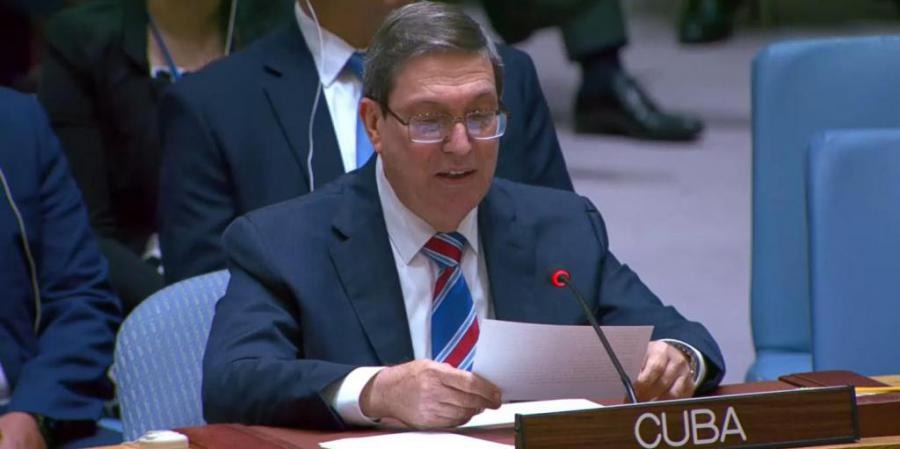
During a speech in New York, Cuban Foreign Minister Bruno Rodríguez stated that the North American siege is already having severe impacts on the population and accused the Donald Trump government of encouraging a scenario of military escalation and attempted regime change in Havana.
Rodríguez declared that Cuba is facing a critical situation marked by prolonged blackouts, shortages of fuel, food and medicine, in addition to the worsening of social conditions caused by North American sanctions.
According to the chancellor, the “energy siege” imposed by the United States produces effects equivalent to a naval blockade and constitutes “an act of war and genocide” against the Cuban people.
The speech took place during the Security Council debate on defending the principles of the United Nations Charter and the UN-centered multilateral system.
Rodríguez stated that it would not be possible to discuss the preservation of international peace without mentioning “the genocide against Palestine”, the “imperialist aggression against Iran” and the threats against Cuba.
The chancellor also called for international mobilization to prevent a military escalation against the island. According to him, a possible North American aggression “would provoke a bloodbath”, with thousands of Cubans killed in the defense of the country and young Americans sent to a war “without a cause or ideal”.
“The president who issued such an order for a military attack […] he would go down in history as a war criminal”, he added.
The Cuban intervention comes amid increased political pressure from the United States on Havana following the kidnapping of Venezuelan President Nicolás Maduro and increased regional tensions involving governments aligned with Washington.
In recent days, Donald Trump has once again made statements hinting at the possibility of intervention against Cuba.
According to Rodríguez, previous North American governments considered similar actions, but the current president “seems willing to carry them out”.
Last week, Washington also intensified the judicial offensive against historic leaders of the Cuban Revolution by filing a criminal complaint against former president Raúl Castro, accused of the death of US citizens in the downing of planes in 1996.
The Cuban chancellor classified the measure as “morally infamous” and “legally arbitrary”, accusing the US of manipulating historical facts to justify a future military adventure against the island.
Rodríguez stated that the accusation seeks to create domestic and international support for a policy of “regime change”, a strategy that, according to Havana, remains the central objective of United States foreign policy towards Cuba.
The chancellor also denounced the use of secondary sanctions to pressure other countries and companies to join the economic blockade against the island.
During the session, the Cuban representative reiterated that Havana remains willing to maintain bilateral negotiations with Washington, as long as there is no interference in the country’s internal affairs.
He cited possible areas of cooperation, such as combating drug trafficking, terrorism, transnational crime and migration. Still, he stated that Cuba will not accept external pressure on its political system or its national sovereignty.
Rodríguez also directly appealed to the population of the United States, especially young people, to reject the policy of aggression against Cuba.
According to him, the current escalation is driven by an “elitist and powerful Miami clique” that represents neither the North American people nor the majority of Cubans residing in the USA.
At the end of his speech, the chancellor stated that “the time for solidarity with Cuba” has arrived and asked the countries of the Global South to build a collective response to pressure from Washington.
He also advocated strengthening multilateralism and praised China’s role in upholding international peace and democratic reform of the United Nations.
Source: vermelho.org.br