Published 05/21/2026 16:48 | Edited 05/21/2026 16:55
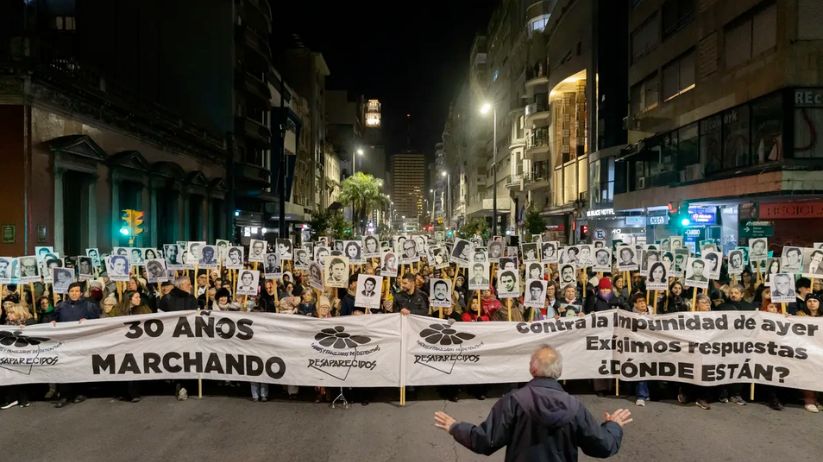
This May 20th, as has been the case for 30 years, thousands of Uruguayans took to one of the main avenues in the center of Montevideo, on July 18th, in an emotional silent protest for memory, truth and justice for the dead of the military dictatorship.
Under the cold of the night, the 31st March of Silence brought together elderly people, young people, adults and children who carried photos, banners and daisies without one of the petals — symbol of the disappeared — to continue demanding that the State respond to the whereabouts of at least 205 Uruguayans whose whereabouts are unknown to this day.
The date on which the march takes place refers to the day in 1976 when parliamentarians Zelmar Michelini and Hector Gutierrez Ruiz and militants Rosario Barredo and William Whitelaw were kidnapped and murdered.
The pain of seeing so many ordinary citizens walking side by side, without saying a single word, for so many decades, is also profound for those who, here in Brazil, know what the tireless struggle of family members, parties and social movements is for the Armed Forces to open their archives definitively and for the Brazilian State to pay this historic debt.
However, unlike here, in Uruguay the cause was not limited to left-wing activists, human rights activists and relatives, spreading throughout practically the entire society, in all generations.
The issue of the dead and missing is mostly respected and supported and the crimes of the dictatorship are repudiated, whether in the speeches of authorities and ordinary citizens, or in books, films or in murgas, one of the great hallmarks of Uruguayan culture.
Here in Brazil, on the contrary, a large part of the population is unaware of this struggle; others pretend not to see this fight. But the worst thing is that there is a non-negligible portion that supports dictatorships, torture and the extermination of opponents; and as if that were not enough, he still mocks those who to this day do not know what happened to a son, a sister, an uncle.
Even governed by Yamandu Orsi, from the Frente Amplio, Uruguay continues to struggle to take steps forward in this fight. Earlier this month, the president received representatives from the organization Mothers and Family Members of Missing Prisoners. At the time, they requested that the presidency give a “formal order” to the Armed Forces for information on the whereabouts of these people to be handed over.
According to one of the organization’s representatives present at the meeting, Ignacio Errandonea, the president stated that the government would be studying how to make this possibility possible. “There is no new information. The work to access the files is slow”, says Errandonea, who attributes this pace to “bureaucratic obstacles”, as reported by the Uruguayan newspaper La Diaria.
“You see people with empathy and everything, but when it gets to the commanders, things slip. It’s not a personal thing, the problem is the institutions”, says Nilo Patiño, also a member of the movement, to La Diaria, during the march.
At that meeting, the movement also asked Orsi to call on the population to hand over documents and information that could help in the search. This is because many of these documents may have been removed from official archives and kept in the homes of members of the dictatorship.
Shortly after the meeting, the country’s Senate approved (with votes from the situation and the opposition, something unimaginable here) a formal declaration asking society to hand over these documents to the National Institution of Human Rights and People’s Defender’s Office.
The agency, in fact, recently announced that it is working on 243 reports of forced disappearances for political reasons that occurred between 1968 and 1985. The dictatorship in the neighboring country began in 1973, but even before that there were episodes of repression, which led to the period being analyzed being extended. For now, the official list of missing persons consists of 205 names.
The issue of Armed Forces documents, as it happens here, is an open problem and difficult to resolve. Hours before the March began, the commander in chief of the Uruguayan Army, Mario Stevenazzi, said that the Force “does not hide documentation” about the missing.
During the march, when asked about the statement, the Vice President of the Republic, Carolina Cosse replied, after reflecting for a few seconds: “I prefer to march in silence”. And he highlighted: “the terrible and distressing situations experienced by family members who walk in this march with posters of the missing men and women are a much greater cause than personal situations. They are a national cause for the construction of truth, memory and justice.”
With agencies
Source: vermelho.org.br