Published 04/28/2026 11:22 | Edited 04/28/2026 11:44
Lisbon does not just keep the Carnation Revolution in institutional memory or commemorative dates, it inscribes it in its own geography, in buildings that span centuries, in walls that are constantly rewritten and in the way bodies occupy the city in the present, so that traveling the paths of the revolution stops being a simple exercise in historical remembrance and becomes a concrete, almost physical experience of crossing a territory where the past is not closed, but remains active, latent and available to those willing to walk carefully.
These paths do not follow an obvious linearity, they are distributed throughout the city as a network that connects military strategy, political action, repression, resistance and memory, requiring the visitor to be willing to detour, pause and move around, as not all points are within reach of a continuous walk, making it necessary, at a certain point, to leave the center, take a bus and cross a less evident Lisbon to understand that the revolution also took place outside the immediate gaze, in a space where everything was still silence, calculation and decision.
The route can begin on Avenida de Berna, in front of the mural of the Faculty of Social and Human Sciences of Universidade Nova de Lisboa, where the figure of Salgueiro Maia imposes itself on the urban concrete as a presence that resists time, and where I had the opportunity, throughout different trips, to follow the successive transformations of the panel, noticing that the colors changed, the features altered and the surrounding elements were constantly replaced, while the central figure remained, creating a dialogue between permanence and transformation that reveals, quite clearly, that the memory of April is not fixed, but is continually reinterpreted.


Staying a few minutes in front of that mural allows you to understand that it is not just a geographical starting point, but a reading key for the entire journey, because even before reaching the places where the revolution unfolded, the city presents the way it chooses to remember it, shifting the gaze from the past to the present and showing that Lisbon not only keeps April, but constantly rewrites it.
To understand what actually happened, it is necessary to leave there and accept the journey to Quartel da Pontinha, a movement that requires time, as it is not a place integrated into the usual tourist circuit, and this physical distance helps to understand that the revolution, before becoming visible, was thought in a space of containment, where, between the 24th and 26th of April 1974, officers coordinated operations, received information and adjusted strategies with absolute precision, while the city still remained oblivious to what was about to happen.
This moment of silent elaboration finds on the radio the transition point between plan and action, and it is important to remember that everything begins with a first password, broadcast at 10:55 pm on April 24th by Emissores Associados de Lisboa, with the song “E Além do Adeus”, performed by Paulo de Carvalho and composed by José Niza, winner of the Festival da Canção the previous year, an apparently trivial choice, but carefully thought out so as not to arouse suspicion, being followed in the early hours of the morning, at 00 hours and 20 minutes on April 25th, through the broadcast of “Grândola, Vila Morena”, by José Afonso, on Rádio Renascença, confirming the start of operations and marking the point of no return in the entire process, making it even more significant to remember that José Afonso was one of the artists most associated with the opposition to the regime and whose work was subject to censorship, which transforms the choice of the song not only into an operational code, but into a political gesture loaded with meaning.


The headquarters of Rádio Renascença is not just a detail in this journey, but one of the central places of the revolution, as it was there that sound turned into action and that a clandestine operation gained a national scale, functioning as a link between dispersed units and allowing simultaneous coordination that would have been impossible by other means in that context, which is why it was quickly occupied by the rebellious military and integrated into the set of strategic points controlled throughout the day, and which today, after the station’s departure in the early 2000s, houses a luxury hotel, creating yet another layer of contrast in the city, where the space that once set in motion a historical transformation becomes part of the contemporary logic of consumption, without, however, being able to completely erase the weight of what happened there.
As the plan materializes, the route begins to take shape in the urban space, leading to Chiado and Rua António Maria Cardoso, where the building of the former PIDE/DGS headquarters stands out as one of the densest points of the entire route, not because of its current appearance, which reveals little, but because of what was concentrated there for decades, with practices of surveillance, interrogation and torture that sustained the regime, and which, on April 25th, culminated in one of the most tragic episodes of that day, when agents they shot. over the crowd, causing the death of four people and leaving dozens injured, in a moment that breaks with the image of a revolution without violence and exposes the resistance of power to give in.
The contrast between past and present becomes inevitable when realizing that, in that same building, today there is a sophisticated commercial space, a high-end design store, creating a silent erasure that reveals how, even in a country that has built a strong memory of the revolution, some marks of repression tend to be diluted in the city’s daily logic.


The route then heads to Terreiro do Paço, where the space opens up wide in front of the Tagus, creating a feeling of respite that contrasts with the density of the events that unfolded there, since it was at this point that the forces commanded by Salgueiro Maia guaranteed control of the ministries and decisively weakened the regime, in a context in which the tension was real, including the moment when a NATO frigate, positioned on the river, came to point in the direction of the revolutionary forces, creating the concrete possibility of an armed confrontation that could have profoundly changed the outcome of history.
Today, what we see is a light occupation of the space, with tourists walking leisurely, couples approaching the river and mothers calmly pushing baby carriages, composing a scene that highlights how the city absorbs and transforms its own historical landmarks, often without explaining what was at stake there.
To understand the depth of this process, it is also necessary to cross the Aljube Resistência e Liberdade Museum, a space that I had already visited on other occasions, but which this time presented itself in a more intense way, perhaps due to the accumulated burden of the route itself, with its recreated cells, sound recordings, images and poetry spread across the walls, creating an experience that does not allow for distance and that highlights that the revolution did not begin in 1974, but is the result of colonial wars and decades of repression and resistance.
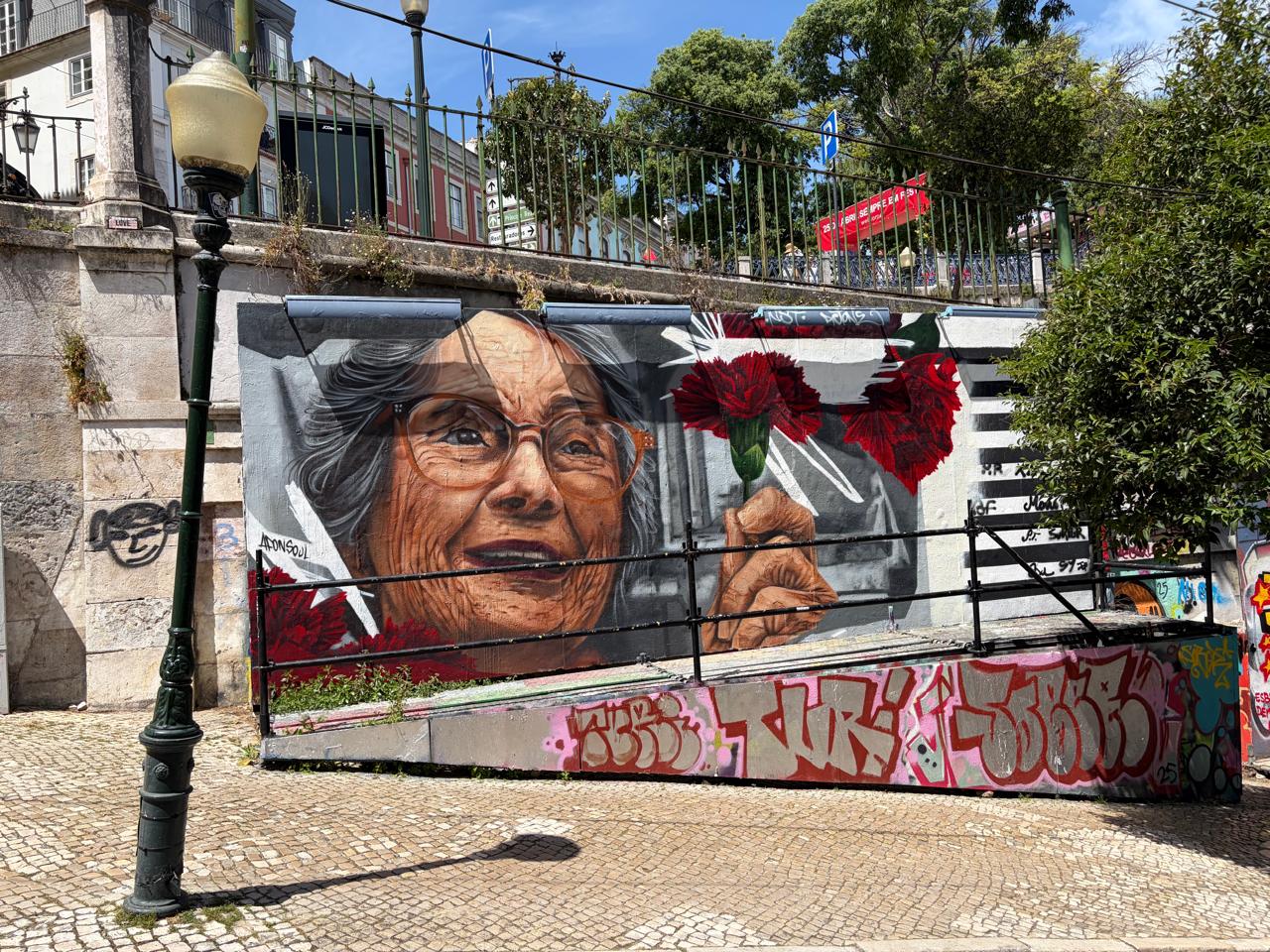
It is in this context that apparently simple gestures take on another dimension, such as that of Celeste Caeiro, the florist who placed a carnation in the barrel of a shotgun, radically altering the meaning of that moment and transforming the red, which could have been blood, into a symbol of freedom, a gesture that is now remembered by a recent mural near the Santa Clara viewpoint, reaffirming the strength of this image in the city’s memory.


The route finds its point of greatest symbolic concentration in Largo do Carmo, where Marcelo Caetano took refuge and where the revolution found its political outcome, in a relatively contained space, but full of meaning, where a plaque on the floor, that day surrounded by carnations, marks the place where history condensed, culminating in Caetano’s departure in a chaimite, an image that summarizes the collapse of the regime and that marks the beginning of a route that would take him to Pontinha, then to Madeira and, finally, end, exile in Brazil.
This moment carries within it a tension that does not disappear, as history could have followed another path, and it is precisely in this unfulfilled possibility that the singularity of the process and the dimension of the choice that was consolidated there are revealed.
The paths of the revolution, however, do not end at that point, they continue in the way in which this memory continues to be constructed and disputed in the present, whether in the Associação 25 de Abril, where the past is kept alive through the action of its protagonists, or in the collective tile panel installed in Rossio, promoted by the Portuguese Communist Party (PCP) in the context of the celebrations of the fifty years of the revolution, a work conceived as a participatory process and built from the contribution of hundreds of people who, throughout workshops held in different spaces, they were invited to translate their experiences, readings and feelings about April into tiles, composing a large harpsichord visible from a distance and, at the same time, a mosaic of multiple narratives when observed up close.
It is an admittedly political initiative, not only because of its authorship, the PCP, but because of the way it articulates memory and action by stating that April lives in every trace of every tile and by inscribing in the collective process of creation itself the idea that the revolution is not completed, but remains as a task, as a project and as a horizon.
Inserted in the heart of the city and exposed to the daily flow of those who pass by, the panel transforms the urban space into a place of affirmation, where the revolution stops being just a historical evocation and becomes a positioning, revealing that the paths of April do not end in the places where it happened, but continue to be written in the way each generation decides to understand it, claim it and transform it.
Touring Lisbon from these places stops being a tourist activity and becomes a pedagogical experience, as each point reveals a stage, each space a layer and each gesture a possibility of reading, showing that the city does not just function as a setting, but as an active structure of a historical process that continues to produce meaning and that remains open to those who decide to cross it carefully.
April continues.
Source: vermelho.org.br