Published 05/28/2026 14:10 | Edited 05/28/2026 14:21
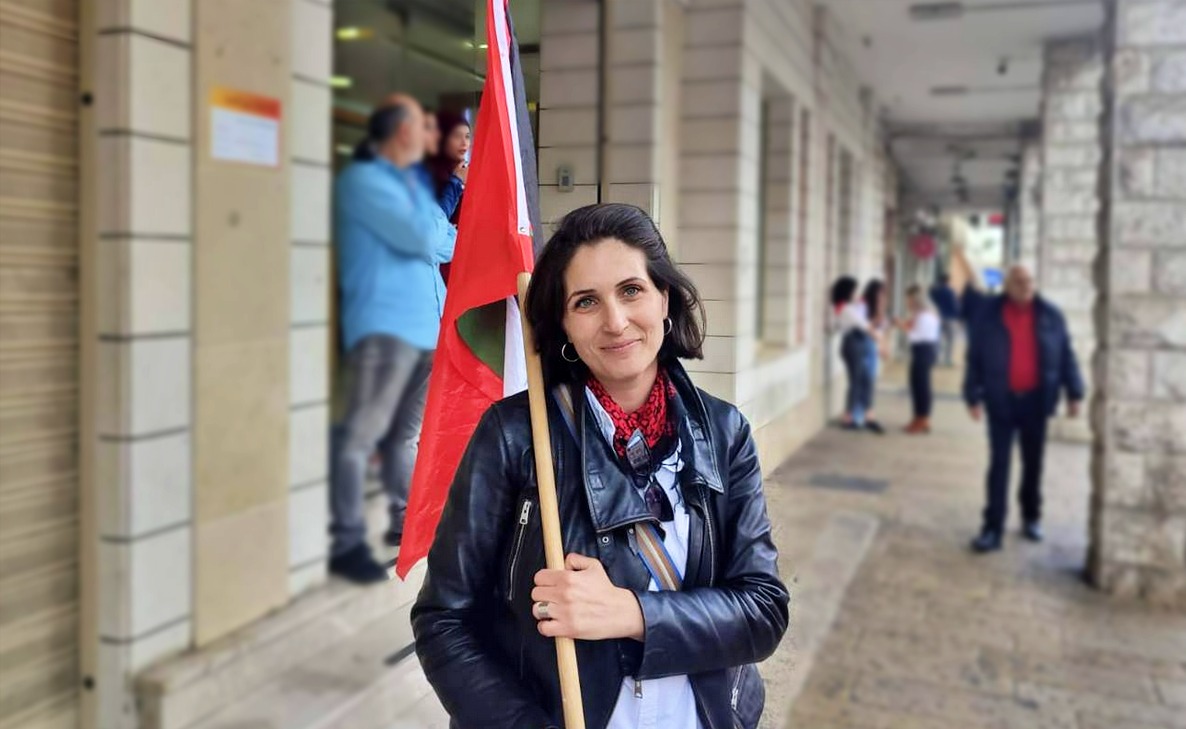
When talking about post-October 7th in Israel, Reem Hazzan insists that the most frightening change did not just come from the Netanyahu government and its repressive apparatus against the Arab population in occupied Palestine. For the Palestinian leader of the Communist Party of Israel, what has been consolidated since the beginning of the war in Gaza was a deeper and daily transformation: Israeli society has naturalized hatred and violence.
“After October 7th, ordinary people started acting like fascists,” he says. In an interview with Red PortalReem describes an environment marked by political persecution, repression of Palestinian citizens of Israel, the strengthening of armed settlers and the expansion of supremacist discourses that, according to her, began to circulate openly in the streets, universities and workplaces.
For the Secretary of International Relations of the Communist Party of Israel, the trauma caused by the Hamas attack was used by the Israeli far right to deepen anti-Arab racism and legitimize even more violent policies in the occupied Palestinian territories. At the same time, he claims, sectors of the anti-occupation left began to face an unprecedented level of intimidation and political isolation.
“We learned from an early age that this was discrimination”
Reem says that she grew up in a family deeply linked to political activism. Her mother and grandmother organized daycare centers and initiatives aimed at working women in Akka, articulating feminist and class demands. “Since I was very little, I saw poverty and the difference in people’s living conditions in the Old City. I learned early on that this was the result of discrimination policies, because we are Palestinians and because this is an occupation state,” she said.
She recalls that the Palestinians who remained within Israel’s borders after the Nakba lived under military rule between 1948 and 1966. “All the people who fled, were displaced or expelled from their villages became Palestinian refugees. And we also had internal refugees within Palestinian society in Israel itself — people who also lost their lands and homes but remained within Israel.”
Today, according to her, segregation appears mainly in territorial distribution, education and public investments. “There are mixed cities, like Akka and Haifa, where Arabs and Jews live together. But there are also cities that are practically exclusive to Jews, as well as separate school systems for Arabs and Jews,” he explained.
She states that inequality can be seen directly in the urban structure: “You can see the discrimination in the difference between an Arab city and a Jewish city. Arab cities are extremely dense, with no green areas, parks or space for new housing.”
According to Reem, her family’s own trajectory expressed a Palestine prior to the closure of borders imposed after the Nakba. Her grandfather worked in Baghdad, Iraq, while her grandmother studied at the University of Beirut in Lebanon — a regional circulation that she says was a natural part of Palestinian life before 1948.

“It was a completely different perception of the region and the land,” he said. According to the leader, the Nakba “did not happen in a single day”, but throughout a process that profoundly altered Palestinian life in the region.
She maintains that Palestinian communists have already been denouncing the colonial character of the Zionist project and the plans for the partition of Palestine sponsored by Western powers since the 1930s. “Palestinian communists understood what was being planned for the region and began to organize against it,” he said.
“After October 7th, everything became prohibited”
Reem rejects the idea that the repression against Palestinians inside Israel is an exclusive consequence of the current war. According to her, what happened after October 7th was the deepening of repressive mechanisms and an atmosphere of dehumanization that already existed previously. “Even before October 7, in Haifa, when we raised Palestinian flags in protests, the police repressed, beat people and openly threw gas,” he reported.
According to her, Palestinian protests already faced frequent police repression, but still managed to take place. “We were able to protest and organize demonstrations, but we needed to fight for this right,” he stated. With the start of the war, however, the scenario changed completely. “After October 7, everything was banned. For a while we couldn’t even protest in the streets,” he said.
The leader states that the main new element was the spread of a “fascist atmosphere” in Israeli society itself. “The main problem after October 7th wasn’t just the police or the government. It was ordinary people starting to act like fascists”, he reveals. She reports “persecution in the workplace, at universities, on social media. Accusations, demonization of Palestinians, intimidation, arrests for publications on social media.”
According to Reem, the trauma caused by the Hamas attack was used by the Israeli far right to deepen discourses of dehumanization of Palestinians. “Politicians like Ben Gvir and Smotrich immediately began advocating ‘annihilate Gaza’, ‘kill them all’, ‘use nuclear bomb’. And this type of speech gained legitimacy within Israel.”
Armed settlers and “Jewish terrorism”
The leader of the Communist Party claims that the deployment of Israeli troops to Gaza and the border with Lebanon opened space for an even greater escalation of settler violence in the occupied West Bank. “The settlers began to use this fascist atmosphere to take more land, kill Palestinians and torture them,” he said.
According to her, many of the current Israeli Army officers come from the settlement movement and the so-called “religious Zionism”, a current linked to the defense of “Greater Israel” and messianic territorial expansion. “In recent years, many religious Zionists have occupied command posts in the Army, especially in the West Bank,” he said. For Reem, this brought the Israeli military apparatus even closer to the most radicalized sectors of the settler movement.

“Today it is the settler’s brother, his friend or his neighbor who is commanding operations in the West Bank,” he said.
Reem also draws attention to the growth of what she defines as “Jewish terrorism”, an expression that, according to her, has already started to be used even by sectors of the Israeli Zionist left. She reports that some of the violent settlers are recruited from vulnerable young people transferred to settlements in the West Bank.
“You take vulnerable, easily manipulated young people and put them in this environment,” he said. “They use even vulnerable groups in society to fuel the settlement industry and its expansion.”
According to her, radicalization gained institutional support after the start of the war. “No one is held accountable. This is supported by the government, the army and the police. So why would these people feel they are doing something wrong?”
“Fascism grows on despair”
For Reem, the Benjamin Netanyahu government worked for decades to make any political solution to the Palestinian issue unfeasible, destroy the credibility of the Oslo Accords — signed in the 1990s between Israel and the Palestine Liberation Organization (PLO) with the promise of a future two-state solution — and strengthen a permanent logic of militarization. “Fascism grows on despair,” he said.

According to her, both the Israeli and Palestinian people began to live without any political horizon. “The Israeli population can no longer see any other solution other than violence and militarism,” he said. “And Palestinian society is completely hopeless because it also sees no political horizon.”
Despite this, Reem states that she still considers it essential to challenge Israeli society and prevent the isolation of the anti-occupation left: “Our main role is to transform Israeli society: to make it more favorable to peace and less favorable to war and militarism.”
Source: vermelho.org.br