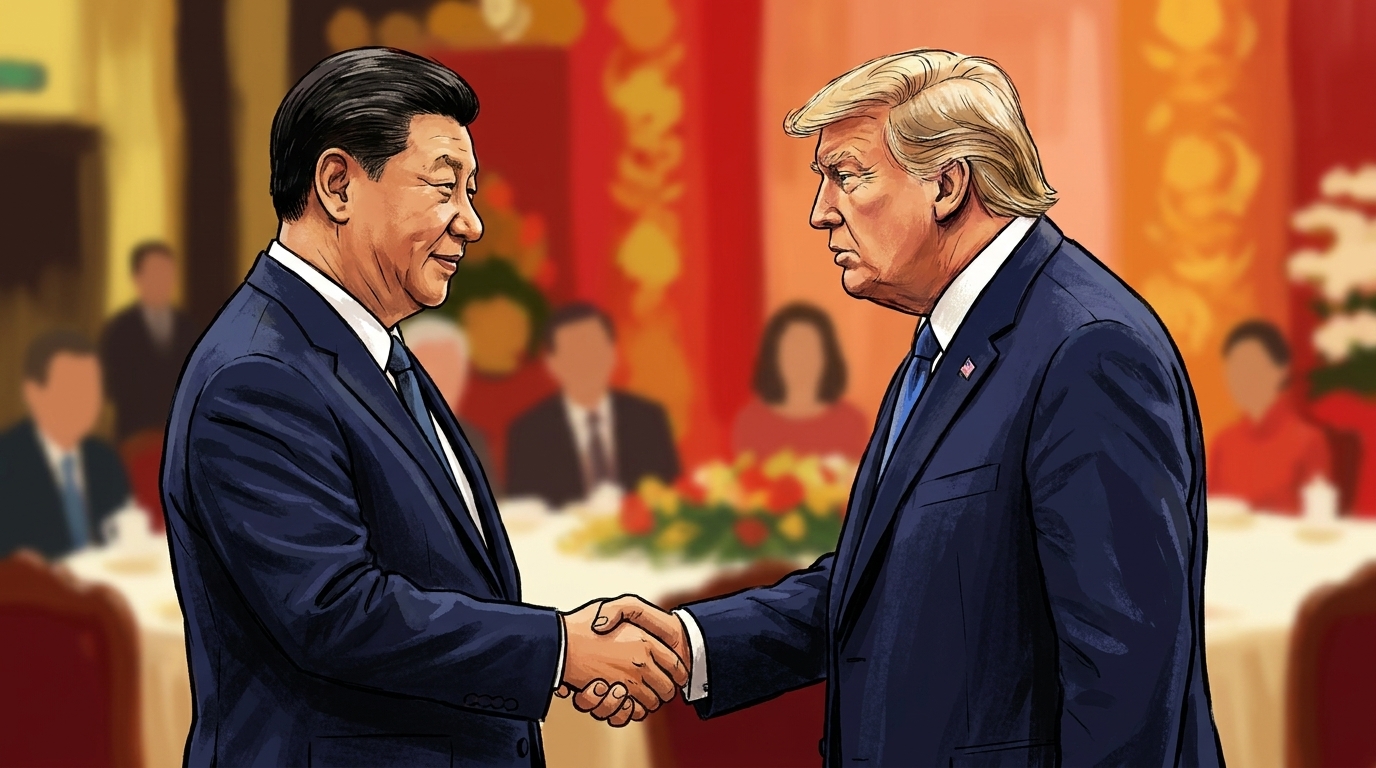
By all appearances, the symbolism mattered as much as the substance.
As United States President Donald Trump arrived in Beijing for a highly choreographed summit with Chinese President Xi Jinping, the message from both capitals was unmistakable. After years of escalating tariffs, technological rivalry, military tension over Taiwan, and geopolitical friction stretching from the South China Sea to the Middle East, Washington and Beijing were attempting something rare in modern diplomacy: a controlled reset.
The first day of talks between the two leaders unfolded beneath red carpets, military ceremonies, state banquets, and carefully calibrated rhetoric. Yet beneath the pageantry lay something more consequential. Both sides appeared eager to prevent strategic competition from spiraling into outright confrontation.
According to reports from Al Jazeera, the two leaders agreed to describe the bilateral relationship as “constructive, strategic and stable,” language that immediately drew attention among diplomats and market analysts alike.
That phrase may sound bureaucratic on the surface. In geopolitical terms, however, it signals an attempt to rebuild a minimum framework of predictability between the world’s two largest economies.
For years, the relationship between the United States and China has been defined by mutual suspicion. Under Trump’s previous presidency, Washington imposed tariffs, targeted Chinese technology companies, tightened export controls, and openly challenged Beijing’s industrial strategy. China responded with retaliatory measures and an increasingly assertive foreign policy.
Now, amid a slowing global economy, persistent supply chain instability, war-related disruptions in energy markets, and rising fears surrounding Taiwan, both governments appear to recognize the dangers of uncontrolled escalation.
The summit in Beijing therefore represented more than a diplomatic spectacle. It represented an effort to redefine the boundaries of rivalry.
A Summit Shaped by Crisis
Timing explains much of the urgency.
The talks came during a period of extraordinary geopolitical pressure. Trade tensions remain unresolved. Artificial intelligence competition has intensified. Semiconductor restrictions continue to divide the global technology sector. Meanwhile, the ongoing conflict involving Iran and instability surrounding the Strait of Hormuz have shaken energy markets worldwide.
Both Washington and Beijing have strategic reasons to avoid additional economic disruption.
China faces slower domestic growth, declining consumer confidence, and mounting pressure in its real estate sector. The United States, meanwhile, continues battling inflationary concerns and fears of broader economic stagnation.
Against that backdrop, the optics of the summit became deeply important.
Trump arrived in Beijing accompanied not only by senior officials but also by some of America’s most influential business executives, including leaders from the technology and manufacturing sectors. The presence of corporate figures sent a deliberate signal that economic cooperation remained possible despite years of strategic decoupling rhetoric.
Chinese officials responded in kind.
Xi presented China as a stable global power open to “mutually beneficial cooperation,” according to summit coverage. The carefully staged ceremony at the Great Hall of the People emphasized continuity, respect, and civilizational grandeur. Beijing clearly intended to portray itself as the composed actor seeking stability while also defending its core interests.
That duality defined the first day of negotiations.
Taiwan Remains the Most Dangerous Issue
Despite warm language and ceremonial diplomacy, one issue overshadowed every other conversation: Taiwan.
Reports from multiple international outlets indicated that Xi warned Trump directly that mishandling the Taiwan question could trigger “clashes and even conflicts.”
For Beijing, Taiwan is not simply a foreign policy dispute. It is tied to national identity, territorial sovereignty, and Xi Jinping’s political legacy.
Chinese officials have repeatedly framed reunification with Taiwan as historically inevitable. In recent years, Beijing has intensified military pressure around the island through naval patrols, air incursions, and military exercises.
The United States continues to maintain strategic ambiguity regarding Taiwan while also supplying defensive military support to Taipei. That balancing act has become increasingly fragile.
Xi’s warning during the Beijing summit therefore carried enormous weight.
Even though Trump publicly emphasized economic cooperation and optimism, the Taiwan issue remained unresolved beneath the diplomatic choreography. Analysts noted that Trump avoided directly answering questions about Taiwan during public appearances alongside Xi.
That silence was itself revealing.
It suggested both sides wanted to avoid a public confrontation while preserving room for private negotiation.
Still, the structural problem remains unchanged. Washington seeks to maintain regional deterrence and support allies in Asia. Beijing seeks eventual reunification and opposes what it sees as foreign interference.
Those objectives fundamentally collide.
No amount of ceremonial diplomacy can erase that reality.
Trump’s Strategic Calculation
For Trump, the summit represented an opportunity to project statesmanship on the global stage while also pursuing practical economic objectives.
Before the visit, Trump repeatedly emphasized trade as the central focus of discussions. He has long framed his approach to China through the lens of transactional leverage rather than ideological confrontation.
That distinction matters.
Unlike some hawkish voices in Washington who advocate comprehensive economic decoupling, Trump historically preferred using tariffs and pressure tactics to negotiate more favorable trade arrangements rather than fully severing economic ties.
The Beijing summit appeared consistent with that worldview.
Trump praised the importance of the US-China relationship during public remarks and described the future between the two countries as potentially “fantastic.” Such language contrasted sharply with the more openly confrontational rhetoric that characterized earlier phases of the trade war.
Yet Trump’s softer tone does not necessarily indicate strategic trust.
Instead, it likely reflects recognition that economic realities have changed.
American corporations remain deeply connected to Chinese manufacturing, consumer markets, and supply chains. Technology competition may continue, but complete separation would impose enormous costs on both economies.
Trump also faces domestic political incentives.
Lower energy prices, stable financial markets, and improved export opportunities could all strengthen his standing at home. The summit therefore carried implications not only for geopolitics but also for domestic economic narratives inside the United States.
Xi Jinping’s Position of Strength
If Trump arrived seeking economic wins, Xi entered the summit determined to project strategic confidence.
Chinese statecraft relies heavily on symbolism, historical continuity, and calibrated displays of power. The elaborate welcome ceremony in Beijing was not merely diplomatic courtesy. It was political theater designed for both domestic and international audiences.
The message was clear: China sees itself as an equal global superpower.
Xi also understands that Beijing currently possesses significant leverage in several critical areas.
China remains central to global manufacturing. It dominates numerous rare earth mineral supply chains. It exerts growing influence across the Global South through investment and infrastructure initiatives. Additionally, Beijing maintains economic relationships with countries increasingly skeptical of Western-led geopolitical frameworks.
Analysts quoted in coverage surrounding the summit argued that Beijing may actually hold a stronger negotiating position than Washington at this stage.
Part of that leverage stems from America’s current strategic overstretch.
The United States continues managing conflicts and security commitments across Europe, the Middle East, and Asia simultaneously. China, by contrast, can focus more narrowly on long-term regional and economic positioning.
Xi’s emphasis on stability during the summit therefore served multiple purposes.
It reassured markets.
It appealed to international partners seeking predictability.
And it allowed Beijing to present itself as the responsible steward of global economic order at a time of widespread uncertainty.
Business Leaders as Diplomatic Signals
One of the most intriguing dimensions of the summit was the participation of prominent American CEOs.
Executives from major technology and industrial firms traveled alongside Trump to Beijing, highlighting how intertwined corporate interests remain despite political tensions.
Their presence carried strategic meaning on several levels.
First, it signaled that American business leaders still view China as essential to long-term growth.
Second, it demonstrated that economic pragmatism continues to shape diplomacy even during periods of ideological rivalry.
Third, it reflected a growing recognition among global corporations that complete economic fragmentation between the United States and China may be unrealistic.
China’s response to these executives was equally calculated.
Xi reportedly assured American companies that they would find broader opportunities in China and welcomed expanded cooperation.
That outreach is especially important given increasing concerns among foreign investors about regulatory unpredictability, political risk, and slowing Chinese growth.
By engaging directly with American corporate leaders, Beijing sought to stabilize investor confidence while also discouraging deeper economic decoupling.
The Iran Factor
Although trade and Taiwan dominated headlines, another geopolitical issue quietly shaped the summit: Iran.
The ongoing conflict affecting the Strait of Hormuz has disrupted shipping routes and increased fears surrounding global energy supplies. Both China and the United States have strong incentives to prevent further escalation.
China imports significant amounts of Middle Eastern energy, including Iranian oil. Any prolonged disruption threatens Chinese economic stability.
The United States, meanwhile, faces domestic political pressure whenever fuel prices surge.
That shared vulnerability creates an unusual overlap of interests.
American officials have reportedly encouraged China to use its influence with Iran to help stabilize the situation. Analysts suggest Beijing could potentially leverage such cooperation in exchange for concessions on other issues, particularly Taiwan.
Whether such negotiations occurred privately remains unclear.
What is clear is that the Iran crisis has added urgency to broader US-China diplomatic engagement.
Globalization has created strategic interdependence even between rival powers. Energy markets, supply chains, shipping routes, and technological ecosystems remain deeply connected.
Neither Washington nor Beijing can fully isolate itself from global instability.
The Language of Strategic Stability
Perhaps the most important outcome of day one was linguistic rather than material.
Diplomacy often functions through carefully chosen wording. Terms like “constructive,” “stable,” and “strategic” may appear vague, but they establish conceptual boundaries for future engagement.
The phrase adopted by Xi and Trump suggests both governments are attempting to manage competition rather than eliminate it.
That distinction matters enormously.
The modern US-China relationship increasingly resembles a long-term strategic rivalry embedded within deep economic interdependence. Unlike the Cold War between the United States and the Soviet Union, the American and Chinese economies remain heavily interconnected.
This creates a paradox.
Both sides compete intensely in technology, military influence, trade policy, and geopolitics.
At the same time, both sides require enough stability to prevent catastrophic economic fallout.
The summit’s language reflects that balancing act.
Neither Washington nor Beijing appears prepared for comprehensive reconciliation. Yet neither side currently benefits from uncontrolled escalation either.
In that sense, the Beijing summit may represent the beginning of a new phase defined not by partnership, but by managed rivalry.
Markets Watching Carefully
Financial markets closely monitored every public statement emerging from Beijing.
Investors increasingly understand that US-China relations shape nearly every aspect of the global economy, from semiconductor supply chains to shipping costs and energy prices.
Reports indicated that markets initially reacted cautiously because the summit produced few concrete policy announcements during its first day.
Still, symbolism alone can influence investor sentiment.
Reduced tensions between Washington and Beijing could ease concerns surrounding tariffs, export controls, and supply chain disruptions. Conversely, renewed hostility could intensify volatility across global markets.
Technology companies remain especially sensitive to summit outcomes.
Restrictions on advanced semiconductors, artificial intelligence systems, and critical technologies have become central battlegrounds in the broader US-China competition.
Any indication of easing restrictions would carry enormous economic implications.
So far, however, both governments appear focused on stabilization rather than breakthrough agreements.
Why the Optics Matter
Critics may dismiss summits like this as theatrical exercises heavy on symbolism and light on substance.
Yet symbolism itself can alter geopolitical trajectories.
Images of Trump and Xi walking together through Beijing, attending banquets, and praising bilateral relations send signals to allies, markets, and rival governments worldwide.
Diplomatic imagery shapes perceptions of stability.
It influences investor confidence.
It affects alliance calculations.
It can even reduce the immediate risk of miscalculation during periods of tension.
The Beijing summit therefore served a broader strategic purpose beyond specific negotiations.
For China, it reinforced Beijing’s image as a global diplomatic center capable of hosting major power dialogue.
For Trump, it projected international leadership and economic engagement.
For the broader international community, it offered at least temporary reassurance that direct communication between Washington and Beijing remains possible.
A Relationship Defined by Contradictions
Despite optimistic rhetoric, the structural contradictions underlying US-China relations remain profound.
The United States seeks to preserve its global leadership position while protecting technological dominance and alliance systems.
China seeks expanded influence, greater technological independence, and eventual regional primacy in Asia.
These goals increasingly overlap in ways that generate friction.
Artificial intelligence competition is accelerating.
Military activity around Taiwan continues intensifying.
Trade disputes remain unresolved.
Cybersecurity concerns persist.
Human rights disagreements continue.
Even climate cooperation has become entangled in broader geopolitical tensions.
The summit did not solve these issues.
What it did accomplish, however, was the creation of temporary diplomatic space.
That space may prove valuable.
History shows that communication channels between rival powers become especially important during periods of rising tension. Diplomatic engagement does not eliminate competition, but it can reduce the likelihood of catastrophic misunderstanding.
The Deeper Historical Context
Trump referenced the long history between the United States and China during his remarks in Beijing, noting early American traders who visited China centuries ago.
That historical framing was intentional.
Both nations increasingly view their relationship through civilizational terms rather than merely transactional politics.
China’s leadership often portrays the country’s rise as the restoration of historical centrality after what Beijing describes as a “century of humiliation.”
Meanwhile, many American policymakers interpret China’s ascent as the defining strategic challenge of the twenty-first century.
This historical consciousness shapes diplomacy in powerful ways.
Neither side views the relationship as temporary.
Both understand that they are managing a generational rivalry likely to define global politics for decades.
That reality makes stabilization efforts simultaneously necessary and fragile.
The Meaning of “Never Mess It Up”
The phrase highlighted in the summit coverage, “Never mess it up,” captures the underlying tension of the entire meeting.
The warning applies to both leaders.
Washington and Beijing are navigating one of the most consequential bilateral relationships in modern history. Errors, miscalculations, or uncontrolled escalation could trigger enormous economic and geopolitical consequences.
Taiwan remains the most dangerous flashpoint.
Technology competition continues intensifying.
Military buildups across the Indo-Pacific are accelerating.
At the same time, both economies remain deeply interconnected.
That combination creates a uniquely unstable form of strategic coexistence.
The first day of talks in Beijing therefore represented something larger than diplomacy between two presidents.
It represented an attempt to prevent systemic rivalry from becoming systemic rupture.
Whether that effort succeeds remains uncertain.
But the stakes could hardly be higher.