Published 14/05/2026 14:21 | Edited 05/14/2026 14:37
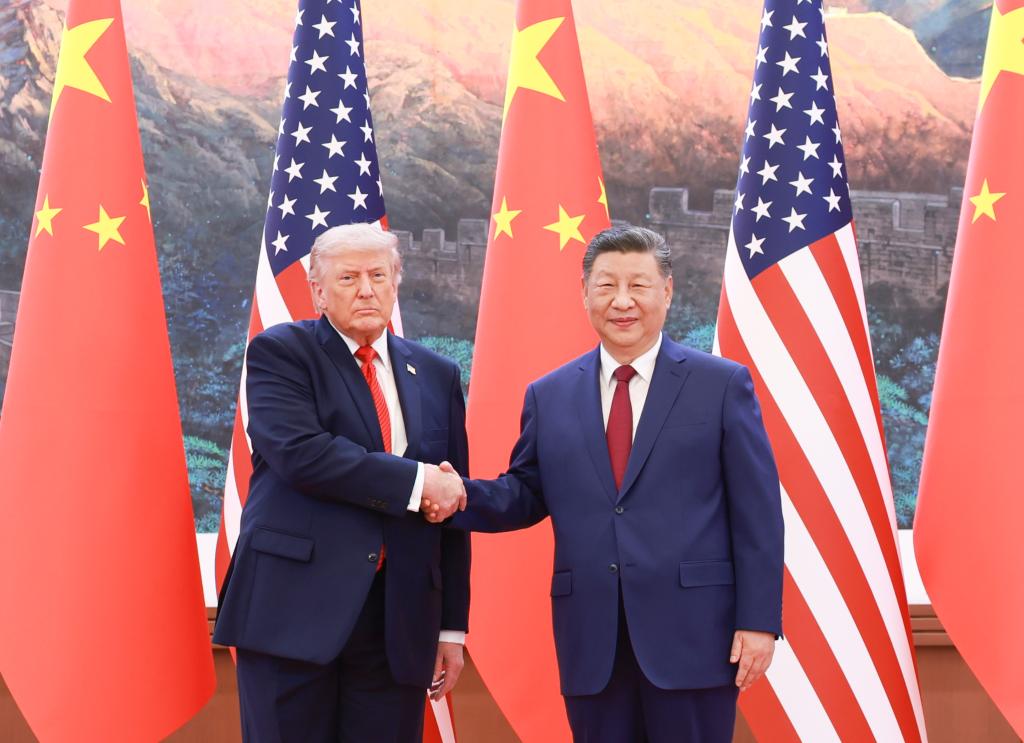
The long-awaited visit of the President of the United States, Donald Trump, to China began this Thursday (14) under strong diplomatic symbolism and a clear message issued by the Chinese leader, Xi Jinping: the relationship between the two greatest powers on the planet must be guided by cooperation, not confrontation. Although the economic agenda dominated the preparation of the meeting, the issue of Taiwan focused international attention on the first day of the visit.
Xi received Trump in Beijing with full state honors. The two leaders visited the Temple of Heaven, a symbol of the long historical continuity of Chinese civilization. They then attended a banquet at the Great Hall of the People, home to China’s main political ceremonies.
According to the state agency XinhuaXi reiterated Beijing’s historic position during the meeting: “The China-US relationship is the most important bilateral relationship in the world today. We must make it work and never ruin it.” The Chinese leader added that “the two countries have to gain from cooperation and lose from confrontation”.
Taiwan no dispute center
The statements came amid growing tensions over Taiwan, an island that is an inseparable part of Chinese territory. Although the conversation took place behind closed doors, several international vehicles reported that Xi warned Trump about the risks of “mishandling” the Taiwanese issue. THE The New York Times highlighted that, following the Chinese warning about Taiwan, the two leaders expressed a positive and cooperative tone.
The Taiwanese issue remains one of the open wounds of contemporary geopolitics. After the victory of the Chinese Revolution led by Mao Zedong in 1949, the defeated Kuomintang government took refuge in Taiwan under US military protection. Since then, Beijing has upheld the “one China” principle, according to which Taiwan is a temporarily separate Chinese province.
Washington formally recognizes this principle, according to Shanghai Proclamation1972: “Chinese on both sides of the Taiwan Strait maintain that there is only one China and that Taiwan is part of China.” Half a century later, Beijing continues to demand that Washington honor what it signed, given that the US maintains political and military support for the island, fueling tensions. For China, the issue transcends foreign policy, as it concerns national sovereignty, territorial integrity and historical memory.
Trap
It was in this context that Xi evoked the so-called “Thucydides Trap”, a concept popularized by the American political scientist Graham Allison, based on the work of the Greek historian Thucydides. The expression suggests that conflicts become more likely when an emerging power challenges a dominant power, as occurred between Athens and Sparta in Antiquity. Allison analyzed 16 similar historical cases over the last 500 years. In 12 of them, the result was armed conflict.
By asking whether China and the US will be able to “overcome the Thucydides Trap” and create another paradigm for relations between great powers, Xi sought to signal that disagreements do not inevitably need to lead to military confrontation. Away from the cameras, however, the Chinese leader got straight to the point: Taiwan is the most important issue in China-US relations.
Xi was even more explicit in stating that “Taiwan independence” and cross-Strait peace are as irreconcilable as fire and water. The Chinese leader urged the American side to exercise “extra caution” in dealing with the issue. According to XinhuaXi conveyed this position firmly, but without breaking the diplomatic tone that marked the entire meeting.
View to the USA
Trump, in turn, responded. In his speech at the banquet, the US president acknowledged that the two sides had positive and constructive conversations – and that both countries must strengthen cooperation to create a better future for the world. And he went further: he called Xi a “great leader” and China a “great country”, declaring that he had “enormous respect” for the Chinese people.
At this point, Trump’s behavior contrasted with more aggressive sectors in Washington. US Secretary of State Marco Rubio said US policy towards Taiwan remains “unchanged” and warned China against any attempt at reunification by force. But his statements sound more like a Pavlovian reflection of Cold War rhetoric than sophisticated political analysis.
Trump himself adopted a speech marked by cordiality and pragmatism. During an official toast, he treated Xi as a “friend” and formalized an invitation to visit the USA. “It is an honor for me to extend an invitation to you, Mrs. Peng, to visit us at the White House on September 24, and we look forward to it,” Trump declared, addressing Chinese first lady Peng Liyuan.
Global stability
Xi said he looks forward to working with Trump to set the course and steer the “gigantic ship” of Sino-US relations, so that 2026 continues the past and paves the way for the future. According to Xi, the economic and trade teams of the two countries produced “generally balanced and positive results” in the most recent round of trade talks yesterday.
Thucydides’ Trap was a warning, but images from Thursday in Beijing suggest that the risk tends to be avoided. On the first day of the visit, at least publicly, the idea defended by Xi Jinping prevailed: that global stability depends more on the coexistence between China and the USA than on the logic of permanent confrontation.
Source: vermelho.org.br