Published 04/14/2026 15:41 | Edited 04/14/2026 16:31
United States President Donald Trump is facing increasing pressure over his mental capacity to hold office after a series of statements considered erratic by critics and even former allies. A report from The New York Times described Trump as “less restrained and more incoherent,” citing repeated factual errors and fanciful claims. Hours later, Rep. Jamie Raskin argued for a cognitive health assessment based on the 25th Amendment, pointing to the president’s volatile statements about Iran and visible physical difficulties.
Read also: Pressure to remove Trump grows with war fluctuations
Attacks on the Pope and the Vatican’s reaction
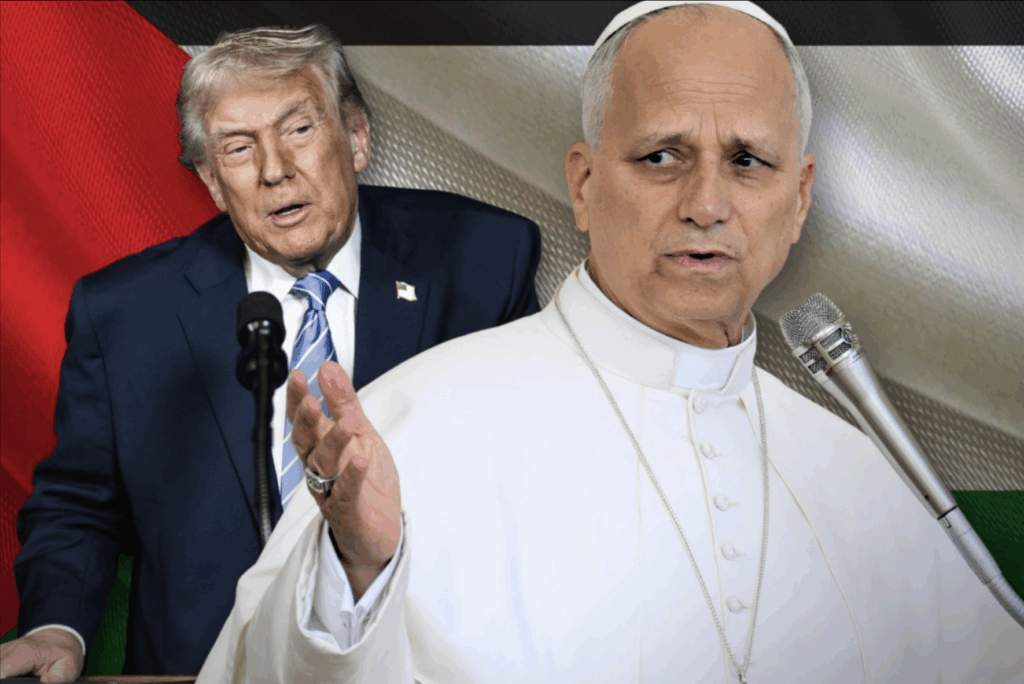
The controversy intensified when Trump published a text on his Truth Social platform personally attacking Pope Leo the 14th, classifying him as “WEAK at fighting crime and terrible at foreign policy”. The president also claimed that the pontiff only ascended to the Vatican because of his influence and criticized his positions on nuclear weapons and foreign policy.
The diatribe provoked an immediate reaction. Pope Leo 14, without mentioning Trump directly, condemned “threats against all the people of Iran” and classified warmongering rhetoric as “truly unacceptable”. On a flight to Algeria, the pontiff stated: “I am not afraid of either the Trump government or of speaking openly about the message of the Gospel.”
The statements provoked a strong political and religious reaction in the United States. The episode was interpreted by analysts as an unusual rupture in relations between Washington and the Vatican. The attack on the religious leader gained additional weight as it occurred amid the military escalation involving the US and Iran, expanding the diplomatic reach of the controversy.
The Vatican functions as a global religious authority and sovereign entity; Public disputes between American presidents and popes are rare. Although the Holy See has avoided open confrontation, the verbal escalation corrodes channels of dialogue at a time of international crisis.
Domestically, the episode further polarizes an already divided electorate. Religious leaders in the US have urged political figures to maintain respectful speech, warning that inflammatory rhetoric can erode public trust. Trump supporters, in turn, dismiss criticism as politically motivated, calling it an effort to undermine his presidency.
Report of New York Times intensifies questions
An analysis published by The New York Times it consolidated perceptions already present in political and media sectors about changes in the president’s discursive pattern. The repercussions were immediate in Congress. Democratic Representative Jamie Raskin defended carrying out an assessment of the president’s cognitive capacity based on the 25th Amendment to the Constitution, which provides mechanisms for removal in case of incapacity.
Criticism was not limited to the opposition. In an unprecedented move, former Republican congresswoman Marjorie Taylor Greene, previously an ally of Trump, published on X a call for the Cabinet to invoke the 25th Amendment. She claimed that statements about Iran — such as the threat that “an entire civilization will die” — would amount to “madness” and justify debate over the 25th Amendment.
In the field of national security, former CIA director John Brennan also defended the application of the amendment, telling MSNBC: “This person is clearly unbalanced. I think the 25th Amendment was written with Donald Trump in mind.” Brennan warned of the risks of Trump controlling military and nuclear powers in a state of supposed instability.
Other conservative voices, such as Tucker Carlson and Candace Owens, also criticized the belligerent rhetoric, while Democrats like Chris Murphy reinforced concerns about possible humanitarian impacts. Some Republicans, such as Senator Ron Johnson, suggested the statements could be a negotiating tactic, but most avoided commenting publicly.
War with Iran worsens political environment
The military offensive against Iran, conducted without prior approval from Congress, became a central element of the crisis. Critics point to planning failures, diplomatic isolation and the inability to anticipate Tehran’s strategic responses, such as tensions in the Strait of Hormuz.
An Ipsos poll released this week shows that 66% of Americans want the US to quickly end involvement in the conflict with Iran, even if goals are not met. Only 27% support the continuity of operations. The sentiment fuels anxiety in the Republican Party about prospects for future elections, as angry posts from Trump amplify concerns about his decisions.
25th Amendment returns to the center of the debate
The 25th Amendment to the US Constitution establishes that the vice president — currently JD Vance — and a majority of the cabinet can declare the president unable to perform his duties. The mechanism, however, has never been used against a sitting president.
Experts point out that, despite the intensification of public and political debate, the application of the measure faces high institutional barriers, mainly due to the need for internal support within the government itself.
Despite the increase in appeals, constitutional law experts warn that invoking the 25th Amendment remains extraordinarily difficult. Section 4 of the amendment requires the vice president and a majority of the Cabinet to declare in writing to Congress that the president is “unable to discharge the powers and duties of his office.”
Vice President JD Vance has publicly aligned himself with Trump’s stance on Iran and is considered unlikely to take action. Without support from the Cabinet and with Republican lawmakers largely loyal to the president, the measure faces high procedural and political hurdles. The term “disability”, deliberately undefined in the Constitution, leaves its interpretation to political actors — not public opinion or media analysis.
Increasing pressure and institutional uncertainty
The convergence of questions about cognitive health, conduct in times of war and attacks on religious institutions marks a potentially crucial moment in Trump’s presidency. Historically, external conflicts tend to consolidate presidential authority; however, the erratic conduct of the current occupant of the White House and fragile alliances have had the opposite effect, weakening political capital.
Although the invocation of the 25th Amendment remains unlikely in the short term, the mere fact that it returns to public debate signals an atypical moment in American politics, in which presidential capacity becomes an explicit topic of institutional dispute.
Source: vermelho.org.br