Published 04/14/2026 11:52 | Edited 04/14/2026 12:50
Madrid returned to the streets in recent days around a date that remains alive in Spanish history and politics. On the eve of the 95th anniversary of the proclamation of the Second Republic, demonstrations took place from north to south of the country, not just in Madrid, in addition to political acts and cultural activities that marked the republican agenda, reaffirming April 14th as a moment of memory, dispute and political project.
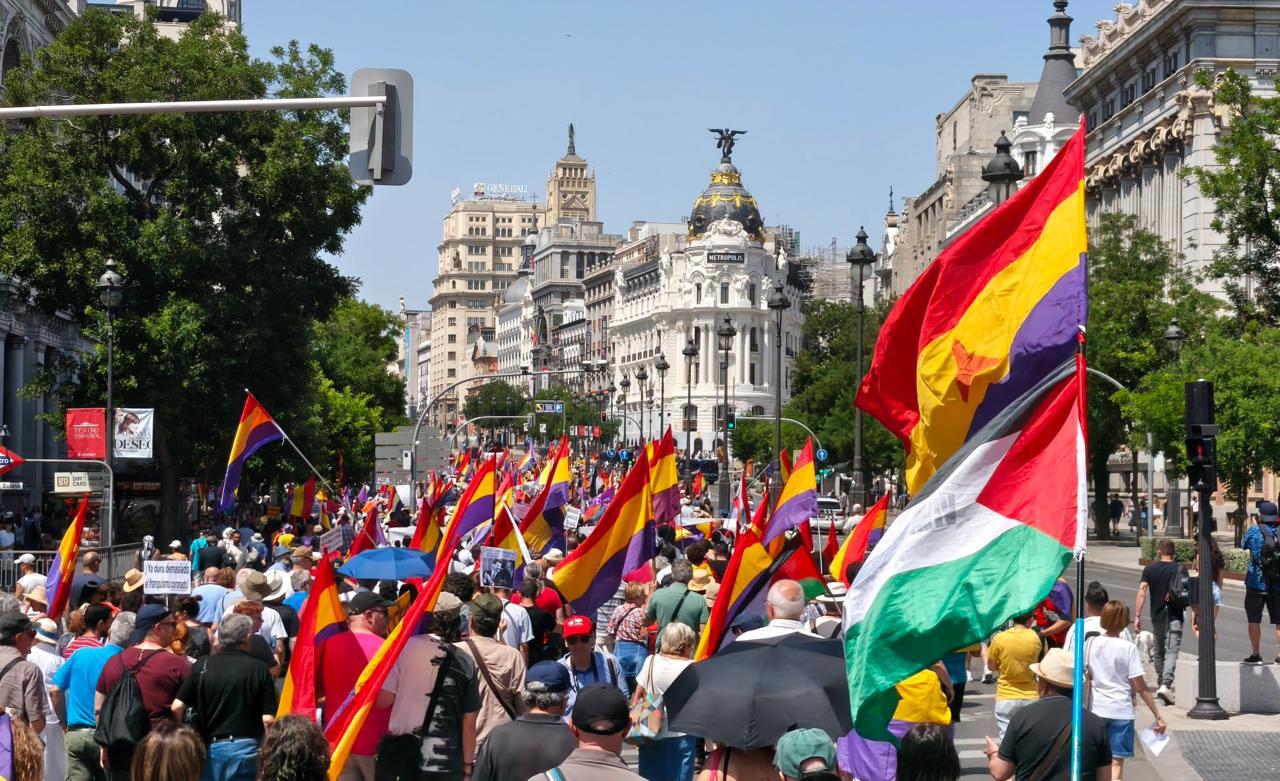
In the capital, the main street mobilization took place on April 12, the Sunday before the event, bringing together around three thousand people on a route through the center of Madrid to Puerta del Sol, the historic site of the popular celebrations of 1931. The anticipation of the demonstration, common in the Spanish political calendar, sought to increase participation by coinciding with the weekend.
Under slogans such as “Por los derechos sociales. ¡Ni Guerra, ni NATO, ni bases! Por la III República”, the protesters articulated republican memory with contemporary disputes, connecting the institutional struggle to the social agenda, the defense of sovereignty and the opposition to militarization. The presence of political organizations, republican collectives, youth and social movements highlighted the plural and unitary character of the mobilizations.
Red, yellow and purple tricolor flags returned to occupy public space in Madrid. Official symbol of the Second Republic, the tricolor historically expresses the incorporation of the people into the national project. Today, its use maintains a strong political significance, representing the defense of a State model based on popular sovereignty, the expansion of rights and the overcoming of structures inherited from the restored monarchy in the post-Franco period.
This presence is not limited to demonstrations. In several neighborhoods of the city, balconies of small buildings display the tricolor flag, while others display the official flag of the Spanish monarchy. The coexistence of these symbols in urban daily life shows that, despite the passage of time, the division around the form of the State remains deeply rooted in Spanish society.
The path of the mobilizations itself reveals the political geography of the Republic in the city. Madrid becomes a true historical map, in which Puerta del Sol remains the epicenter of popular celebrations in 1931, while spaces such as Cibeles, Alcalá and Gran Vía continue to be axes of political visibility.
Proclaimed on April 14, 1931, the Second Republic represented a profound break with the monarchy and inaugurated a period of advanced reforms. Its Constitution established principles such as the secular State, female suffrage, the expansion of civil rights and the strengthening of public education.
The republican process was also marked by contradictions and the evolution of political forces. As stated by Sergio Mesa, from the Communications Secretariat of the Communist Party of Spain, in an interview with Portal Vermelho, “our Partido fell into serious sectarian errors, so that it maintains an aggressive position before the proclamation of the Second Republic”, in reference to the organization’s initial stance in the first moments of the new regime.
As the political and social tensions advance, the role of the PCE has been transformed, especially in the defense of republican legality against reactionary forces. As highlighted by the Secretariat of Democratic Memory of the Communist Party of Spain, “The PCE was the political party that insisted on the need to arm the people and the creation of a regular army with a single command, an army that is formed with commanders loyal to the republic and with military leaders linked to the people. An army forged in the fight against fascism and against the foreign invader (…) The involvement of the PCE in defense of the Second Republic was clear and distinct.”
Even with its historical relevance, April 14th is not recognized as a national holiday in Spain, which expresses the continuities of the period after the Republican defeat. The absence of the date in the official calendar is often pointed out as part of a political and symbolic heritage that dates back to Francoism and that still projects itself over the institutions and organization of the Spanish State.
Despite its advances, the Republic faced intense resistance from conservative sectors, economic elites and part of the armed forces, in addition to internal tensions between progressive forces. This scenario ended up interrupting the republican experience, paving the way for its defeat and decades of dictatorship.
Still, his legacy has endured and continues to be reactivated on the streets and in contemporary political disputes. According to Sergio Mesa, “women and men decided that to progress it was essential to free themselves from the corrupt burden of the monarchy”, inaugurating a stage of unprecedented social advances in the country.
In recent decades, this republican movement has undergone a significant transformation. After years outside of the political agenda, the Third Republic’s demand to gain centrality. “The demand for the Third Republic (…) returned to the agenda of the majority of the working class forces and the leftist forces,” says Sergio Mesa.
This process is also expressed in recent mobilizations. Hundreds of events are carried out across the country throughout the month of April, in addition to the consolidation of a republican state march in Madrid, which should take place again in June, reinforcing the topic’s presence in the public debate.
The reading of the Spanish communist forces points to a change in historical meaning. The Republic stops being just a memory and becomes a project. As José Manuel García, Secretary of the Republic of the PCE, highlights, the construction of the Third Republic asserts itself as a concrete alternative to the needs of the social majority, linked to a broader process of political, economic and social transformation.
The contemporary republican proposal is directly associated with the defense of concrete rights. Stable employment, decent wages, housing, public services and social protection appear as pillars of a new country model.
The issue of housing, in particular, has occupied a central place in this debate. As stated in the note from the Communist Party of Spain released on the occasion of April 14th, “capitalism has transformed a right, that of housing, into a business. Having a decent and adequate roof over one’s head is a fundamental human right to live with dignity, safety and health.”
On the international scene, the defense of the Republic is also connected to the fight for peace and the opposition to militarism. In this sense, contemporary republicanism presents itself as an anti-imperialist project, linked to national sovereignty and cooperation between peoples.
In the current context of the advance of the extreme right, the republican struggle takes on new meaning. For Sergio Mesa, it is about “establishing a full, participatory, integral, transparent and secular democracy”, capable of guaranteeing rights and facing the growth of authoritarian forces.
In this context, reading about the current moment of the political dispute in Spain also benefits from an external perspective, although deeply connected to the country’s reality. A member of the Central Committee of the Communist Party of Uruguay and resident in Madrid for more than a decade, Gustavo Alvarez follows Spanish political dynamics closely and states that “for the current left, the idea of a ‘Republican Spain’ goes far beyond replacing a head of state. It is a project of political, economic and social transformation, which also functions as an element of mobilization and unity in the face of the fragmentation of left-wing forces.”
The construction of this alternative involves the formation of a broad popular unit and the opening of a new constituent process. The Republic thus appears as a political horizon that articulates democracy, social justice and structural transformation.
Ninety-five years later, the Spanish Republic remains a historical experience that has not completely ended. His memory continues to be reactivated on the streets, in political debates and in cultural expressions. In Madrid, amid tricolor flags and popular demonstrations, April 14th reaffirms its character as a moment of dispute over the future.
The Republic, in this sense, does not appear only as a reminder of an interrupted past, but as a political horizon that continues to mobilize generations around the idea of democracy, social justice and emancipation.
Source: vermelho.org.br