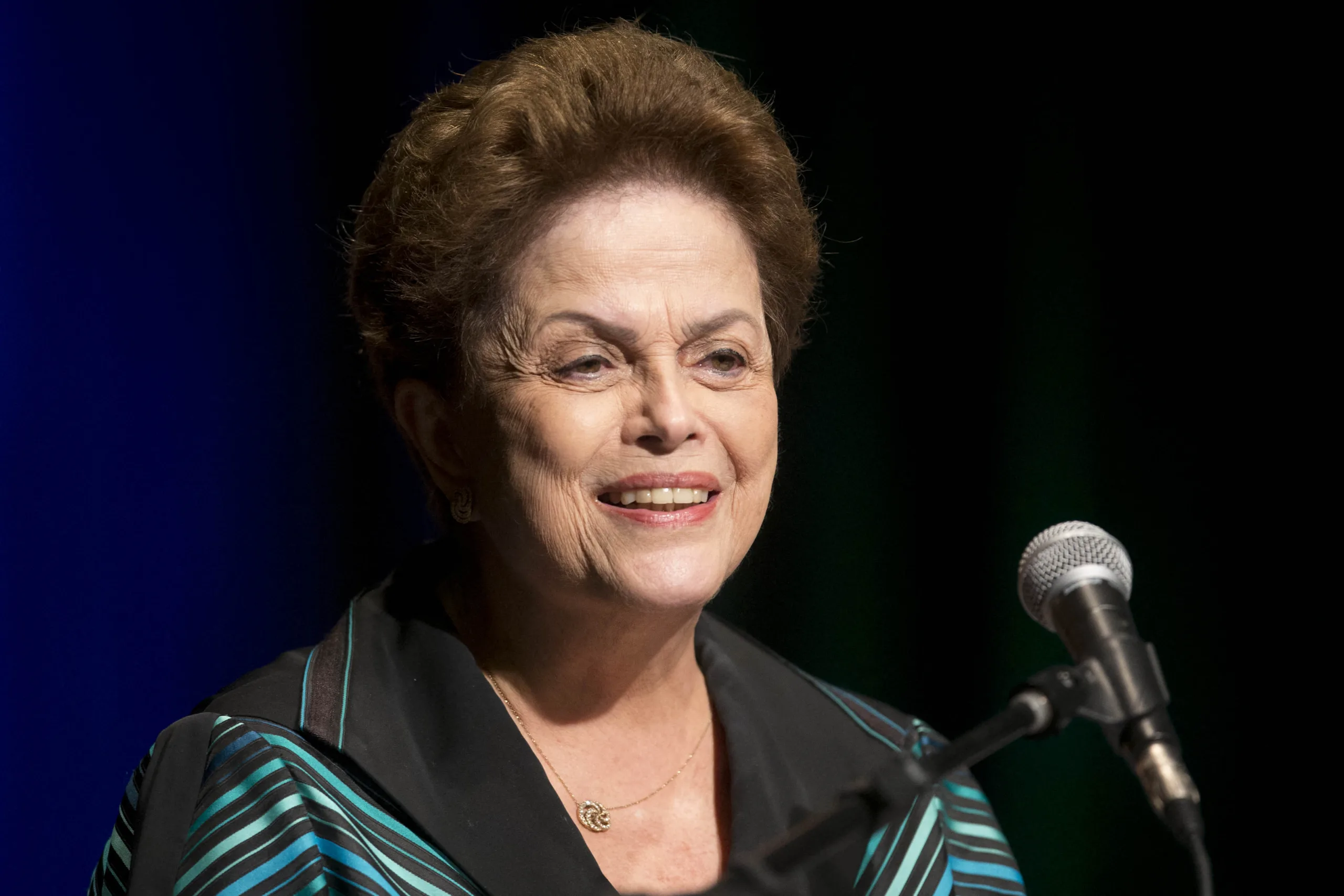
The former president of Brazil and current president of the New Development Bank (called the BRICS Bank), Dilma Rousseff, sent a greeting to the 1st International Colloquium “Fidel Castro Ruz: thought and work”, held in Havana, in which she claimed the relevance of the legacy of the leader of the Cuban Revolution and his influence on the generation of Latin Americans who faced the region’s military dictatorships.
“I speak not only as a former president of Brazil, but as a militant who, in her youth, was deeply marked by the example of courage and rebellion that emerged in Cuba in 1959”, began the former Brazilian president in her message.
Rousseff stated that the Cuban Revolution represented, for her generation, a reference of hope and the possibility of transformation. And he highlighted that Fidel was, for Latin Americans of his time, “a living symbol of the struggle for social justice, freedom and sovereignty”.
In an emotional memory, the former president recalled one of the meetings she had with Fidel, at his residence in Havana, during the inauguration of the port of Mariel, when the Cuban leader had already retired from public life. She said that the two spent around two hours talking and highlighted the lucidity, memory and passion with which Fidel conducted the conversation. “That day, I saw the man behind the myth. And it only increased my admiration for him.”
When addressing the relationship between Fidel and Brazil, Rousseff stated that “Fidel’s relationship with Brazil was not limited to the field of ideas; it had a concreteness that transformed the lives of millions of Brazilians”. She recalled that, during her government, the support of Cuba and the Cuban leader was decisive for the implementation of the Mais Médicos program, which she classified as one of the main initiatives of her administration. The experience, he stated, “showed in a concrete way the scope of Cuban solidarity and internationalism defended by Fidel.”
“More than 11 thousand Cuban doctors arrived in Brazil to serve where no other professional wanted to go: on the outskirts of the largest cities, in the semi-arid region, in the Amazon and in indigenous villages. In five years, these doctors, whom Fidel affectionately called his army of white coats, saved lives, restored hope and dignity to entire populations. The communities where they worked welcomed them as heroes”, said the former president of Brazil.
From this experience, Rousseff related Fidel’s legacy to a conception of international relations based on cooperation and solidarity between people. “With Cuba and Commander Fidel Castro, I learned that true foreign policy is not just made with speeches, but with concrete acts of solidarity.”
Along the same lines, he highlighted Fidel’s role in articulating the struggles of the people of the Global South and in Cuba’s international projection. Rousseff recalled that, under Fidel’s leadership, the island participated in the fight against apartheid in Africa and developed a broad policy of medical and educational cooperation. For her, this internationalism was expressed in concrete actions and was marked by commitment to other peoples.
“Who can forget his intervention at the Earth Summit, in Rio de Janeiro, in 1992? With the lucidity that characterized him, Fidel was already warning the world about the dangers of climate change and unbridled consumerism, defending an international order that put life and nature at the center. And not profit. He was a visionary”, he stated.
Rousseff’s message is part of a series of videos released by the Cuban Foreign Ministry as part of the colloquium, in which international leaders recall the trajectory and legacy of Fidel Castro. Among them are former Prime Minister of Jamaica, James Patterson, former President of Ecuador, Rafael Correa, former Prime Minister of Saint Vincent and the Grenadines, Ralph Gonsalves, and former President of Colombia, Ernesto Samper.
At the end of her message, Rousseff also reaffirmed her commitment to the principles that, as she highlighted, are part of Fidel’s political heritage: social justice, the sovereignty of the people, Latin American integration and solidarity as the basis of international relations.
“Fidel Castro has physically left, but his political heritage, his courage and his example remain more alive than ever. We reaffirm our commitment to the ideals he defended: social justice, sovereignty of the people, Latin American integration and solidarity as a fundamental principle of international relations”, concluded Dilma Rousseff.
Source: www.brasildefato.com.br