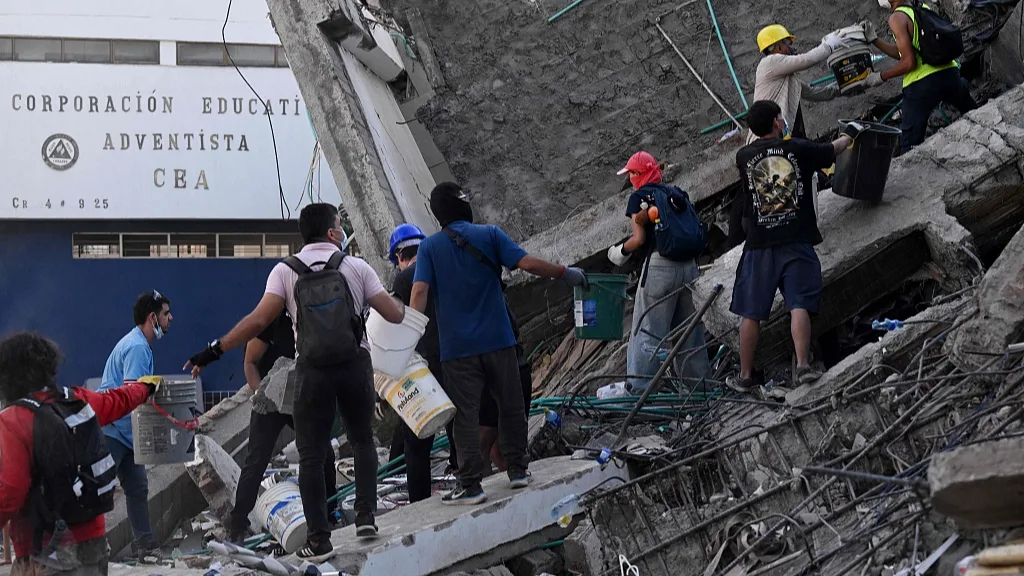
China made itself available to help Colombia after the 7.4 magnitude earthquake that hit the country on Monday (10). In response to a question from Brazil in factChinese Foreign Ministry spokesperson Guo Jiakun stated that Beijing is prepared to provide assistance in accordance with Colombian needs.
The question asked mentioned that the earthquake had left more than 100 people dead and thousands injured and asked what China’s position was in the face of the situation.
Guo began his response by highlighting that President Xi Jinping had sent a message to Colombian President Abelardo de la Espriella, “expressing deep condolences for the lives lost and sincere condolences to the bereaved families and those injured.”
According to the spokesperson, Xi also expressed confidence in the Colombian people’s ability to overcome the tragedy: “We believe that under the leadership of the Colombian government and President Abelardo de la Espriella, the Colombian people will remain united and will recover and rebuild soon.”
The message was sent a few days after the inauguration of De la Espriella, who assumed the presidency on August 7. Guo then presented Beijing’s position on possible assistance: “China is ready to see what it can do to help in appropriate ways, in light of Colombia’s needs.”
Colombia asks for supplies instead of rescue teams
Different countries offered help to Bogotá. China, Mexico, Chile and El Salvador were among the countries that expressed their willingness to collaborate, in addition to the United Nations.
However, the government of Abelardo de la Espriella did not request any assistance. The Colombian administration reported that it had enough of its own teams to carry out this work and prioritized the reception of humanitarian supplies.
The decision generated criticism and controversy. The contrast is significant: on the one hand, foreign governments offered specialized teams; on the other hand, the newly installed administration initially decided not to request this type of support, claiming to have its own capacity.
To date, there has been no announcement of a specific humanitarian aid package by the Chinese government. Beijing’s statement makes it clear that there is a willingness to contribute, but that assistance will be defined taking into account the needs presented by Colombia itself.
In the Mexican case, for example, a rescue contingent was prepared and was awaiting Bogotá’s formal request to begin operations. Subsequently, the Colombian government began to coordinate the reception of international aid in the form of inputs, but continued without requesting the sending of teams.
The earthquake highlights the handling of the emergency by the recently installed government of De la Espriella, who assumed the presidency just three days before the earthquake.
Chinese companies doing business in Colombia mobilize
The Chinese International Development Cooperation Agency (CIDCA) also confirmed that the country is willing to provide humanitarian assistance when Colombia needs it. The body reiterated that support will occur within Chinese capabilities and in accordance with the needs expressed by Espriella’s government.
While Beijing keeps the possibility of humanitarian assistance open, Chinese companies operating in Colombia have already begun to mobilize. The Chinese Embassy in Bogotá reported that these private entities are moving heavy equipment to the affected areas. The machines will be used to support rescue and debris removal operations.
The mobilization was not restricted to the Chinese government, companies and diplomatic representation. The Chinese community in Colombia has also activated its own mechanisms to locate and provide assistance to its members in the affected areas. People seek to identify affected citizens and organize support for those in need.
Embassy accompanies Chinese citizens
Chinese diplomacy is also organized to assist Chinese citizens who live or are in Colombia. In the same response to Brazil in factGuo Jiakun reported that, to date, there have been no reports of Chinese citizens being injured or killed.
“The Chinese Embassy in Colombia is doing everything it can to verify the safety of Chinese citizens in the earthquake zone and will actively provide necessary assistance,” he continued.
Guo also presented a safety guidance: “We recommend that Chinese citizens in Colombia exercise caution in the face of possible secondary risks from the earthquake.”
Earthquake occurs at the beginning of new government
The earthquake hit Colombia just three days after Abelardo de la Espriella took office. The president, aligned with Trump and the far right, replaced the first left-wing government in the country’s history, led by Gustavo Petro until August 7th.
In 2023, during a Petro State visit to China, the two countries elevated their relations to the level of strategic partnership. The decision deepened the channels of political dialogue between Beijing and Bogotá and expanded the possibilities for cooperation between the two countries.
In 2025, Petro returned to China to participate in the China-Celac Forum. The two countries also advanced cooperation related to the Belt and Road Initiative.
The rapprochement with Beijing was part of the Petro government’s effort to expand Colombia’s relations with countries in the Global South and diversify its international partners. During this process, Chinese companies also expanded their presence in the country. Some of them are part of the group that is now mobilizing heavy equipment to support rescue and debris removal operations.
The actions of these private organizations give a practical dimension to the relationship built between the two countries in recent years. Despite the change of government in Bogotá, the canals built between China and Colombia over the past few years continue to function, and the response to the earthquake shows this.
Source: www.brasildefato.com.br