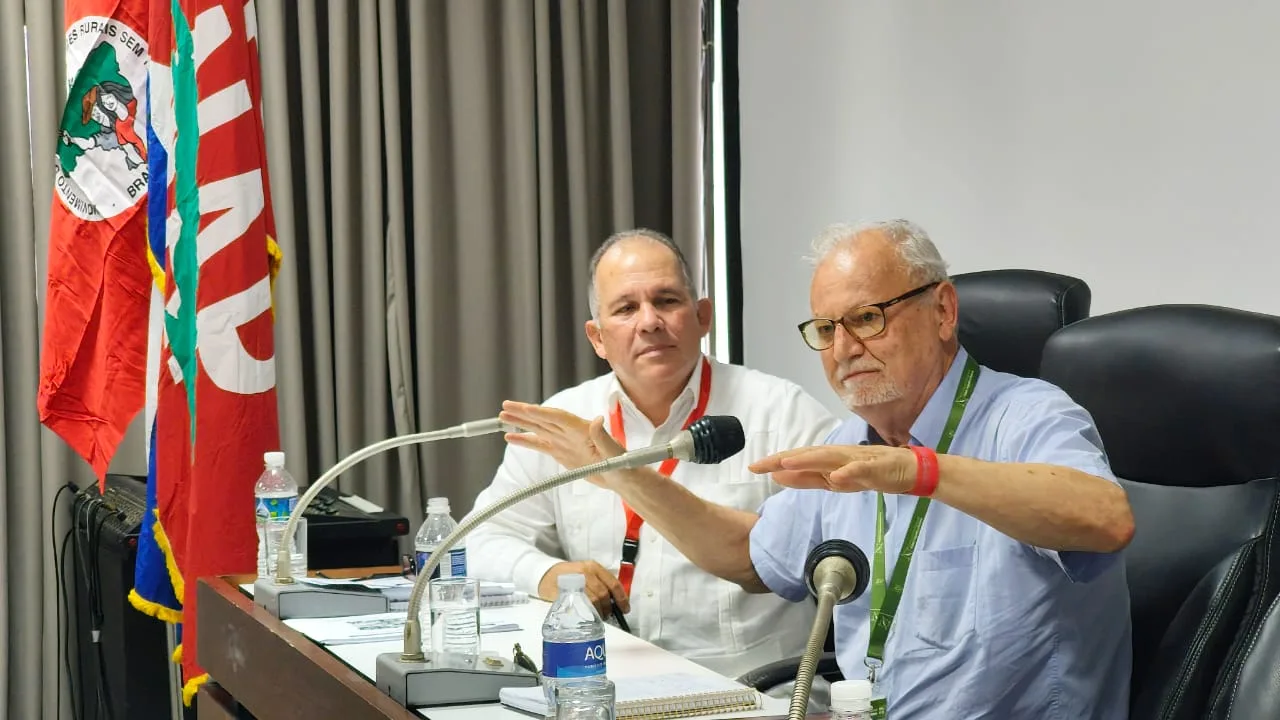
“We have a history of relationships, as companions and brothers, with the National Association of Small Farmers of Cuba [ANAP] a long time ago. On our side, it has been practically since the beginning”, stated João Pedro Stedile, leader of the Landless Rural Workers Movement (MST), during the 1st International Colloquium “Fidel Castro Ruz: thought and work”, held in Havana.
Meeting with Cuban peasant leaders and researchers at the forum dedicated to the history and current affairs of ANAP, in which the Cuban Agrarian Reform Law and the trajectory of the peasant organization were discussed, João Pedro recovered, in his intervention, the history of relations between the MST and the Cuban organization.
Through anecdotes and memories, Stedile said that the relationship between the MST and ANAP practically dates back to the birth of the Brazilian movement. At the beginning of the 1980s, Brazil was going through the last years of the civil-military dictatorship, in a context of profound intensification of the class struggle. In that period, traditional peasant agriculture was being displaced by large agribusiness based on export-oriented monocultures, causing a mass rural exodus. In response, local struggles for land began to emerge, supported by the Pastoral Land Commission (CPT), in which thousands of peasants mobilized to demand access to their means of work and subsistence.
It was in this context that, in 1984, the 1st National Meeting of the Landless took place, which brought together more than 80 delegates and peasant leaders from at least 13 Brazilian states, with the aim of articulating the different struggles that were spreading across the country. Just one year later, the founding congress of the MST was held in Curitiba, capital of Paraná.
Stedile recalled that, at that time, they still did not know where the process of organizing the movement would lead. Even so, that congress was attended by international peasant movements from 16 countries. Among them were representatives from ANAP, which the MST had decided to invite since that first national meeting. “We didn’t even know, but we had this reference: ANAP has to be at our congress”, he reported.
“We were still emerging from the dictatorship and, at that time, talking about Cuba was a danger. We didn’t even have diplomatic relations”, he explained, laughing. “So, I don’t know how they got there, but two ANAP representatives arrived,” he added.
Cuban agrarian reform as a reference
After going through the different conceptions of agrarian reform throughout history, Stedile highlighted that the Cuban experience, driven by Fidel, is a fundamental reference for understanding the conceptions of the MST and the evolution of struggles for land on an international scale.
“We consider that the agrarian reform idealized by Fidel and transformed into law was also a theoretical framework for the development of the idea of agrarian reform for the entire world peasantry,” he stated.
The MST leader explained that the idea of agrarian reform emerged in the context of the expansion of industrial capitalism, between the middle and end of the 19th century, driven by the industrial bourgeoisies of Europe, the United States and Japan. In that period, the distribution of land and the confrontation of rural oligarchies played a central role in the development of industrial productive forces.
In a context in which peasants represented between 80% and 90% of the population, the industrial bourgeoisies promoted this process of “classical agrarian reform” with the aim of transforming a largely dispossessed peasantry into producers and consumers of goods. In this way, they sought to expand the market for the industry.
It was with the experience of the Mexican Revolution and the figure of Emiliano Zapata that one of the first major shocks occurred in the struggle for land. Zapata developed a more radical conception of agrarian reform, summarized in the slogan: land for those who work it.
“Then came the Mexican Revolution, in the same period. And Zapata built another conception of agrarian reform, which was radical, but had no law. They just wanted land, land for those who worked on it, and that’s why they made the revolution”, he stated. In this sense, he recalled that “the Mexican agrarian reform law was made with a rifle”.
From this path, Stedile situated the experience of the Cuban Revolution as a true turning point in the history of agrarian reforms. “When you carried out the agrarian reform in 1959, a new type of agrarian reform emerged that marked the history of agrarian reform in universal terms. And, therefore, it also served as a guide. We classify the Cuban agrarian reform, in fact, as a popular agrarian reform”, he stated.
Stedile explained that the popular character of Cuban agrarian reform was related to the existence of an organized peasant movement and its active participation in the revolutionary struggle, as well as the subsequent construction of a government that emerged from this process and a State aimed, according to his analysis, at representing popular interests.
With the Cuban agrarian reform, he added, land was no longer conceived as a commodity destined for speculation and began to be considered a common good at the service of society and food sovereignty.
Fidel didn’t wear a watch
Stedile highlighted that there was a simple — and, at the same time, extraordinary — issue that was the one that most impressed and influenced the MST: the method of work developed by Fidel with the peasants.
He highlighted Fidel’s constant concern with directly knowing the reality of the countryside and maintaining close contact with rural communities, as well as his permanent dialogue with the people and a way of exercising political leadership based on an extraordinary capacity for listening.
“Fidel didn’t wear a watch, did he? That impressed us. In any situation, we always listened: Fidel was there, among the people, in good times and bad times. And also the way he listened. We were always told that Fidel asked a lot of questions and listened to the peasant. He was one of the best journalists this country has ever had.”
“With this method of working and organizing the peasants, we dare to say that Fidel was, in reality, a great pedagogue by example,” he stated. According to Stedile, traveling through the countryside and maintaining direct contact with the peasants continues to be fundamental to understanding their problems and building a policy linked to this reality.
Source: www.brasildefato.com.br