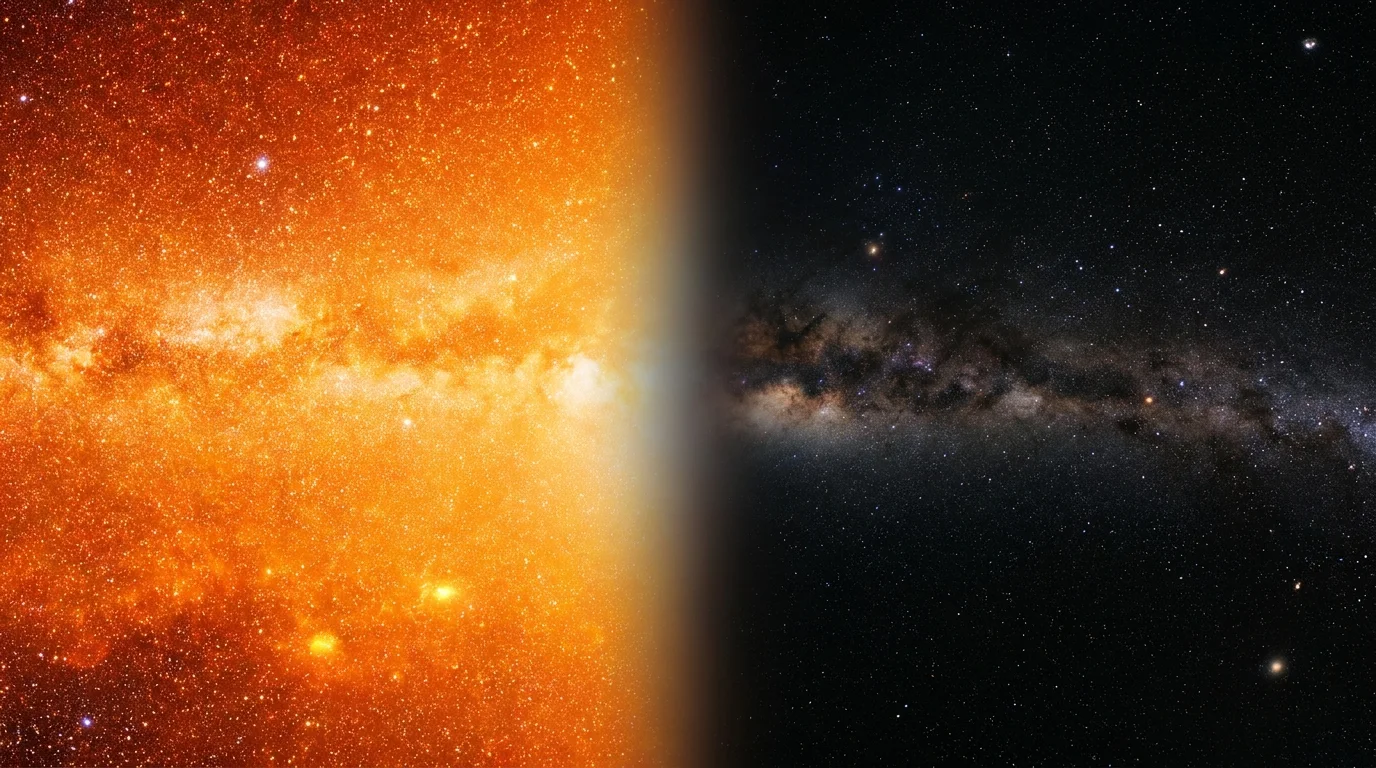
For as long as humanity has gazed upward, the darkness of the night sky has been a source of wonder, fear, and philosophical contemplation. We accept this darkness as a fundamental fact of existence, a natural consequence of the sun setting below the horizon. Yet, for centuries, astronomers and physicists were deeply troubled by this very blackness. If the universe is infinite, eternal, and filled with an endless distribution of stars, every line of sight should eventually terminate on the surface of a star. The entire celestial sphere should blaze with the intensity of the solar photosphere, rendering night impossible and bathing the Earth in perpetual, searing light. This profound contradiction between theoretical expectation and observational reality is known as Olbers’ Paradox, and its resolution tells one of the most important stories in the history of cosmology.
The Historical Roots of a Dark Mystery 📜
Although named after the German astronomer Heinrich Wilhelm Olbers, who articulated the problem clearly in 1823, the paradox has a lineage stretching back to the earliest days of modern astronomy. Johannes Kepler raised similar concerns in 1610 when he argued against an infinite universe precisely because the sky was dark. Later, Edmond Halley and Jean-Philippe de Cheseaux revisited the issue in the 17th and 18th centuries, attempting mathematical formulations that fell short of a complete solution. Olbers himself suggested that interstellar dust and gas might absorb the light from distant stars, thereby dimming the background glow. For over a century, this absorption hypothesis remained the dominant explanation.
However, the dust argument contains a fatal thermodynamic flaw. In an eternal, static universe, any absorbing medium would eventually reach thermal equilibrium with the radiation field. Over infinite time, the dust would heat up until it re-radiated exactly as much energy as it absorbed, glowing with the same brightness as the stars it was supposed to obscure. Absorption merely delays the inevitable; it cannot permanently solve the paradox. The true answer required a radical reimagining of the universe itself, one that would not arrive until the 20th century brought forth the theories of relativity and the discovery of cosmic expansion.
The Finite Age of the Universe ⏳
The primary and most significant resolution to Olbers’ Paradox lies in the fact that the universe is not eternal. Current cosmological models place the age of the universe at approximately 13.8 billion years. This finite age imposes a strict limit on how far we can see, creating what is known as the particle horizon. Light travels at a finite speed, roughly 300,000 kilometers per second, which means we can only observe objects whose light has had sufficient time to reach us since the Big Bang. Beyond this cosmic horizon, there may indeed be countless stars and galaxies, but their light has not yet arrived.
This temporal boundary fundamentally breaks the assumptions underlying the paradox. The classical formulation assumes an infinitely old universe where light from every possible star has already reached every possible observer. In our actual universe, the volume of observable space is finite, and therefore the total number of stars contributing to the night sky’s brightness is also finite. Even if the universe extends infinitely beyond our horizon, those regions are causally disconnected from us and contribute nothing to the illumination of our sky. The darkness we see is, in part, the shadow of cosmic youth, a reminder that the universe has not had enough time to fill every line of sight with starlight.
Cosmic Expansion and the Redshift Effect 🔴
While the finite age of the universe provides the foundational answer, cosmic expansion adds a crucial secondary effect that further dims the distant cosmos. Edwin Hubble’s discovery in the 1920s that galaxies are receding from us at speeds proportional to their distance revealed that space itself is stretching. This expansion has two direct consequences relevant to Olbers’ Paradox. First, it increases the proper distance to faraway objects over time, meaning that some galaxies whose light was once en route to us have now crossed beyond our event horizon, forever removing their contribution to the sky’s brightness.
Second, and perhaps more importantly, expansion stretches the wavelength of traveling photons, producing cosmological redshift. As light traverses expanding space, its energy decreases proportionally to the scale factor of the universe. Visible light from extremely distant galaxies is shifted into the infrared and microwave portions of the spectrum, becoming invisible to the human eye. The energy density of background radiation is diluted not only by geometric spreading but also by this redshift factor. Calculations show that expansion reduces the expected brightness of the night sky by roughly a factor of two compared to a static universe of the same age. While this effect alone cannot resolve the paradox, it works in concert with the finite age to ensure that the integrated starlight remains comfortably dim.
The Observable Universe and Stellar Evolution ⭐
Even within our observable horizon, the universe is not uniformly populated with luminous sources across all epochs. Stars are not eternal beacons; they have lifespans determined by their mass and fuel reserves. Massive stars burn brightly but perish quickly in supernova explosions, while low-mass stars shine faintly for trillions of years. The rate of star formation has varied dramatically over cosmic history, peaking roughly 10 billion years ago during what astronomers call cosmic noon and declining steadily since. This means that the universe was never simultaneously filled with the maximum possible density of luminous objects.
Furthermore, the conversion of baryonic matter into stars is remarkably inefficient. Only about five percent of ordinary matter has ever been incorporated into stellar objects, and only a fraction of that mass is converted into radiant energy through nuclear fusion. The vast majority of baryonic matter exists as diffuse gas or dark remnants like white dwarfs, neutron stars, and black holes that emit little to no visible light. When combined with the finite age and expansion effects, the actual emissivity of the universe falls many orders of magnitude below the threshold needed to produce a bright night sky. Detailed calculations integrating the observed star formation history, initial mass function, and cosmological parameters yield a predicted extragalactic background light that matches observations perfectly, confirming that the darkness is exactly what modern physics predicts.
The Cosmic Microwave Background: A Ghost of Brightness 📡
Ironically, the sky is not entirely dark. It glows uniformly in microwave wavelengths at a temperature of 2.7 Kelvin, a relic radiation field known as the Cosmic Microwave Background (CMB). Discovered accidentally by Arno Penzias and Robert Wilson in 1965, the CMB represents the afterglow of the hot, dense early universe, released when the cosmos became transparent to radiation approximately 380,000 years after the Big Bang. At that epoch, the universe was indeed brilliantly luminous, with every point in space radiating at roughly 3,000 Kelvin, comparable to the surface of a red dwarf star.
The CMB is, in a very real sense, the bright sky that Olbers’ Paradox predicted, but transformed by 13.8 billion years of cosmic expansion. The original optical and ultraviolet photons have been redshifted by a factor of about 1,100 into the microwave regime, reducing their energy density by a factor of over a trillion. If our eyes could perceive microwaves, the entire sky would appear uniformly bright, and Olbers’ question would seem trivially answered. The fact that we see darkness in visible light while detecting uniform glow in microwaves provides stunning confirmation that the universe evolved from a hot, opaque state to the cold, transparent expanse we inhabit today. The paradox is thus resolved not by denying the premise of universal radiation, but by recognizing that the radiation has been fundamentally altered by the dynamics of spacetime itself.
Philosophical Implications of Cosmic Darkness 🤔
Beyond its technical resolution, Olbers’ Paradox carries profound philosophical weight. Before the 20th century, the darkness of night was often interpreted through theological or metaphysical lenses, seen as evidence of divine design or as a necessary contrast to highlight celestial order. The scientific resolution strips away these interpretations, replacing them with a narrative grounded in physical law and empirical observation. The darkness becomes a datum, a measurable quantity that constrains models of cosmic origin and evolution.
Moreover, the paradox illustrates a deeper epistemological principle: absence of evidence can indeed be evidence of absence, but only when properly contextualized within a theoretical framework. The missing starlight did not mean stars were absent; it meant that our assumptions about time, space, and light propagation were incomplete. Every failed explanation, from interstellar absorption to hierarchical clustering, served as a stepping stone toward the correct synthesis. Today, when cosmologists study the extragalactic background light or measure the CMB anisotropies, they are engaging directly with the legacy of Olbers’ question, using darkness as a probe to illuminate the structure and history of the cosmos.
Modern Observational Confirmations 🔭
Contemporary astronomy has moved far beyond theoretical speculation to provide direct observational tests of the paradox’s resolution. Deep field surveys conducted by the Hubble Space Telescope and now the James Webb Space Telescope have mapped galaxy populations across cosmic time, measuring star formation rates, luminosity functions, and metallicities with unprecedented precision. These observations confirm that the integrated light from all galaxies accounts for the measured extragalactic background in optical and infrared bands, with no missing component that would suggest unresolved sources lurking in the darkness.
Additionally, measurements of the CMB spectrum by satellites such as COBE, WMAP, and Planck have verified its perfect blackbody nature to extraordinary accuracy, ruling out alternative explanations involving local emission or foreground contamination. The agreement between predicted and observed background levels across the electromagnetic spectrum stands as one of the strongest validations of the standard cosmological model. Far from being an outdated curiosity, Olbers’ Paradox remains an active area of research, with scientists continuing to refine measurements of the background light to constrain models of galaxy formation, reionization, and potential exotic physics. The night sky’s darkness continues to speak, and we are still learning to listen.