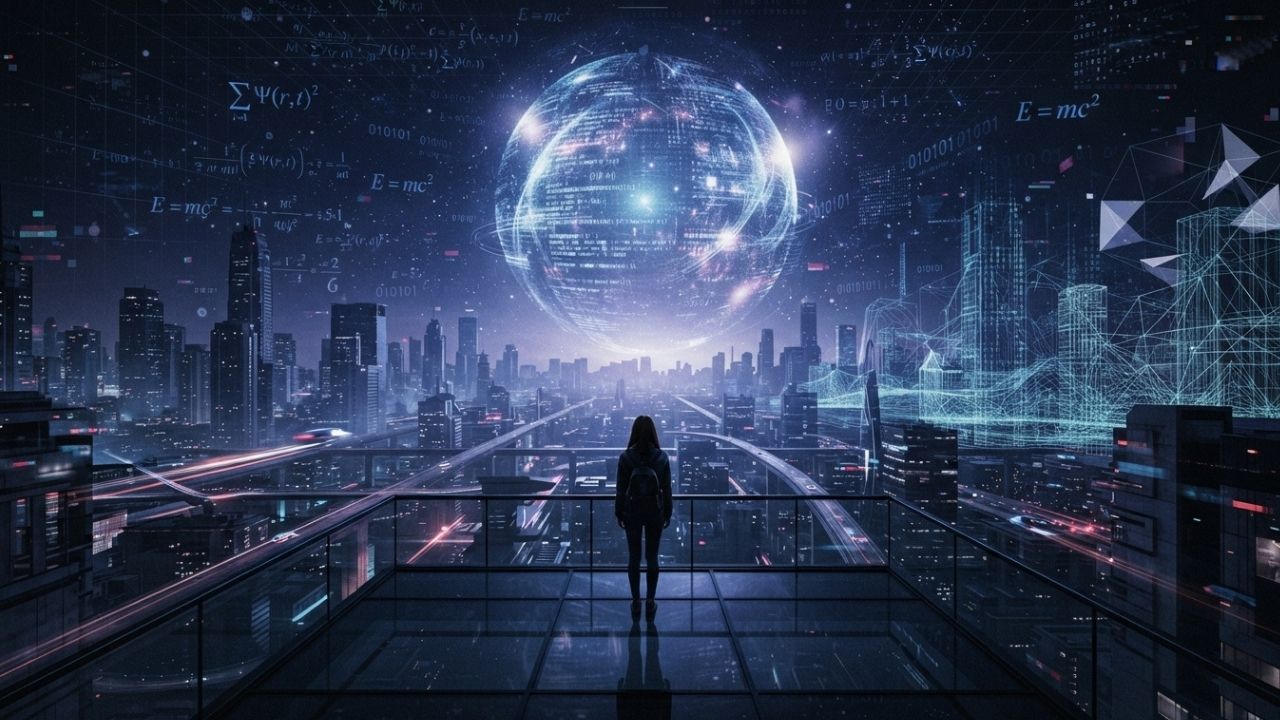
The idea that reality may be a sophisticated simulation has moved from the pages of science fiction into serious philosophical and scientific discussions. What was once a concept associated mainly with futuristic movies, virtual worlds, and dystopian novels is now debated by philosophers, physicists, computer scientists, and technology researchers.
The central question is both simple and unsettling: What if the reality we experience is not the fundamental level of existence, but a constructed environment generated by something more advanced?
There is currently no scientific evidence proving that humanity lives inside a computer simulation. Still, several characteristics of our universe have inspired researchers and thinkers to examine the possibility. Some are related to the mathematical structure of nature. Others involve the apparent limits of physical reality, the strange behavior of quantum mechanics, and the extraordinary progress of computing technology.
None of these observations proves that we are simulated beings. However, taken together, they provide fascinating reasons to ask whether reality could be more complicated than it appears.
Here are six of the most intriguing signs that have fueled the simulation hypothesis.
🧠 1. The Universe Appears Surprisingly Mathematical
One of the most striking features of reality is how effectively mathematics describes it.
From the movement of planets to the behavior of subatomic particles, nature follows patterns that can often be represented using mathematical equations. Gravity, electromagnetism, relativity, quantum mechanics, and other areas of physics rely heavily on mathematical structures.
This has led some thinkers to wonder whether mathematics is merely a language humans invented to describe reality, or whether reality itself is fundamentally mathematical.
The distinction is important.
If mathematics simply helps us organize observations, then the universe does not necessarily resemble a computer. But if the deepest structure of reality is inherently mathematical, some argue that it could be interpreted as information being processed according to precise rules.
This idea becomes especially interesting when considering how much of modern technology depends on mathematical descriptions of the physical world. Engineers can calculate the trajectory of a spacecraft, predict the behavior of materials, design computer chips, and model complex systems because nature behaves according to remarkably consistent rules.
A simulation would also need rules.
A virtual environment cannot function without a defined set of relationships governing what can happen and what cannot happen. In a video game, for example, objects obey programmed physics. A character cannot simply decide to ignore gravity unless the underlying rules allow it.
The universe appears to have similarly consistent boundaries.
The speed of light represents a fundamental limit. Energy and momentum follow conservation laws. Particles interact according to specific rules. Even seemingly chaotic processes occur within a framework of physical laws.
To simulation theorists, this resembles an extraordinarily sophisticated rule-based system.
But there is an important limitation to the argument. Mathematical consistency does not automatically imply computer simulation. Physics may simply be mathematical because mathematics is the most precise language available for describing reality.
The mystery remains.
⚛️ 2. Quantum Mechanics Makes Reality Look Stranger Than Expected
If classical physics makes the universe appear predictable and orderly, quantum mechanics does almost the opposite.
At extremely small scales, nature behaves in ways that challenge everyday intuition. Particles can exist in combinations of possible states, measurements can affect quantum systems, and outcomes are often described in terms of probabilities rather than definite predictions.
One of the most famous examples is the double-slit experiment.
When particles such as electrons are sent toward two narrow openings, they can produce an interference pattern characteristic of waves. Yet when scientists determine which slit a particle passes through, the observed behavior changes.
The experiment does not prove that the universe is a simulation. However, it raises profound questions about observation, information, and the nature of physical reality.
Another intriguing feature of quantum mechanics is that some properties of particles cannot be described as having definite values before measurement in the classical sense. Instead, quantum theory provides probabilities for possible outcomes.
To some observers, this resembles a system that calculates or resolves information only when necessary.
That comparison has become particularly popular in discussions of simulations. A video game does not need to render every possible detail of an enormous virtual environment at maximum resolution if those details cannot currently affect the player’s experience. The system can allocate computational resources where they are needed.
Some people speculate that quantum behavior could represent something similar in the universe.
But this is where caution is essential.
There is no evidence that quantum mechanics is caused by computational limitations. Quantum theory works extraordinarily well as a physical theory, and scientists do not need the simulation hypothesis to explain its predictions.
The resemblance between quantum phenomena and computational concepts is intriguing, but it remains an analogy rather than proof.
💻 3. Technology Is Moving Toward Artificial Worlds
Perhaps the most accessible argument for the simulation hypothesis comes from technological progress.
Humanity has already begun creating increasingly convincing artificial environments.
Video games can generate enormous worlds. Virtual reality systems can place users inside computer-generated spaces. Artificial intelligence can produce realistic images, voices, videos, and interactive characters. Digital environments can respond dynamically to human behavior.
The difference between physical reality and simulated reality may still be enormous, but the direction of technological development is clear.
Consider how rapidly digital graphics have evolved.
Early computer games used extremely simple shapes and limited environments. Modern systems can create virtual landscapes with lighting, physics, characters, weather, and detailed textures that can be difficult to distinguish from photographs in certain circumstances.
Artificial intelligence is accelerating this transformation.
Modern generative systems can produce realistic environments, simulate conversations, reconstruct voices, and generate interactive content. Future systems could potentially create digital worlds containing billions of autonomous entities.
If technological civilizations continue advancing for thousands or millions of years, the computational possibilities could become difficult for us to imagine.
This leads to a famous philosophical argument associated with philosopher Nick Bostrom. His simulation argument suggests that at least one of several possibilities must be true: civilizations may become extinct before reaching the ability to create highly realistic ancestor simulations, advanced civilizations may have little interest in creating them, or simulated conscious beings could eventually vastly outnumber biological beings.
If the third possibility occurred, statistically speaking, an observer might be more likely to exist inside a simulation than in the original reality.
That is not evidence that we are simulated.
It is a probability-based philosophical argument built on assumptions about future civilizations, consciousness, computation, and the number of simulations that might be created.
Still, it forces us to confront an uncomfortable possibility.
If humans could one day create convincing simulated worlds containing conscious observers, why should we assume that no civilization before us has already done so?
🌌 4. The Universe Has Fundamental Limits
Another feature that attracts attention is the existence of apparent limits in nature.
The speed of light is perhaps the most famous example. According to Einstein’s theory of relativity, information cannot simply travel through space at unlimited speed. The universe also appears to have fundamental limits concerning energy, matter, information, and the resolution at which physical processes can be described.
Some physicists have explored the possibility that space and time may have a granular structure at extremely small scales.
The Planck scale, for example, represents a regime where our current theories suggest that classical descriptions of space and time may no longer be sufficient. Scientists do not know whether spacetime is fundamentally continuous or whether there is some deeper structure beneath it.
Simulation enthusiasts sometimes compare such limits to the resolution of a digital system.
A computer screen consists of pixels. A digital image has a maximum resolution. A computational system has finite resources. If reality were simulated, perhaps the universe would also possess a fundamental resolution limit.
This idea is fascinating, but it should not be confused with established physics.
The existence of fundamental physical constants does not mean that the universe is running on hardware. A natural universe can have limits without being simulated.
Nevertheless, the question remains intriguing because information has become increasingly important in modern physics.
Physicists study black holes, quantum information, entropy, and the relationship between information and physical systems. Some theories suggest that information may be more fundamental to our description of reality than previously believed.
If the universe can ultimately be described in terms of information, the conceptual distance between physics and computation becomes smaller.
👁️ 5. Reality Depends on Observation in Strange Ways
Human beings normally assume that objects exist with definite properties whether or not anyone is looking at them.
Quantum mechanics complicates that intuition.
The role of measurement in quantum physics has produced some of the deepest debates in modern science. Different interpretations of quantum mechanics disagree about what the mathematical formalism actually means, but the experimental predictions are remarkably successful.
The famous thought experiment involving Schrödinger’s cat illustrates the conceptual problem. A quantum system can be mathematically described as a combination of possible states until a measurement occurs, although the thought experiment was designed to expose the strange implications of quantum theory rather than suggest that ordinary cats literally behave this way.
This has inspired a popular question: does the universe somehow need observers?
If reality were a simulation, one could imagine that computational resources are concentrated on information that is being observed or that interacts with other parts of the system.
Some speculative interpretations of reality therefore compare consciousness and observation to a user interface.
But once again, this is not established science.
Quantum mechanics does not demonstrate that human consciousness creates reality. In physics, measurement can refer to physical interactions between systems, not necessarily to a person looking at an experiment.
Still, the relationship between observation and reality remains one of the most fascinating unresolved philosophical questions connected to modern physics.
It also highlights a broader mystery: we do not experience the universe directly in all its complexity. We experience a representation constructed by our senses and brain.
Everything we see, hear, touch, and remember is processed information.
In that sense, every human being already experiences reality through an internal model.
🔢 6. The Universe Could Be Built From Information
The final and perhaps most profound clue is the growing role of information in our understanding of the universe.
Computers process information. Living organisms store and transmit information through DNA. Human brains process enormous quantities of sensory information. Communication systems transform information into signals.
Modern physics increasingly treats information as a fundamental concept.
Black holes provide one of the most dramatic examples. Physicists have spent decades examining what happens to information when matter falls into a black hole. The resulting debates have connected gravity, quantum mechanics, entropy, and information theory.
This has contributed to a broader intellectual movement sometimes described as the idea that reality may be fundamentally informational.
If everything in the universe can ultimately be represented as information governed by rules, then the universe begins to look conceptually similar to an information-processing system.
Again, similarity is not proof.
A computer simulation requires hardware, software, an external environment, and an entity capable of creating it. The universe does not currently provide evidence of any of these things existing outside itself.
There is also a major philosophical problem.
If our universe is simulated, what created the reality containing the simulator?
That reality would itself require an explanation.
This could lead to an infinite chain of simulations, sometimes called a simulation regress. Perhaps our universe is simulated by another universe, which is itself simulated by another system, and so on.
Alternatively, there could eventually be a fundamental reality that does not require a simulation.
We simply do not know.
🔬 What Would Actually Prove We Are Living in a Simulation?
The biggest challenge for the simulation hypothesis is scientific testability.
A scientific theory must make predictions that can be tested against observations. If every possible observation can be explained by saying, “The programmers designed it that way,” the hypothesis becomes difficult to falsify.
Researchers have proposed possible tests over the years, including looking for unusual structures in cosmic radiation or unexpected limitations in the behavior of high-energy particles.
However, no experiment has produced convincing evidence that our universe is a computer simulation.
That distinction is crucial.
There is a difference between saying that an idea is possible, saying that it is philosophically interesting, and saying that it is scientifically demonstrated.
The simulation hypothesis currently belongs primarily to the first two categories.
🧩 The Biggest Problem With the Simulation Idea
There is an even deeper issue.
Perhaps the simulation hypothesis tells us more about human technology than about the universe.
Humans naturally explain unfamiliar systems using familiar concepts. In ancient times, people compared the universe to machines, clocks, organisms, or divine creations. Today, because computers dominate our technological imagination, we increasingly describe reality using computational language.
That does not necessarily mean the universe is a computer.
It may simply mean that computers are the most powerful metaphor available to us.
The same pattern has appeared throughout history. When new technologies emerge, people often use them to explain consciousness, nature, and existence itself.
The brain has been compared to a telephone switchboard, a hydraulic system, a machine, and now a computer.
The universe may be no different.
🌍 So, Are We Living in a Simulation?
At present, there is no reliable scientific evidence demonstrating that we are.
The six signs discussed here are better understood as philosophical clues and intriguing parallels than as proof. The mathematical structure of nature, quantum mechanics, technological progress, physical limits, the role of observation, and the importance of information all raise profound questions about what reality actually is.
But none of them establishes the existence of a cosmic computer.
Perhaps the universe is a simulation.
Perhaps reality is fundamentally mathematical.
Perhaps consciousness is a phenomenon we do not yet understand.
Or perhaps the universe is simply stranger than any analogy humans have invented.
There is another possibility that may be even more important.
The question itself could change the way we think about reality.
If we eventually discover that the universe is simulated, one of the greatest scientific revolutions in history would follow. If we discover that it is not, the investigation could still reveal extraordinary things about physics, consciousness, computation, and the nature of existence.
For now, the simulation hypothesis remains exactly what its name suggests: a hypothesis.
But in a universe where matter can behave like waves, time can slow down, space can bend, and information appears to play a fundamental role in physical law, asking whether reality is exactly what it seems may not be such a strange question after all.