Russia has intensified its diplomacy with the African continent. During the BRICS summit, held last weekend in India, President Vladimir Putin once again highlighted the strengthening of relations with African countries and preparation for the next Russia-Africa Summit, scheduled for October in Moscow.
The movement is not by chance. The African continent has been gaining importance in the Russian strategy of approaching the Global South and strengthening the BRICS, which in recent years have expanded their presence on the international scene. And, within this movement, the African Sahel region occupies a unique place.
The geopolitical landscape of the Sahel has undergone a transformation. The countries Burkina Faso, Mali and Niger have been seeking greater autonomy in relation to former colonial powers and diversifying their international partnerships.
In an interview with Brazil in factactivist Joseph Thiombinao, from Burkina Faso, states that the processes currently taking place in the Sahel region are linked to a demand for greater sovereignty and the “right of Sahel countries to make their own strategic choices”.
“I believe that what is happening in the Sahel can be understood, to a large extent, as a rupture with certain aspects of the colonial and post-colonial order. […] For many years, security, economic and diplomatic relations in the region have been largely shaped by external partners. Today, Burkina Faso, Mali and Niger are seeking to regain greater control over these areas and redefine their relations with the outside world”, he argues.
In this context, Russia has been inserting itself as a relevant actor in the region. The turning point for this geopolitical restructuring was the withdrawal of French forces from Mali, Burkina Faso and Niger.
“The geopolitical landscape of the Sahel has changed considerably in recent years. The withdrawal of French forces from Mali, Burkina Faso and Niger marked the end of a security arrangement that dominated the region for decades. At the same time, Russia has become an important strategic partner for the AES countries, particularly in the security and military-technical areas.”
The assessment helps to establish a bridge between the Sahel countries’ demand for greater autonomy and the space occupied by Russia in this process. For Moscow, the region has come to represent not only an opportunity to expand its presence on the continent, but also one of the main points of contact with African governments seeking to reduce their dependence on former colonial powers.
It is precisely this combination of interests that, in the opinion of political scientist Vladimir Shapovalov, from the Moscow State Pedagogical University, helps to explain the rapprochement between Russia and the Sahel countries. In an interview with Brazil in factthe analyst notes that, in recent years, Russia has managed to significantly increase its “social and political capital” in relations with African countries.
“The Sahel region is one of Russia’s most important partners, for the simple reason that, on the one hand, there is a need among the people of the region. The political elites who came to power in the region’s countries clearly need Russia’s help to free themselves from colonial dependence on France and the United States”, he states.
The rapprochement, however, is not restricted to the political dimension. Security cooperation has become one of the most visible aspects of the relationship, in a region marked by the activity of jihadist groups and a succession of military coups that altered the external alliances of Burkina Faso, Mali and Niger. In this context, Russia also questions the Western military presence and points to the permanence of forms of influence inherited from colonialism.
Coup processes that took place in Burkina Faso, Mali and Niger accelerated this change. By breaking with the former French influence, the three countries began to seek new partners to face security and stability challenges. In this sense, Russia has been occupying a prominent place, expanding its military operations through the private military organization “Afrika Corps”, which came under the control of the Russian Ministry of Defense after the dissolution of the Wagner Group.
The Africa Corps was structured by the Russian Ministry of Defense and began to concentrate part of the operations and contingents that were previously associated with the Wagner Group in African countries. In the Sahel, its operations are mainly linked to military cooperation and support for local government security forces.
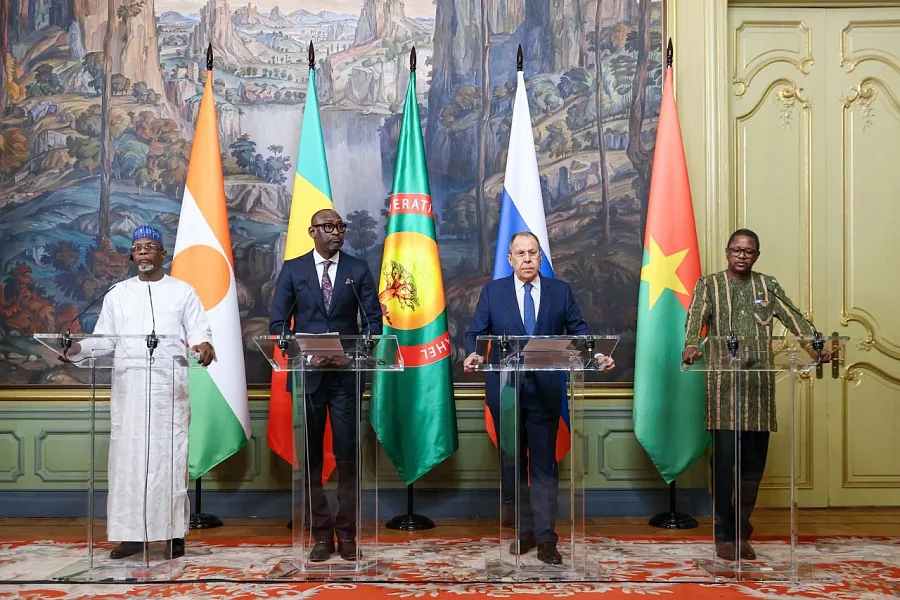
For Moscow, the presence of the Russian contingent occurs following official requests from African governments and its main justification is to combat armed groups operating in the region. It is this interpretation that Russian Foreign Minister Serguei Lavrov presented when commenting on the Africa Corps’ performance in August.
“As you know, the Africa Corps of the Russian Ministry of Defense operates completely legally, in response to official requests from legitimate African governments, and carries out the tasks assigned to its units by these governments. These tasks mainly include repelling terrorist attacks, including those planned by some countries that are unable to accept the loss of their colonial influence in Africa,” he stated.
“It is no secret that France is involved in this, working directly with illegal armed groups — arming them, financing them and guiding them. Above all, it guides them in creating problems for those countries — in this case, the Sahara-Sahel region — that have decided to definitively, completely and irrevocably break with their former colonizers and consistently follow this path,” the Russian Foreign Minister added.
The statement summarizes the narrative presented by Moscow for its actions in the Sahel, highlighting a partnership requested by the African governments themselves and focused mainly on security, amid the process of breaking with old colonial alliances.
But the Russian presence in the region is not limited to the military field. At the same time as expanding security cooperation, Moscow seeks to deepen relations in sectors such as energy, mining, agriculture, infrastructure and professional training, including the Sahel in a broader strategy of rapprochement with the African continent and the Global South.
For activist Joseph Thiombinao, the challenge is to transform openness to new partners into an effective autonomy strategy.
“More broadly, the arrival of new partners can increase the region’s strategic room for maneuver. States are no longer necessarily dependent on a single external security or geopolitical partner. But there is an important principle that must guide this process: sovereignty cannot simply mean replacing one dependency with another. If the goal is genuine strategic autonomy, the Sahel must be able to diversify its partnerships, negotiate based on its own interests and maintain control over its strategic decisions,” he said.
The same concern extends to the exploration of natural resources, an area that has also been gaining ground in the rapprochement between African countries and new international partners. For the activist, the foreign presence can only be considered advantageous if it contributes to the development of the region’s own economies.
In Thiombinao’s assessment, therefore, the growing Russian presence must be understood within a broader change in the region’s geopolitical balance, and not simply as a new relationship of dependence.
“Therefore, I see Russia’s growing role as part of a broader geopolitical rebalancing. It can contribute to greater autonomy, but the long-term objective should be to build stronger national and regional capabilities, rather than permanent dependence on any external power.”
The connection to the Ukraine war
The rapprochement between Russia and the Sahel countries is also part of a geopolitical dispute that goes beyond the region. Since the start of the war in Ukraine, Moscow has sought to expand its relations with countries in the Global South, while accusing Western powers of trying to preserve their political and economic influence in Africa.
In this context, Africa also began to occupy an important place in the narrative dispute surrounding the war. Russia seeks to present its rapprochement with African countries as part of a process of building a more multipolar international order, while accusing Western countries of using different instruments to maintain their influence over the continent.
Furthermore, Moscow accuses Kiev of expanding its operations on the African continent and supporting armed groups that fight governments allied with Russia in the Sahel.
The accusations gained greater repercussion after clashes in Mali, where armed groups linked to the insurgency in the region entered into combat with Malian forces and members associated with the Russian contingent. The Russian government then began to accuse Ukraine of providing support to groups acting against its African partners. Kiev, in turn, rejects the Russian characterization of its actions and also presents its African policy from the perspective of dispute with Moscow.
For political scientist Vladimir Shapovalov, Ukrainian action on the continent represents an extension of the conflict beyond European territory. It is in this context that the analyst warns of “operations by illegal armed groups from abroad that are also using Ukrainians, not mercenaries, but military personnel”.
“This means that we are no longer talking about isolated terrorist attacks, but about state terrorism against the Sahel countries. In the spring, there was a serious attack by the illegal militias I mentioned, supported by Ukraine, against Mali,” says Shapovalov.
Moscow’s accusation places the Sahel within a dispute that goes beyond African borders. For Russia, the conflict in Ukraine and the competition for influence on the continent are part of the same geopolitical confrontation with Western powers.
Source: www.brasildefato.com.br