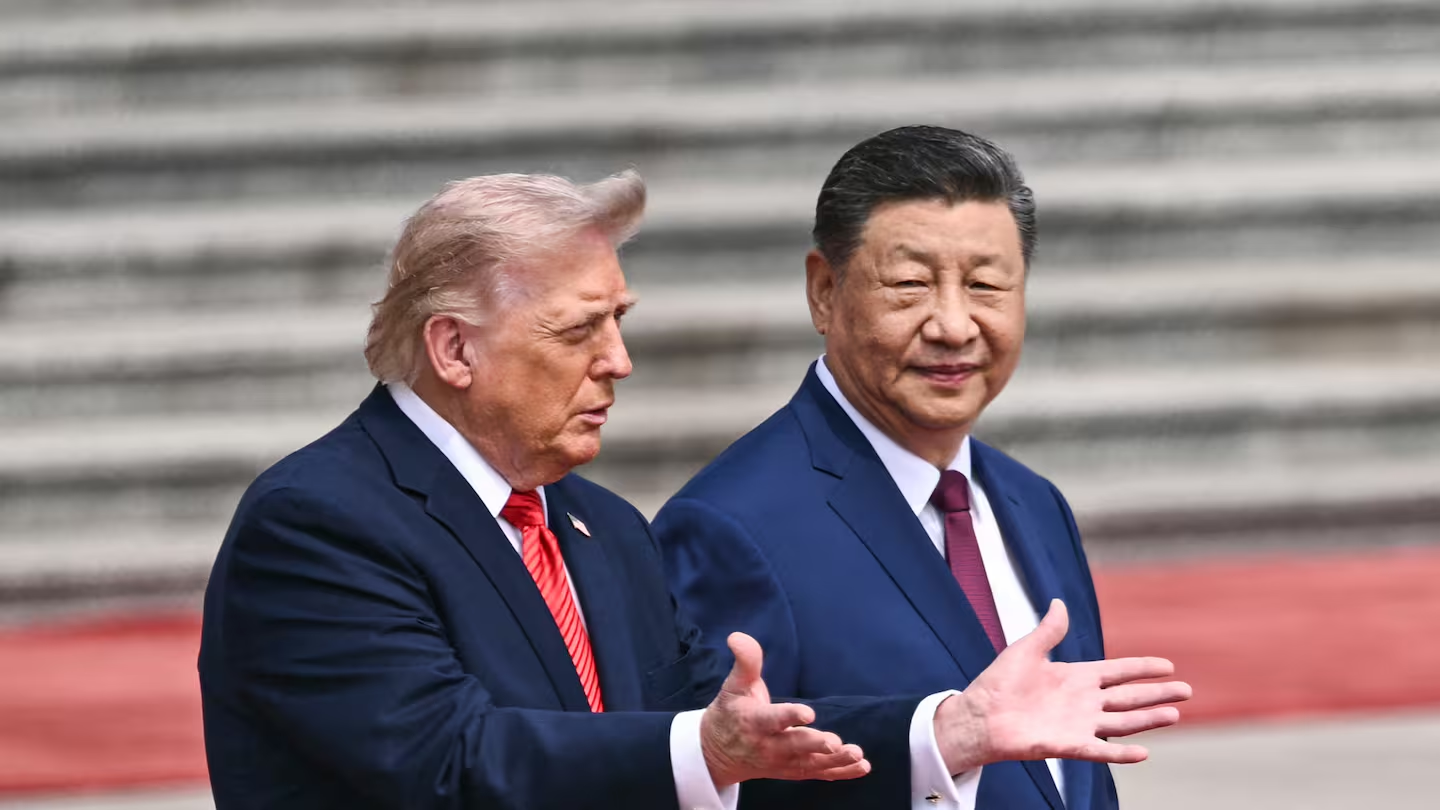
Chinese President Xi Jinping began an official visit to the United States this Wednesday (23), at the invitation of President Donald Trump. The main event of the trip will be the meeting between the two leaders, scheduled for Thursday (24), in Washington. The visit comes four months after Trump traveled to China in May, at a time of efforts by both governments to manage tensions and preserve stability in the bilateral relationship.
Relations between the world’s two largest economies continue to be marked by disputes in areas such as tariffs and trade, technology, artificial intelligence, rare earths and other critical minerals. Taiwan also remains one of the main strategic issues in the relationship between Beijing and Washington. At the same time, the two governments have sought to maintain negotiation channels and avoid further escalation.
In an exclusive interview with Brazil in factheld in Beijing on the eve of the meeting, Professor Zhao Hai, director of International Political Studies at the National Institute for Global Strategy, of the Chinese Academy of Social Sciences (CASS), analyzes the prospects for the meeting and the main challenges of the China-US relationship.
An expert in China-US relations and strategic issues in the Asia-Pacific, Zhao talks about the meaning of the meeting, trade and technological disputes, Taiwan, the impact of the bilateral relationship on the Global South, China’s role in the international order and the possibility of Chinese action in negotiations involving Iran and the United States.
Check out the full interview:
Brazil in fact: How important is the meeting between Xi Jinping and Donald Trump for relations between China and the United States?
Zhao Hai: President Xi has just left China and is on his way to Washington, DC, in the United States. This visit is extremely important at a very significant time in world history because President Trump visited China just a few months ago in May.
The two sides agreed to establish a relationship of constructive strategic stability, which is very important because it was the first time that both sides agreed on how to define the bilateral relationship. Furthermore, the two sides agreed to maintain peace, stability and peaceful coexistence with each other.
This is very important because, in reality, there are people in the United States pushing to suppress China’s development and trying to contain the country, just as happened during the Cold War against the Soviet Union. China stood up against pressure from the United States, fought for its own sovereignty and defended its own interests. And he was very successful in standing up to American imperialism.
So that’s success, in my opinion. President Xi’s visit to the United States demonstrates that China has been successful in dealing with the American strategy.
Going forward, I think the next step, naturally, is to ensure that stability continues and to ensure that the United States does not take further action against China. Therefore, negotiation and communication between the two main leaders are very important at this time.
Trade disputes have largely given way to technological competition between China and the United States. How important are topics such as tariffs, artificial intelligence, rare earths and critical minerals at the meeting?
Apparently, the first Trump administration started the trade war with China. So the first stage of friction was over tariffs and trade barriers. However, I think we are now entering a second stage where technological competition is becoming more important.
Apparently, the Americans are very concerned about China’s advances in artificial intelligence and are using all kinds of measures, including export controls and now also import measures, to contain Chinese development.
China has used countermeasures to respond, including rare earths and other measures against US companies. And now I think we’re reaching an impasse, a kind of balance.
This is why both sides agree to maintain stability at this time, to ensure that China does not use rare earths and other countermeasures to disrupt American supply chains, and that the United States does not cut off China’s supply chains either. So now it’s kind of a ceasefire situation.
Do you expect any substantial changes in the relationship between the two countries after the meeting?
There will be no substantial change in the bilateral relationship. There will be no significant deviation from the current trajectory.
Let’s go back a little, because I think China’s main objective right now is to maintain stability. Previously, there was a downward spiral in the bilateral relationship. The situation was getting worse and there was a risk that the two sides could get into some kind of conflict. Now, the situation is improving, which means both sides are avoiding moving towards escalation or direct conflict with each other.
Whether it’s trade and tariffs, technology, rare earths, critical minerals, or geopolitics and many other issues, I think we can all agree that right now, for the sake of both countries and also for global peace and stability, we need to come to an agreement. This is why President Xi’s visit to the United States at this time is very important.
Looking back at the last few months, a lot of things have happened in the world, right? Lots of turbulence, chaotic situations and wars breaking out. So I think the two largest countries, the two largest economies, maintaining stability will play a key role in ensuring that peace is maintained on a broader scale around the world.
Taiwan is another of the most sensitive topics in the China-US relationship. What do you expect Xi Jinping to say to Trump about the issue?
Well, there is a very long and complex history involving Taiwan. But first and foremost, Taiwan is China’s internal issue. There is a civil war that, until now, has not ended.
I think the basic situation is that the United States and the world, the vast majority of countries in the world, recognize that Taiwan is part of China, and China is now seeking ultimate reunification with Taiwan. In Trump’s last visit to Beijing, I think President Xi gave him an explanation of the history of Taiwan, China’s position on the Taiwan issue, and China’s opposition to continuing and increasing US arms sales to Taiwan.
Going forward, I think this time, when President Xi visits the United States, he will continue to emphasize the importance of the United States complying with the three joint communiques signed between the United States and China. He will also continue to warn of the serious consequences of US arms sales to Taiwan, especially offensive weapons.
And he will also tell President Trump that China will continue to pursue the goal of reunification, and that the United States should not and cannot prevent that eventual outcome.
The point is that China will pursue this peacefully. I think this is a point that both sides need to understand better.
In addition to the bilateral relationship, what impact can greater stability between China and the United States have on international peace and the Global South?
First, China is now a global country. It has global interests. China is the main trading partner of more than 120 countries and has investments around the world. So, it is clear that China is very concerned about global peace, stability and prosperity. This serves both our own interests and the interests of our partners around the world.
Secondly, I think China needs to take responsibility and wants to provide public goods to the world. Because now, if we think about the Middle East, Africa and even Latin America, there are still ongoing conflicts, as well as repression and exploitation.
In many ways, China wants to use its own development history to show other countries that they can learn from Chinese history, culture and experience and develop their own countries. This way, we can move forward together. Therefore, the Global South must work together to improve the living conditions of its populations.
Furthermore, for hundreds of years, the West was dominant, and the global order was established without true consultation with the Global South. Now, I think China, as a member of BRICS, the Shanghai Cooperation Organization and many other Global South partnerships, wants to promote the voice of the Global South and also take responsibility to play a constructive role in helping all other countries develop together.
That’s why President Xi put forward four global initiatives, including development, security, civilization and global governance. And if we look at these initiatives, China really wants to present its own history and its own experience to many developing countries and help them grow together.
You also see contradictions in the United States’ strategy. How does China interpret Washington’s role in the international order and in Latin America?
I think there are many contradictions in the US strategy. On the one hand, Americans say: “The world is not our problem. America first.” Therefore, they want to transfer certain responsibilities to their partners and allies.
At the same time, they are applying the so-called Monroe Doctrine, trying to dominate Latin America and the Western Hemisphere. Therefore, they continue with their internal interference and economic exploitation.
I think China’s message to the world, as well as to the leaders and people of the United States, is that the United States should be a normal state in the world, not a country that can dominate and try to suppress other countries. All countries must be equal in terms of sovereignty.
Therefore, it is very important that the United Nations General Assembly meets this week and that leaders from all over the world are present. It is, basically, a direct message to the United States and, subsequently, through bilateral channels, that American power has limits. The United States can no longer dominate other parts of the world.
I think the faster the United States adapts to its new role, the better.
You mentioned international conflicts. Could the issue of Iran appear in the conversation between Xi Jinping and Donald Trump? And what could China’s role be?
Well, firstly, in principle, China always advocates a peaceful solution through a political settlement. Therefore, from the Chinese perspective, negotiation should always be the first and only option to resolve any conflict.
But specifically in the case of Iran, the United States tried to bomb Iran and use military means to subdue the country, but failed. And until now, because of this failure, the Strait of Hormuz remains closed, and the world market and the international community, including the American people, are suffering from the effects of higher energy prices.
It is clear that China wants to defend peace. And right now, I think political negotiation and a peaceful solution are also the only option for the United States. If they want to restart the war and use more military means to resolve the situation, things will only get worse, and other Gulf countries and neighboring countries will also suffer the consequences of the military conflict.
Therefore, I think the only effective way is through negotiations, either directly between the two sides or with the mediation of Pakistan, Qatar and other countries. And China will play a very constructive role in bringing the two sides closer together and achieving the ultimate goal of peace.
China has done this before. Let’s remember that, a few years ago, there was the JCPOA, the agreement between the five countries plus one. At that time, China played a very constructive role behind the scenes in helping the two sides reach an agreement. Now I think China can do it again.
Source: www.brasildefato.com.br