Published 04/14/2026 11:19 | Edited 04/14/2026 19:10
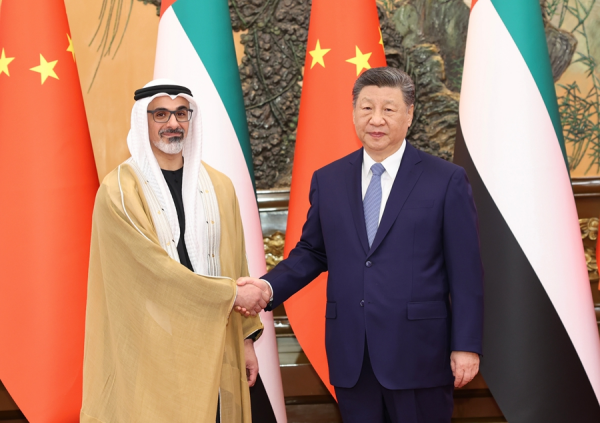
In an unprecedented diplomatic move, President Xi Jinping presented this Tuesday (14), a four-point proposal for peace and stability in the Middle East. The announcement, made during a meeting in Beijing with the Crown Prince of Abu Dhabi, Sheikh Khaled bin Mohamed bin Zayed Al Nahyan, marks the Chinese leader’s first direct and personal initiative to mediate the regional conflict, historically dominated by the influence of the United States and Israel.
The proposal comes at a time of extreme tension, coinciding with the total military blockade imposed by the Donald Trump government on the Strait of Hormuz. In a practical defiance of Washington’s sanctions, the Chinese oil tanker Rich Starry crossed the strait on the same day as the announcement, becoming the first vessel to break the American siege under the justification of protecting trade flow and international law.
Points of the peace plan
Beijing’s plan is based on adherence to peaceful coexistence through a common and sustainable security architecture, in absolute respect for national sovereignty e territorial integrity, in defense of international law to avoid what Xi called the “law of the jungle” and in close coordination between economic development and regional security. By linking peace to the crisis in Hormuz, China positions itself as a mediator seeking global consensus, contrasting its diplomatic stance with the policy of sanctions and blockades. Official sources highlight that although China has previously presented joint proposals, such as the five-point plan with Pakistan in March, This is the first time that Xi has personally taken the lead in a structural solution for the regionconsolidating Beijing’s role as guarantor of stability.
Positive reaction from most nations in Europe and the Middle East
The international community reacted with a mix of pragmatism and openness. Iran called China and Russia “true friends” and reliable guarantorsas leaders Europeans demonstrated receptivity. The Spanish Prime Minister, Pedro Sánchez, on a visit to Beijing, classified China as an “indispensable mediator” to stop the war escalation. In the United Kingdom, the Prime Minister Keir Starmer adopted a stance of “strategic realism”; despite pressure from Washington, Starmer argued that engagement with China is in Britain’s national interest to avoid economic collapse and protect shipping lanes, even refusing to initially participate in attacks against Iran. Kaja Kallas, head of EU diplomacy, reiterated that the bloc sees China as an essential partner for dialogue, prioritizing energy security over direct confrontation. Brazil also reinforced its diplomatic stance through Chancellor Mauro Vieira, who condemned attacks from both sides and defended an immediate ceasefire, highlighting the inflationary risks of the crisis.
After successfully testing passage through the strait, the oil tanker Rich Starry, operated by Shanghai Xuanrun Shipping bound for China, began maneuvers to return to the Middle East, amid the blockage, for reasons that have not yet been confirmed, Reuters reported.
By securing the support of powers from the Global South and the condescension of the US’ European allies, Xi Jinping not only proposes a peace agreement, but lays the foundations of a new order of governance in the Gulf, where security is treated as a common good and economic development serves as the main pillar against war.
Source: vermelho.org.br