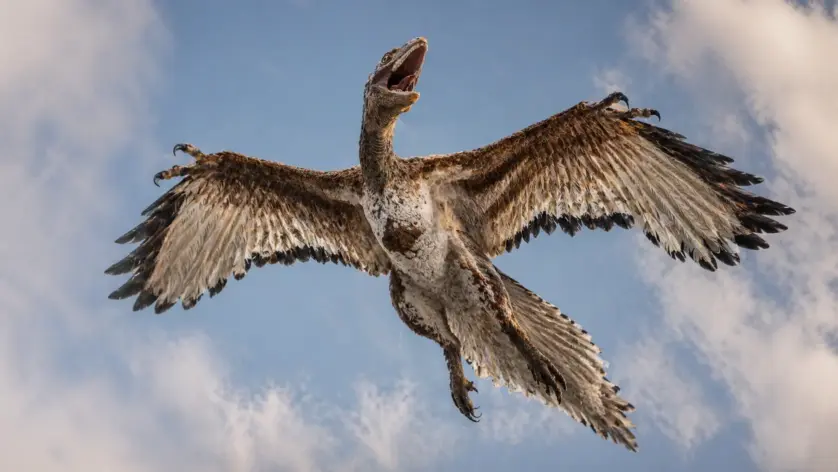
For generations, dinosaurs occupied a distant mental shelf reserved for vanished giants. They belonged to a prehistoric world of volcanic skies, fern forests, and catastrophic extinctions. Birds, meanwhile, were treated as something entirely separate: delicate creatures of feathers, songs, migration, and flight. One group seemed monstrous and ancient. The other felt familiar and alive.
Modern paleontology demolished that division.
Birds are not merely descendants of dinosaurs in the loose sense that humans descend from mammals or mammals descend from reptile-like ancestors. Birds are dinosaurs. More specifically, they belong to the theropod branch, the same major lineage that produced predators such as Tyrannosaurus rex, Velociraptor, and Deinonychus. Chickens and tyrannosaurs are not identical creatures separated by time, but they are relatives on the same evolutionary tree.
That realization transformed one of the most famous animals in history. Dinosaurs were no longer just giant reptiles doomed to extinction. Some survived. They adapted, diversified, and still fill the skies of every continent on Earth.
The evidence behind this conclusion did not emerge all at once. It developed over more than a century through fossil discoveries, anatomical comparisons, chemical analysis, and astonishingly preserved remains from places that seemed almost designed by geology to preserve secrets from deep time.
At the center of this scientific revolution stood feathers.
The Fossil That Changed Everything
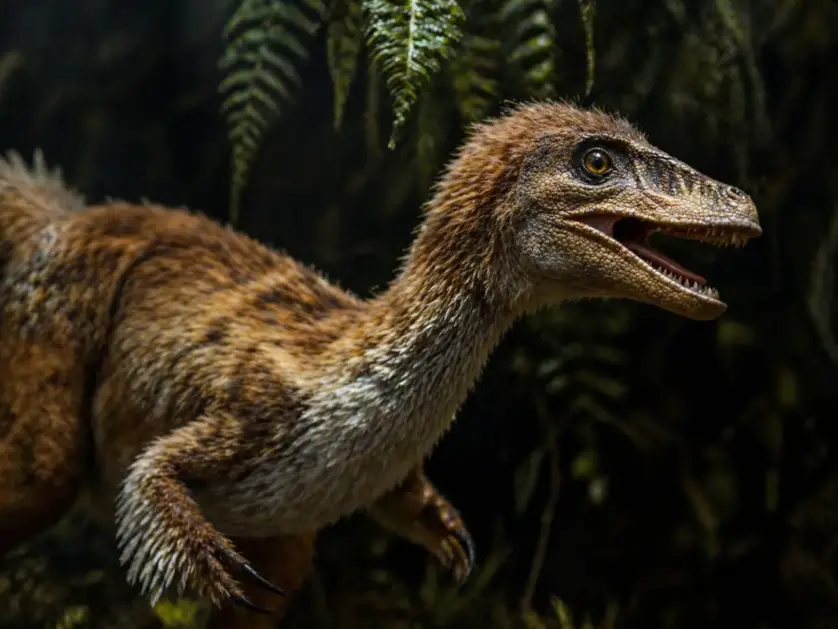
The connection between birds and dinosaurs was suspected long before modern technology could confirm it. In 1861, a fossil discovered in Germany introduced a strange and unsettling creature to science: Archaeopteryx.
It looked almost impossible.
The animal possessed feathers and wings resembling those of modern birds, yet it also carried unmistakably reptilian features. It had teeth. It had a long bony tail. It had clawed fingers on its wings. Archaeopteryx appeared to stand directly between two worlds.
For some scientists, that fossil became one of the strongest pieces of evidence for evolution itself. Thomas Henry Huxley, a contemporary and defender of Charles Darwin, noticed similarities between Archaeopteryx and small predatory dinosaurs. He argued that birds and dinosaurs were deeply connected.
Yet the theory remained controversial for decades.
The main problem was simple: Archaeopteryx could be dismissed as an isolated oddity. Critics argued that one unusual fossil was not enough to prove that birds evolved from dinosaurs. What paleontologists truly needed was a non-avian dinosaur, clearly terrestrial and unmistakably dinosaurian, preserved with feathers or feather-like structures.
That evidence would not appear until more than a century later.
And when it arrived, it came from northeastern China.
China’s Dinosaur Pompeii
The province of Liaoning does not immediately resemble one of the most important paleontological sites on Earth. Today, much of the region consists of quiet hills, farmland, and small towns. During the Jurassic and Cretaceous periods, however, the landscape was violently unstable.
Volcanic eruptions repeatedly covered lakes and forests in fine ash and mud. Organisms were buried with extraordinary speed, sometimes so rapidly that delicate tissues survived long enough to fossilize before decay could destroy them.
The result was one of the greatest fossil archives ever discovered.
Scientists eventually uncovered fish, insects, plants, mammals, birds, and dinosaurs preserved with astonishing detail. Soft tissues, skin impressions, and feather-like structures survived in forms almost unimaginable in traditional fossils.
Then came Sinosauropteryx.
Formally described in 1998, Sinosauropteryx was a small theropod dinosaur roughly the size of a chicken. Its skeleton alone would have been important, but what surrounded the body caused an international sensation.
Fine filaments extended across much of the animal’s body, forming what looked like primitive fuzz or down.
This was not a bird.
Sinosauropteryx lacked wings adapted for powered flight. It was a terrestrial carnivorous dinosaur, a member of the coelurosaur lineage. Yet it possessed filamentous covering strongly resembling early feathers.
That discovery changed everything.
The fossil had originally been found in 1996 by a Chinese farmer named Yumin Li. According to accounts later described by paleontologist Steve Brusatte, photographs of the specimen circulated during a Society of Vertebrate Paleontology meeting in New York and immediately shocked specialists.
For decades, feathers had been associated almost exclusively with birds. Suddenly, a non-avian dinosaur wore them too.
The implications were enormous.
Feathers Before Flight
One of the most important lessons from Sinosauropteryx was that feathers did not necessarily evolve for flight.
That conclusion overturned popular assumptions about bird evolution.
If a ground-dwelling carnivorous dinosaur possessed feather-like structures without the ability to fly, then feathers must have served earlier functions before becoming aerodynamic tools. Evolution rarely invents structures for a single purpose from the beginning. Instead, features often emerge for one role and later become useful for another.
In small dinosaurs, primitive feathers may have functioned primarily as insulation. Warm-blooded or highly active animals benefit enormously from retaining body heat. Filamentous coverings could have helped stabilize temperature, particularly in cooler environments.
Feathers also likely played visual roles.
Modern birds use plumage for communication, courtship, intimidation, camouflage, and species recognition. Dinosaurs may have done the same. Bright displays, patterned tails, or unusual feather arrangements could have influenced mating success or social behavior long before flight entered the picture.
Once feathers already existed, some lineages eventually adapted them for gliding, balance, maneuverability, and ultimately powered flight.
Evolution works through modification, not sudden invention.
The Dinosaur Renaissance
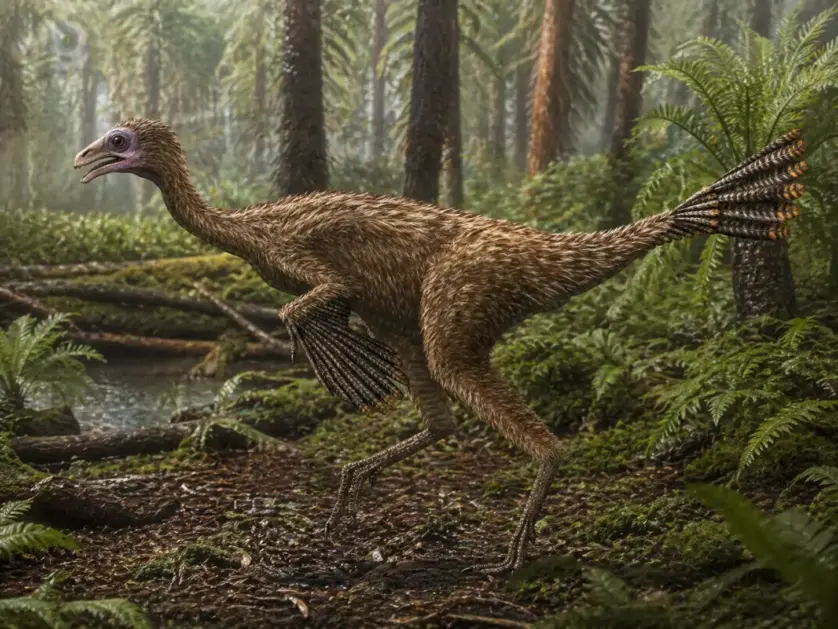
The groundwork for this revolution had actually begun earlier in the twentieth century.
In the 1960s, Yale paleontologist John Ostrom studied a predator called Deinonychus. Unlike the sluggish, tail-dragging reptiles popularized in old museum displays, Deinonychus appeared agile, fast, and highly active. It possessed bird-like wrists, lightweight bones, and a body plan suggesting dynamic movement.
Ostrom argued that many dinosaurs were energetic and behaviorally complex. His work helped trigger what became known as the Dinosaur Renaissance, a major shift in how scientists understood dinosaur biology.
Still, the feather question lingered.
Without direct evidence of feathers in non-avian dinosaurs, skepticism remained possible. Archaeopteryx alone was not enough to settle the issue for everyone.
Sinosauropteryx changed the debate from theoretical to physical.
It placed feather-like structures on a dinosaur that could not realistically be mistaken for a primitive bird.
That distinction mattered enormously.
The discovery became front-page news around the world. Even major newspapers treated it as a scientific breakthrough with broad cultural significance. Dinosaurs were no longer just giant reptiles. They had become something stranger, more dynamic, and far more bird-like than previous generations imagined.
A Growing Gallery of Feathered Dinosaurs
After Sinosauropteryx, discoveries accelerated rapidly.
Liaoning and surrounding regions began producing an extraordinary diversity of feathered dinosaurs. Some possessed simple filaments. Others displayed branching structures. Still others carried fully formed feathers remarkably similar to those of modern birds.
Each new fossil added another piece to the puzzle.
Caudipteryx possessed symmetrical feathers arranged on its arms and tail, despite being incapable of true flight. Microraptor shocked researchers by displaying long feathers not only on its forelimbs but also on its hind limbs, creating a four-winged appearance unlike anything alive today.
Beipiaosaurus exhibited elongated filamentous structures. Dilong, an early relative of tyrannosaurs, showed evidence of feather-like covering. Yutyrannus, a giant predator related to tyrannosaurs and measuring nearly nine meters long, preserved evidence suggesting large feathered carnivores once existed.
That did not necessarily mean every adult Tyrannosaurus rex looked like a giant fuzzy bird. Large animals lose heat differently than small ones, and scaling matters in biology. Yet the discoveries proved that the tyrannosaur family was evolutionarily connected to feathered ancestors.
The classic image of dinosaurs as uniformly scaly reptiles became increasingly outdated.
Instead, paleontologists began envisioning ecosystems filled with animals displaying mixed textures, varied coverings, colors, and complex visual traits.
The prehistoric world suddenly became more alive.
Color Returned to the Past
For many years, dinosaurs in museums and films were typically depicted in muted greens, browns, or grays. Those choices reflected artistic caution more than scientific certainty.
Then microscopic analysis changed the field again.
Researchers began searching fossil feathers for melanossomes, tiny pigment-bearing structures also found in modern bird feathers. Different shapes and arrangements of melanossomes correlate with different colors in living animals.
In 2010, a team including Fucheng Zhang, Michael Benton, Zhonghe Zhou, and Xing Xu published research demonstrating preserved melanossomes in fossil feathers from dinosaurs and ancient birds.
The findings allowed scientists to reconstruct probable color patterns.
Sinosauropteryx appeared to possess a striped tail with reddish and lighter bands. Other fossils suggested iridescent feathers, dark coloration, or patterned plumage.
That discovery mattered for more than artistic reconstruction.
Color reveals behavior.
Camouflage can indicate predator-prey relationships. Bright displays may reflect sexual selection. Contrasting patterns can help species recognition or territorial signaling. Pigmentation transforms fossils from static skeletons into living organisms with ecological roles and behavioral strategies.
Scientists were no longer simply studying bones. They were recovering fragments of prehistoric appearance and social interaction.
The dinosaurs were becoming less alien and more biologically familiar.
The Amber Tail That Seemed Impossible
Even exceptional rock fossils usually flatten organisms during fossilization. Soft tissues compress under geological pressure, reducing three-dimensional structures into thin impressions.
That is why a discovery announced in 2016 attracted enormous attention.
Researchers described a section of feathered dinosaur tail preserved in amber from Myanmar. Unlike flattened rock fossils, amber preserved the specimen in three dimensions.
The fossil included vertebrae, skin, and feathers attached to the same animal.
That detail proved crucial.
Feathers isolated in amber cannot always be confidently linked to specific species. In this case, the preserved tail anatomy demonstrated that the feathers belonged to a non-avian dinosaur.
The feathers themselves were primitive. They possessed branching structures but lacked the aerodynamic arrangement needed for modern flight.
Again, the evidence reinforced the same evolutionary story.
Feathers originated before flight.
Insulation, display, communication, and ornamentation likely came first. Only later did certain dinosaur lineages adapt feathers into aerodynamic structures capable of powered flight.
The amber fossil also carried emotional power. It preserved not just anatomy, but texture and depth. For a moment, the distance between modern life and the Cretaceous seemed to collapse.
This was not merely an impression in stone.
It was part of a dinosaur preserved almost as if time itself had hesitated.
Not Just Carnivores
For a long time, feather-like structures appeared mostly associated with theropods, the carnivorous dinosaur group closest to birds.
Then paleontologists discovered Kulindadromeus in Siberia.
Kulindadromeus belonged to Ornithischia, a different major dinosaur lineage that included many herbivores. The animal displayed both scales and feather-like structures across different regions of its body.
The implications were profound.
Either feather-like coverings evolved very early in dinosaur history and spread widely among multiple groups, or they evolved independently more than once.
Both possibilities were remarkable.
If filamentous coverings were ancestral to many dinosaurs, then paleontologists may need to rethink the appearance of numerous species traditionally reconstructed as entirely scaly.
If similar structures evolved repeatedly, that would demonstrate an extraordinary evolutionary flexibility in dinosaur skin and body coverings.
Either way, the simplistic image of dinosaurs became increasingly difficult to defend.
Dinosaurs were not visually uniform animals. Some had scales. Some had fuzz. Some had complex feathers. Some likely combined multiple body coverings in intricate patterns.
The diversity of dinosaur appearance may have rivaled or exceeded that of modern birds and mammals.
Why Birds Survived
Understanding that birds are dinosaurs answers one major question. It immediately raises another.
Why did birds survive when all other dinosaurs disappeared?
Around 66 million years ago, an asteroid impact near present-day Mexico triggered one of the most devastating extinction events in Earth’s history. Dust, smoke, climate disruption, collapsing food chains, and ecological chaos spread across the planet.
Non-avian dinosaurs vanished.
Yet some bird lineages survived.
Scientists continue debating the exact reasons, but several likely factors emerge repeatedly.
Size mattered.
Many surviving birds were relatively small animals requiring less food than giant dinosaurs. In collapsing ecosystems, reduced energy demands become a critical advantage.
Diet flexibility also helped.
Birds capable of consuming seeds, insects, scavenged material, or varied food sources may have adapted better to unstable environments. After forests burned and vegetation patterns changed, specialized feeders likely suffered more than generalists.
Flight may have contributed as well.
The ability to travel rapidly between habitats could improve survival during environmental catastrophe. Birds capable of exploiting scattered resources possessed advantages unavailable to many ground-dwelling animals.
Some researchers emphasize seeds as especially important. Seeds can persist in damaged ecosystems longer than fresh vegetation or fruit. Birds with strong beaks and flexible feeding behavior may have found temporary refuge in food sources that remained available after the impact winter.
Not all birds survived, however.
Many ancient bird lineages disappeared alongside other dinosaurs. The birds alive today descend from the few groups that successfully navigated that catastrophic bottleneck.
Their survival shaped the modern world.
The Dinosaurs Outside the Window
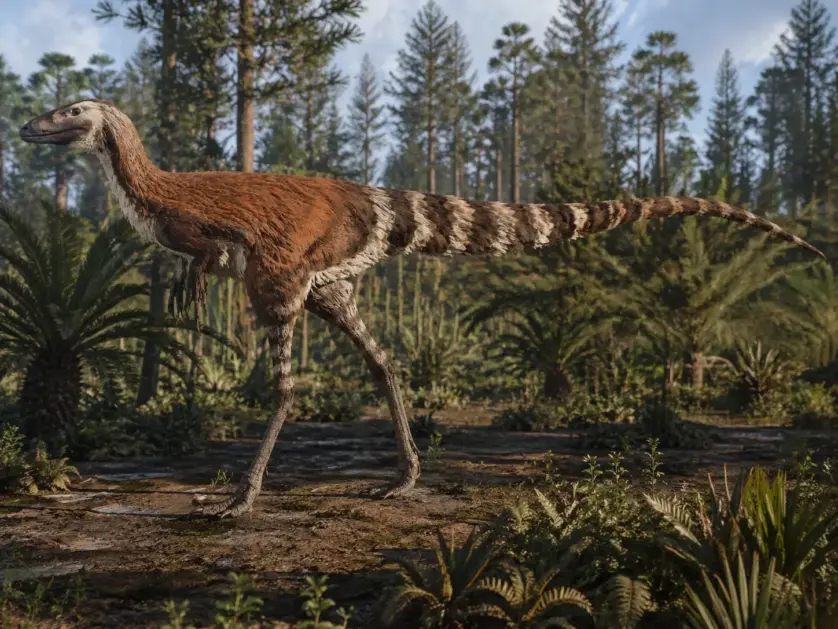
Today, more than 10,000 bird species inhabit Earth.
They range from hummingbirds smaller than a human hand to ostriches taller than many people. They soar over oceans, dive beneath water, migrate across continents, and solve complex problems.
Crows use tools. Ravens remember human faces. Parrots mimic speech. Pigeons navigate astonishing distances. Eagles dominate skies. Penguins transformed wings into flippers and returned to marine life.
All of them are dinosaurs.
Modern birds possess highly specialized anatomy. Teeth disappeared and were replaced by beaks. Bones became lighter and more pneumatic. Air sacs increased respiratory efficiency. Feathers diversified into extraordinary forms adapted for insulation, waterproofing, display, stealth, and flight.
Yet beneath those adaptations, their dinosaur ancestry remains visible.
Bird legs retain the posture of theropod dinosaurs. Their eggshells, nesting behavior, bone structure, and even sleeping positions preserve ancient evolutionary heritage. Some birds still display clawed wings during development. Others exhibit scales on their feet, reminders of reptilian ancestry embedded within modern anatomy.
The line between past and present becomes thinner the more closely one looks.
A New Image of Dinosaurs
The scientific transformation of dinosaurs reshaped popular imagination as much as academic understanding.
Older depictions portrayed dinosaurs as lumbering failures: giant reptiles too primitive to survive changing conditions. Modern paleontology instead reveals a dynamic evolutionary success story spanning more than 160 million years.
Dinosaurs dominated terrestrial ecosystems longer than mammals have existed as a major group.
They evolved enormous diversity in size, diet, behavior, and appearance. Some became towering herbivores with necks longer than buses. Others developed razor-sharp predatory adaptations. Some evolved feathers, warm-blooded metabolism, complex social behavior, and eventually flight.
Birds are not evolutionary afterthoughts.
They are the continuation of one of Earth’s greatest biological lineages.
In a sense, dinosaurs never truly disappeared. One branch transformed and endured.
That realization changes ordinary experiences in subtle ways.
A pigeon landing on a sidewalk is no longer merely a city bird. A sparrow outside a café carries echoes of Jurassic ancestry. A crow watching traffic from a telephone wire belongs to the same evolutionary dynasty as Velociraptor and Tyrannosaurus.
The distance between ancient prehistory and modern life becomes unexpectedly small.
The Past Still Breathes
Perhaps the most fascinating part of this story is not simply that dinosaurs survived.
It is that dinosaurs were never one thing.
Popular culture often reduced them to giant reptilian monsters, but the fossil record reveals astonishing diversity. Some dinosaurs were covered in scales. Others possessed primitive fuzz. Some had elaborate feathers and complex color patterns. Some were apex predators. Others were delicate omnivores or herbivores.
And among them were small feathered animals resilient enough to survive catastrophe itself.
When the asteroid struck and ecosystems collapsed, nearly all dinosaur lineages vanished forever. Yet a handful endured. Over millions of years, they spread into forests, deserts, mountains, coastlines, and cities.
They became songbirds, hawks, parrots, penguins, owls, cranes, and hummingbirds.
The next time a bird crosses a street, lands near a window, or erupts into sound before sunrise, it is worth remembering what it truly represents.
Not a distant reminder of dinosaurs.
Not a symbolic descendant.
A dinosaur itself.
Alive, breathing, adapting, and still sharing the planet with us after more than 66 million years.