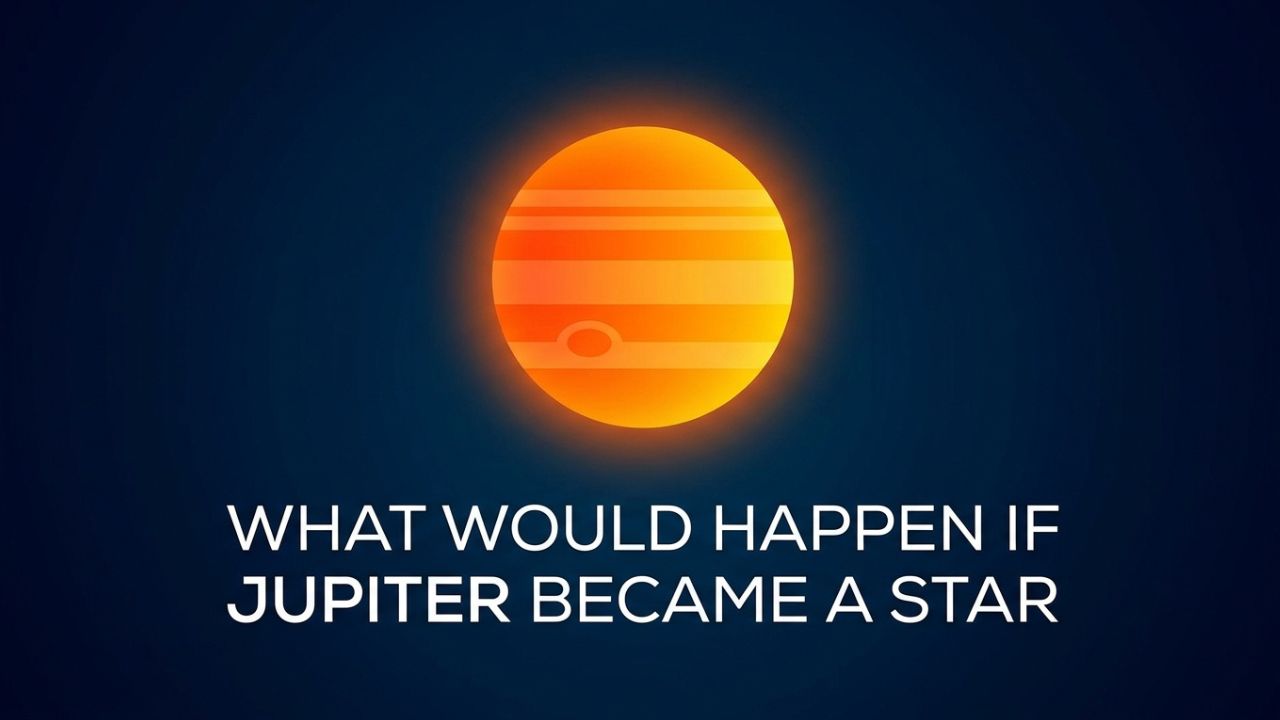
The solar system as we know it is a carefully balanced cosmic dance, with the Sun at its center and eight planets orbiting in predictable patterns. Among these celestial bodies, Jupiter stands out as the largest planet, a gas giant whose mass exceeds that of all other planets combined. But what if this massive world underwent a dramatic transformation? What if Jupiter somehow became a star? This hypothetical scenario has fascinated astronomers and science fiction writers alike, offering insights into stellar formation, planetary dynamics, and the delicate conditions that make our solar system habitable.
To understand the implications of Jupiter becoming a star, we must first examine why it is not one already. Stars are born when massive clouds of gas and dust collapse under their own gravity, creating intense pressure and heat at their cores. When temperatures reach approximately ten million degrees Celsius, nuclear fusion ignites, converting hydrogen into helium and releasing enormous amounts of energy. This process requires a minimum mass of about eighty times that of Jupiter. Our largest planet, despite its impressive size, falls far short of this threshold. Jupiter contains roughly one-thousandth the mass of the Sun, making it fundamentally different from even the smallest stars.
However, for the sake of scientific exploration, let us imagine that Jupiter somehow acquired enough mass to initiate nuclear fusion. Perhaps an unlikely collision with another massive object provided the necessary material, or some unknown cosmic mechanism compressed its core beyond natural limits. Once fusion began, Jupiter would transform into what astronomers call a red dwarf star, the smallest and coolest type of true star. This new stellar body would emit light and heat, fundamentally altering the architecture of our solar system.
The most immediate consequence would be the creation of a binary star system. Our Sun would no longer be the sole source of illumination and gravitational influence in the solar system. Instead, two stars would orbit their common center of mass, creating complex gravitational interactions that would ripple through every planet and asteroid. The stability of planetary orbits, which has persisted for billions of years, would face unprecedented challenges.
Earth’s position in this new configuration would become precarious. Currently, our planet orbits the Sun at an average distance of ninety-three million miles, receiving just the right amount of energy to maintain liquid water and support life. With a second star in the system, Earth would experience varying levels of radiation depending on its position relative to both luminaries. During certain orbital configurations, our planet might receive excessive heat, causing oceans to evaporate and temperatures to soar beyond survivable limits. At other times, reduced energy input could trigger global cooling events, potentially initiating ice ages of unprecedented severity.
The climate systems that regulate Earth’s weather patterns would face complete disruption. Atmospheric circulation depends on temperature gradients between the equator and poles, which would become unpredictable with dual stellar heating. Storm systems might intensify dramatically, while traditional seasonal cycles could vanish entirely. Agricultural systems that humanity has developed over millennia would fail, threatening food security for billions of people.
Beyond Earth, the other planets would experience equally dramatic changes. Mars, currently a cold desert world, might temporarily warm enough to release frozen carbon dioxide and water vapor into its atmosphere. However, this warming would likely be inconsistent and insufficient to create stable conditions for liquid water. The outer planets—Saturn, Uranus, and Neptune—would receive additional energy from the new star, potentially altering their atmospheric dynamics and moon systems. Saturn’s iconic rings might sublimate under increased radiation, while the icy moons of Uranus and Neptune could develop temporary atmospheres.
The asteroid belt between Mars and Jupiter would face particular turmoil. Gravitational perturbations from the new star would destabilize countless asteroids, sending many on collision courses with inner planets. Earth would face increased bombardment risk, with potential impacts causing extinction-level events. The protective role that Jupiter currently plays by capturing or deflecting comets and asteroids would vanish, as the transformed planet would now contribute to chaos rather than order.
Perhaps most significantly, Jupiter’s moons would undergo radical transformations. Io, Europa, Ganymede, and Callisto currently orbit a dark, cold planet. Under stellar illumination, these worlds would experience surface heating that could melt ice layers and create subsurface oceans. Europa, already suspected of harboring a liquid water ocean beneath its icy crust, might see this ocean expand and potentially breach the surface. Such conditions could theoretically support microbial life, though the increased radiation environment would pose significant challenges.
The transformation would also affect the heliosphere, the bubble of charged particles that the Sun creates around the solar system. A second star would generate its own stellar wind, interacting with the Sun’s output in complex ways. This interaction could compress or distort the heliosphere, allowing more cosmic rays to penetrate the inner solar system. Increased radiation exposure would threaten both technological infrastructure and biological organisms across multiple planets.
From an observational perspective, the night sky would change forever. A second sun, even a dim red dwarf, would be visible during daytime hours, casting faint shadows and altering the quality of natural light. Nights would never be truly dark, as the secondary star would provide constant illumination from various positions in the sky. Human circadian rhythms, evolved over millions of years under single-star conditions, would face physiological stress. Sleep patterns, hormone production, and mental health could all suffer under perpetual twilight conditions.
The economic and social implications would be staggering. Energy systems designed around solar power would require complete redesign. Satellite communications would face interference from increased solar activity and radiation. Space exploration missions would need to account for altered gravitational fields and radiation environments. International cooperation would become essential as humanity faced shared existential threats, yet competition for resources and safe habitats might intensify conflicts.
Scientifically, this scenario would provide unprecedented opportunities to study stellar evolution, planetary migration, and the formation of multi-star systems. Astronomers could observe in real time how planetary systems adapt to dramatic changes, information that could prove valuable for understanding exoplanetary systems throughout the galaxy. However, the cost of such knowledge would be the potential end of civilization as we know it.
It is important to emphasize that this scenario remains purely hypothetical. The physical mechanisms required to transform Jupiter into a star do not exist in nature, and the probability of such an event occurring through any known process is effectively zero. Jupiter will remain a planet, continuing its role as the solar system’s gravitational guardian for billions of years to come. Yet exploring this thought experiment helps us appreciate the fine-tuned conditions that allow life to flourish on Earth and the fragility of the cosmic balance we often take for granted.
The exercise also highlights humanity’s dependence on stable astronomical conditions. Our technology, agriculture, culture, and very biology have evolved in response to specific environmental parameters. Even modest changes to these parameters could have catastrophic consequences. As we look toward the future of space exploration and potential colonization of other worlds, understanding these dependencies becomes crucial for ensuring long-term survival.
In conclusion, while Jupiter becoming a star belongs firmly to the realm of science fiction, examining this possibility reveals the intricate connections between stellar physics, planetary dynamics, and biological evolution. It reminds us that our existence depends on a delicate cosmic arrangement that has persisted for billions of years. Rather than fearing hypothetical disasters, we should focus on appreciating and protecting the stable conditions that allow life to thrive on our pale blue dot, suspended in the vast darkness of space.