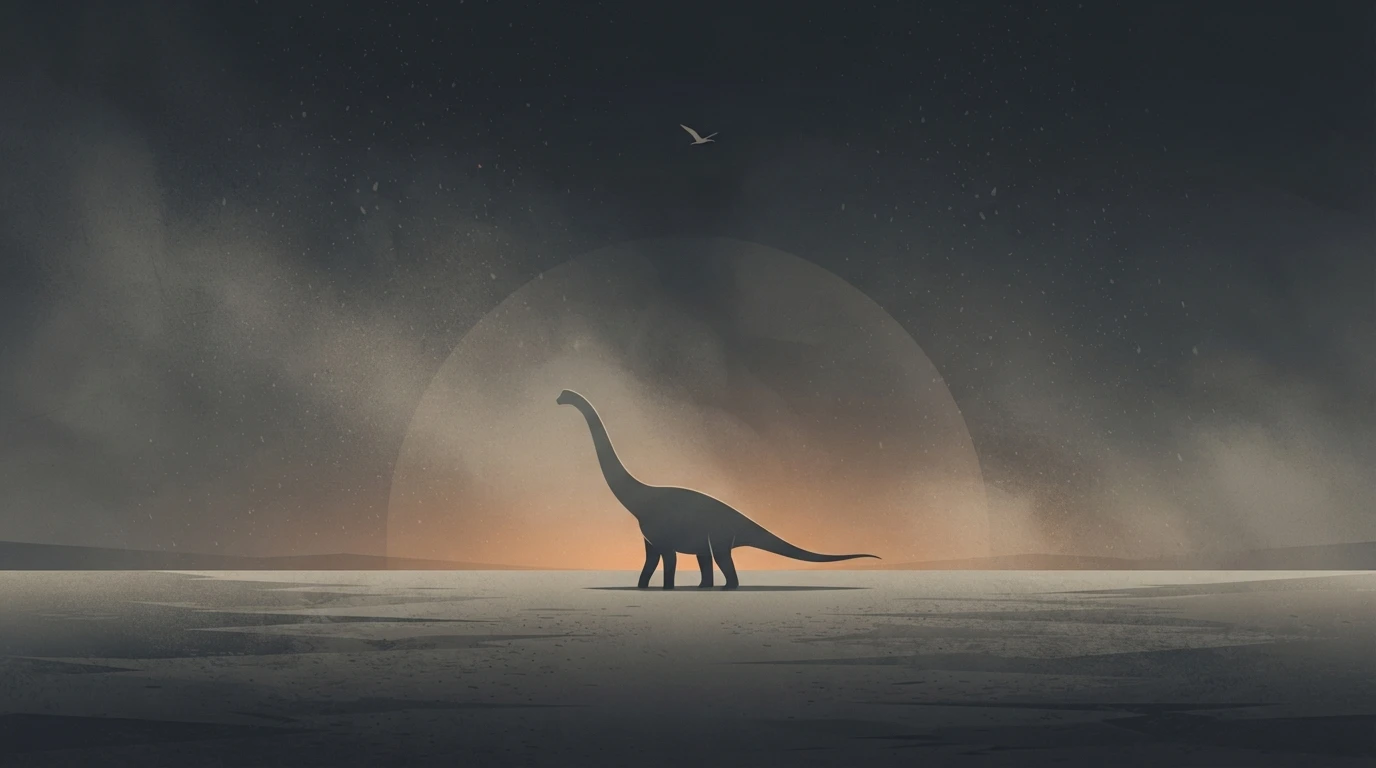
For more than 160 million years, dinosaurs dominated Earth.
They lived across continents, adapted to radically different environments, evolved into an extraordinary variety of forms, and survived dramatic changes in climate and geography. Some were enormous plant eaters that weighed several tons. Others were agile predators with sharp teeth and powerful jaws. There were dinosaurs covered in feathers, dinosaurs with horns, dinosaurs with armored bodies, and dinosaurs small enough to fit in a person’s arms.
Then, about 66 million years ago, most of them disappeared.
The extinction of the dinosaurs is one of the most famous events in the history of life on Earth. Yet the basic question remains surprisingly complex: what really happened to the dinosaurs?
The short answer is that a massive asteroid struck Earth, triggering environmental changes that made survival extremely difficult for many species. But the full story is more complicated. Volcanic activity, climate change, changing ecosystems, and the biological characteristics of different dinosaur groups may also have influenced what happened before and after the impact.
And there is one important correction to the popular story.
Dinosaurs did not completely disappear.
Birds are living dinosaurs. The extinction event eliminated all non-avian dinosaurs, but one branch of the dinosaur family tree survived and eventually produced the extraordinary diversity of birds living today.
A World Ruled by Dinosaurs
To understand their extinction, it is necessary to understand how successful dinosaurs had been.
Dinosaurs first appeared more than 230 million years ago during the Triassic Period. They were initially just one group among many reptiles living on a planet populated by numerous strange and now-extinct animals.
Over millions of years, however, dinosaurs expanded into a remarkable range of ecological roles.
During the Jurassic and Cretaceous periods, dinosaurs became major herbivores, predators, scavengers, and other specialized members of terrestrial ecosystems. Some groups developed gigantic bodies, while others evolved feathers, complex behaviors, and highly specialized feeding strategies.
Their success was not based on a single biological advantage. Instead, dinosaurs evolved repeatedly in response to changing environments.
By the end of the Cretaceous Period, Earth looked very different from the modern world. There were no humans, no cities, and no modern continents in their current positions. Flowering plants had become increasingly important, oceans covered large areas of the planet, and atmospheric and climatic conditions differed significantly from today.
Then came the event that changed everything.
The Asteroid Impact
Approximately 66 million years ago, an asteroid estimated to have been around 10 kilometers wide struck the region that is now the Yucatán Peninsula in Mexico.
The impact created the Chicxulub crater, which is more than 180 kilometers wide.
The energy released was enormous. The collision instantly transformed the surrounding environment and generated powerful shock waves. Massive amounts of rock were vaporized or blasted into the atmosphere.
The consequences extended far beyond the impact site.
Dust, aerosols, and other material entered the atmosphere, reducing the amount of sunlight reaching Earth’s surface. Fires may have spread across large areas, while powerful earthquakes and tsunamis affected regions far from the crater.
The immediate destruction was devastating. But the longer-term atmospheric effects may have been even more important.
A Planet Suddenly Darkened
Plants depend on sunlight.
When sunlight is dramatically reduced, photosynthesis declines. That creates a chain reaction through ecosystems.
Plants become less productive. Herbivores have less food. Predators then lose access to their prey.
This is one reason scientists believe the asteroid impact could have caused such widespread extinction.
The event was not simply a matter of an enormous rock hitting the ground and killing animals in the surrounding region. The impact disrupted Earth’s climate and food systems on a global scale.
Temperatures changed. Light levels fell. Ecosystems were placed under severe stress.
For animals that depended on abundant vegetation or stable food supplies, the disruption could be catastrophic.
Large animals may have been especially vulnerable because they generally require more food and energy to survive. However, body size alone cannot explain the extinction. Different species responded differently to the environmental crisis.
The End of the Cretaceous
The extinction event at the end of the Cretaceous is known as the Cretaceous-Paleogene, or K-Pg, extinction.
It was not a dinosaur-only disaster.
A large proportion of Earth’s species disappeared during the event. Marine organisms were heavily affected. Many plants and animals vanished. In the oceans, several important groups became extinct.
Among the most famous victims were the non-avian dinosaurs.
Tyrannosaurs, triceratops, hadrosaurs, ankylosaurs, and the many other dinosaur groups that had populated terrestrial ecosystems for millions of years disappeared from the fossil record.
But some organisms survived.
Small mammals, birds, reptiles, amphibians, insects, and other animals managed to persist. Their survival may have been helped by factors such as small body size, flexible diets, the ability to shelter, or access to food sources that were less dependent on fresh vegetation.
Birds, in particular, crossed the boundary between the Cretaceous and Paleogene.
Their survival means that the statement “the dinosaurs went extinct” is technically incomplete.
Birds Are Living Dinosaurs
Modern birds belong to the dinosaur lineage.
They evolved from theropod dinosaurs, the same broad group that included famous predators such as Tyrannosaurus rex.
Over tens of millions of years, birds diversified into thousands of species.
This means a pigeon walking through a city park, an eagle flying above a mountain, or a penguin swimming through cold ocean water represents a surviving branch of the dinosaur family tree.
The extinction 66 million years ago therefore did not erase the entire dinosaur lineage. Instead, it removed the non-avian dinosaurs while leaving one evolutionary branch alive.
That surviving branch became enormously successful in the world that followed.
What About Volcanoes?
The asteroid is widely regarded as the primary trigger of the K-Pg extinction, but scientists have also investigated another major environmental event: enormous volcanic eruptions in what is now India.
These eruptions formed the Deccan Traps, one of the largest volcanic provinces in Earth’s history.
Volcanic eruptions can release gases into the atmosphere, including carbon dioxide and sulfur compounds. These gases can influence climate and atmospheric chemistry.
The Deccan volcanism occurred around the same broad period as the extinction, making it an important part of the scientific debate.
However, evidence from the geological record strongly supports the Chicxulub impact as the principal cause of the sudden global extinction event. Volcanic activity may have contributed to environmental stress before or around the same period, but the asteroid provides a particularly strong explanation for the abrupt nature and global scale of the catastrophe.
Why Did Some Animals Survive?
One of the most interesting questions is not simply why so many species died, but why others survived.
The survivors were not necessarily the strongest animals. Evolution does not work according to a simple ranking of strength.
Instead, survival depends heavily on circumstances.
An animal that can eat many different types of food may have an advantage when a particular food source disappears. An animal capable of hiding underground or in water may be protected from extreme conditions. A smaller animal may require less food than a large one.
Some survivors may also have benefited from reproductive strategies or ecological flexibility.
Birds that could eat seeds, for example, may have had access to food sources that remained available after the destruction of much of the vegetation. Some mammals could survive on insects, roots, or other relatively resilient food sources.
These factors probably interacted in complex ways.
The Fossil Evidence
Our understanding of the extinction comes from several lines of evidence.
One of the most important is a thin geological layer enriched in the element iridium.
Iridium is rare in Earth’s surface rocks but relatively abundant in many asteroids. Scientists discovered unusually high concentrations of iridium in rocks dating to the boundary between the Cretaceous and Paleogene periods.
That discovery provided an important clue.
Later, researchers identified the Chicxulub crater and found evidence connecting it to the same period.
Together, these discoveries created a powerful scientific case for an asteroid impact.
Fossils provide another essential piece of evidence. The disappearance of many species occurs at the same geological boundary associated with the impact.
The story is therefore reconstructed not from a single fossil or a single discovery, but from multiple independent clues preserved in rocks around the world.
Could the Dinosaurs Have Survived Without the Asteroid?
This is a much more difficult question.
Scientists cannot conduct an experiment on Earth 66 million years ago, so there is no way to know with certainty what would have happened in an alternative history.
Some dinosaur populations may already have been experiencing environmental pressures before the impact. Climate and sea levels were changing, ecosystems were evolving, and volcanic activity was affecting the atmosphere.
However, evidence does not support a simple picture of dinosaurs gradually becoming incapable of surviving.
Dinosaurs remained diverse at the end of the Cretaceous.
The asteroid appears to have transformed an already changing planet into an environmental crisis severe enough to eliminate most of the existing dinosaur groups.
Without the impact, the history of dinosaurs could have unfolded very differently. Some groups might have declined, while others could have continued evolving.
But that remains a scientific question rather than an established fact.
A Mass Extinction That Changed Evolution
The disappearance of the non-avian dinosaurs did more than remove familiar prehistoric giants.
It reshaped the evolutionary future of the planet.
With many ecological niches suddenly empty, surviving groups had opportunities to expand and diversify.
Mammals, which had existed alongside dinosaurs for more than 100 million years, entered a world with far fewer large terrestrial competitors.
Over the following millions of years, mammals diversified dramatically.
Eventually, one mammalian lineage produced primates, and much later, humans.
In that sense, the asteroid impact became part of the long chain of events that eventually made human existence possible.
That does not mean the extinction “happened for humans.” Evolution has no predetermined destination. Humans were not the goal of the process.
Our existence is simply one of the consequences of an extraordinarily complex sequence of evolutionary events.
The Dinosaurs Are Still Here
Perhaps the most fascinating conclusion is that the story did not truly end 66 million years ago.
Dinosaurs are still part of the living world.
They sing in trees, fly across oceans, hunt in wetlands, and migrate across continents.
Their descendants have adapted to nearly every environment on Earth.
The asteroid ended an era dominated by non-avian dinosaurs, but it did not erase their evolutionary legacy.
Instead, one branch survived.
That branch became birds.
So, what really happened to the dinosaurs?
A colossal asteroid struck Earth about 66 million years ago, disrupting the atmosphere, climate, and food chains. The resulting environmental crisis caused one of the most severe mass extinctions in Earth’s history and eliminated all known non-avian dinosaurs.
But the dinosaur lineage survived.
The next time a bird lands on a rooftop or flies across the sky, it can be viewed not simply as a modern animal, but as a living reminder of a world that existed long before humans.
The dinosaurs did not vanish without a trace.
In evolutionary terms, they never completely left.