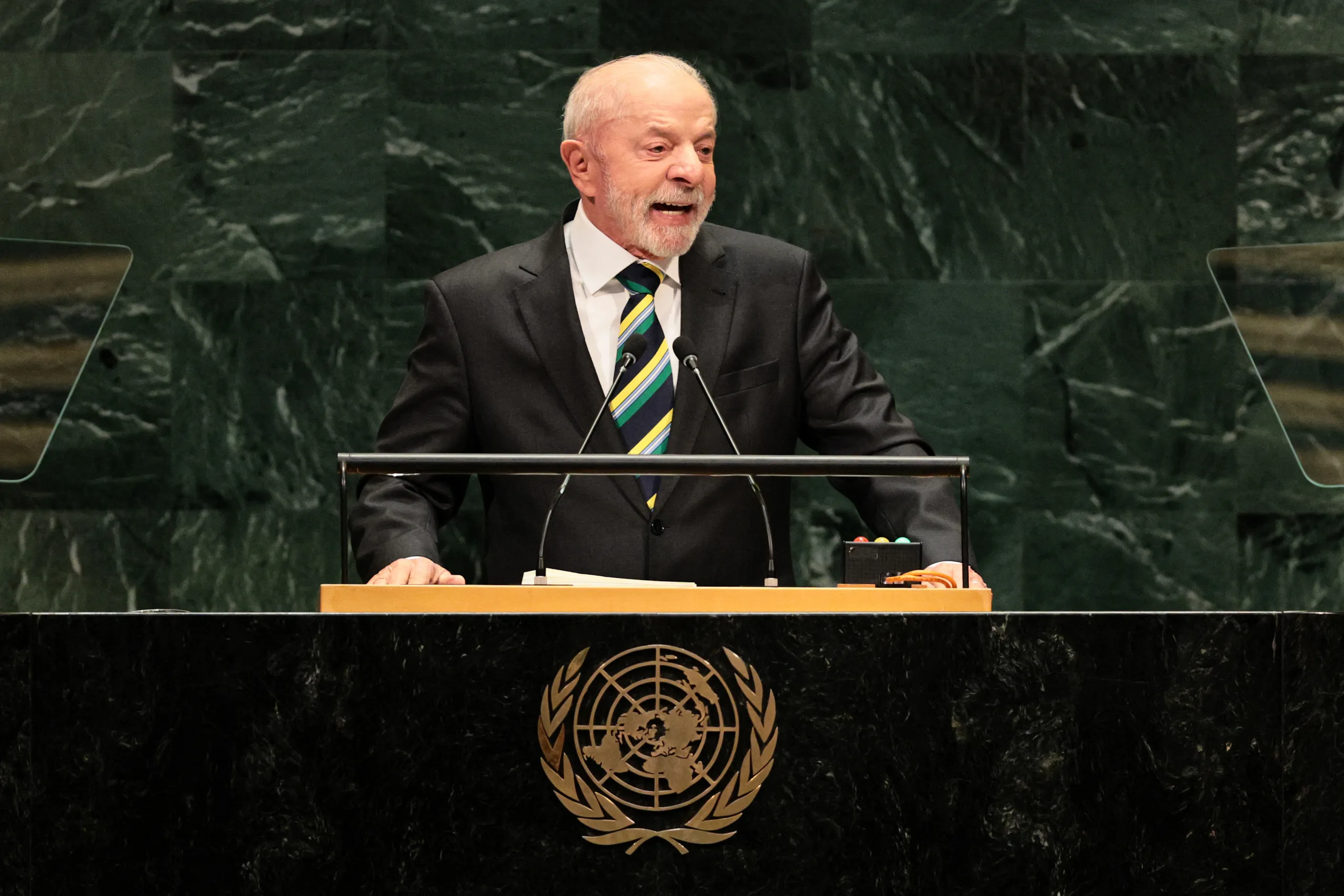
President Luiz Inácio Lula da Silva (PT) spoke at the opening of the General Assembly of the United Nations (UN) this Tuesday (22), in New York. In a speech surrounded by expectations, the Brazilian president indirectly criticized the Donald Trump government’s attempts to interfere in Latin American countries, defended Brazilian sovereignty and took the opportunity to discuss the presidential elections in October, saying that the Brazilian electorate will decide “between democracy and denialism”.
In clear contrast to Washington, Lula was direct: “Brazil doesn’t fit in anyone’s backyard,” said the Brazilian president, alluding to the current guidelines of American foreign policy. Trump and US Secretary of State Marco Rubio have already used the expression “this is our hemisphere” to conceptualize that Western countries owe obedience to the US.
In his speech, Lula pointed to the “recrudescence of hegemonic temptations”. “We need partners with a positive agenda, which encourages development. Ideological differences should not be an obstacle to greater integration between neighbors”, said the PT member, stating that democracy “is once again in check”.
He cited the case of Venezuela, stating that “the Venezuelan people deserve to define their own destiny”. Regarding Cuba, Lula said that “the world is appalled at the punishment imposed by an illegal economic embargo and energy siege.”
“When governments capitulate to those who use tariffs as weapons of coercion and blackmail, the consequences are disastrous. We have the critical minerals and rare earths that the world needs for the energy transition. Our natural riches belong to the Brazilian people, and it is for their benefit that they will be explored”, highlighted Lula.
By tradition, Brazil is the first country to speak at the entity’s most important annual meeting. The rite was established within the framework of the creation of the UN itself, at the end of the Second World War, and has to do with the importance that Brazil had in the process of articulating the United Nations. Diplomat Oswaldo Aranha presided over the first session of the UN General Assembly, having been one of the main figures leading the process of creating the state of Israel.
Crisis of multilateralism
In this 2026, in which Lula spoke for the tenth time at the event, the PT member said he was being driven by a feeling of “indignation”. “The UN is failing in one of its highest missions: to free humanity from the scourge of war. Its credibility has never been so low. We are all hostages to the immobility of a Security Council that does not fulfill its role”, he stated.
For years, the Brazilian government has been demanding a more robust reform of the Council, which expresses the world order immediately after the post-war period. In his speech, Lula said that “concessions to the law of the strongest have already gone beyond their limit”, in a direct message to the Trump administration.
In his speech in New York, the Brazilian president also warned of threats made to the International Criminal Court (ICC) at a time when Washington, according to information from the American press, could impose sanctions on the main international court.
“Persecuting the International Criminal Court and its members is a stimulus” for the continuation of crimes, reinforced Lula. “Threatening civilizations with extinction will not bring stability to the Middle East. Families around the world pay for rising fuel, fertilizer and food prices. There will be no winners on the battlefield”, said the Brazilian, warning of the dangers of wars such as those between the USA and Israel against Iran, as well as between Russia and Ukraine.
Election on the agenda
It is not uncommon for Brazilian presidents, when speaking in election years, to mention the election. In Lula’s speech this Tuesday, it was no different. Taking to the UN pulpit one of the most important topics for the Brazilian electorate, Lula spoke about public security and mentioned that Brazil “does not underestimate the challenge of organized crime”. He made a point of saying that Brazil will not accept foreign interference, in a veiled criticism of the stance that the USA has taken.
“We are not going to outsource the responsibility for our borders. We do not need aircraft carriers monitoring our waters. We need cooperation. This is the spirit of the proposal that I personally delivered to the President of the United States,” said Lula.
The PT member also acknowledged that, internally, “crime took advantage of the lack of coordination” between states and the Union, but listed public policies to combat crime. “We are facing all levels of criminality, including criminal tycoons. The fight against corruption will continue relentlessly, no matter who it hurts,” said Lula.
The Brazilian president also said that it would be a “historic omission not to face the challenge of regulating big techs and artificial intelligence. A handful of techno-oligarchs want to resurrect a version of digital neoliberalism. The billion-dollar betting industry has transformed addiction into profit. Brazil will not tolerate this business model. We will not give in to pressure from multinationals who want to privatize our Pix”, he stated.
Regarding internal issues, Lula reinforced some of his campaign guidelines: “Workers need time to rest, qualify and spend time with their family. In Brazil, achieving this objective involves ending the so-called 6×1 scale to guarantee workers two free days a week. This change is essential to alleviate the domestic burden that still falls on women.”
At the end of the speech, Lula assessed that there is “a legitimate desire for change” throughout the world, but highlighted: “Change is not going backwards, changing is not taking away rights, it is not reissuing the theory of racial supremacy and female submission, it is not recolonizing the Global South.”
Lula concluded by giving a message to Brazil. According to the president, the October election will define whether the country “will move towards a future with more opportunities or return to a past of exclusion”. “We know that some abuse this freedom [de expressão] to associate with foreign interests contrary to the country. We will not allow the enemies of democracy, internal and external, to undermine the popular will. Brazil will continue to be a sovereign country. No one, no one will keep us from this path,” he said.
Source: www.brasildefato.com.br