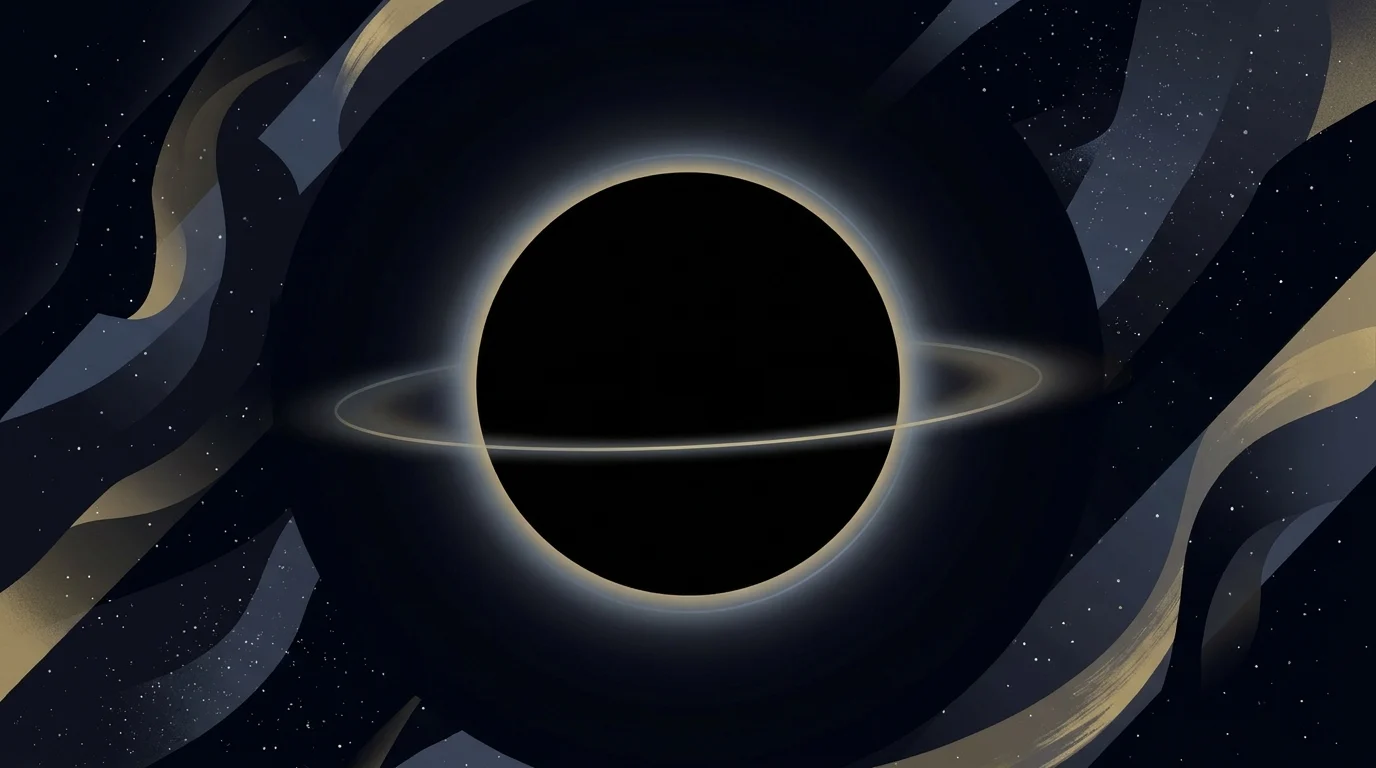
Black holes are among the most fascinating and mysterious objects ever discovered. They are invisible, immensely powerful, and capable of trapping anything that crosses a boundary known as the event horizon. Not even light, the fastest thing in the universe, can escape their gravitational pull.
For decades, black holes have challenged humanity’s understanding of space, time, and reality itself. Astronomers can observe how black holes influence nearby stars and gas clouds. They can detect gravitational waves produced when black holes collide. They can even capture images of the glowing material surrounding them.
Yet one question remains unanswered:
What is actually inside a black hole?
The truth is that nobody knows.
Scientists have developed sophisticated theories, mathematical models, and thought experiments, but direct observation remains impossible. Everything beyond the event horizon is hidden from the outside universe.
As a result, the interior of a black hole has become one of the greatest scientific mysteries of all time.
🔭 What Exactly Is a Black Hole?
A black hole forms when an enormous amount of matter is compressed into a relatively small region of space.
The most common type emerges when a massive star reaches the end of its life. After exhausting its nuclear fuel, the star can no longer support itself against gravity. Its core collapses inward, triggering a spectacular supernova explosion.
If enough mass remains after the explosion, gravity continues crushing the material until it forms a black hole.
The resulting object contains so much mass concentrated in such a tiny area that it warps the very fabric of spacetime.
According to Einstein’s theory of general relativity, gravity is not simply a force pulling objects together. Instead, massive objects bend spacetime around them. Black holes create the most extreme distortions known in the cosmos.
At the center lies a region where gravity becomes unimaginably intense.
This is where the mystery begins.
⚫ The Event Horizon: The Point of No Return
One of the defining features of a black hole is its event horizon.
The event horizon is often described as the point of no return. Once an object crosses this boundary, escape becomes impossible.
Imagine a waterfall flowing toward a cliff. A fish swimming upstream may escape while still some distance away. But once it reaches a certain point, the current becomes too strong. No matter how hard it swims, it will inevitably be dragged over the edge.
The event horizon functions similarly.
Outside the horizon, a spacecraft could theoretically escape with enough power. Inside, every possible path leads deeper into the black hole.
To an outside observer, strange effects occur near this boundary. Time appears to slow dramatically for anything approaching the event horizon. A falling astronaut would seem to move more and more slowly until appearing almost frozen.
However, from the astronaut’s own perspective, time would continue normally.
This bizarre behavior is one of the many consequences of Einstein’s equations.
🧠 The Singularity Problem
According to general relativity, matter falling into a black hole eventually reaches a point called a singularity.
A singularity is a location where density becomes infinite and the known laws of physics break down.
In mathematical terms, space and time cease behaving in ways scientists can currently describe.
This prediction creates a major problem.
Infinity often signals that a theory has reached its limits rather than revealed physical reality. Many physicists believe singularities indicate that our understanding of nature is incomplete.
If a singularity truly exists, it would represent one of the most extreme environments imaginable.
Every particle of matter swallowed by the black hole would be crushed into an infinitely dense point.
Yet many researchers suspect something else may happen before such an impossible state is reached.
The challenge is that no current theory can definitively explain what replaces the singularity.
📚 Einstein’s Theory Meets Quantum Mechanics
The mystery deepens because black holes sit at the intersection of two powerful but incompatible theories.
The first is general relativity, which describes gravity and the behavior of large-scale objects such as stars, galaxies, and black holes.
The second is quantum mechanics, which governs the microscopic world of atoms and subatomic particles.
Both theories have been tested extensively and produce extraordinarily accurate predictions.
The problem is that they do not work well together.
Inside a black hole, gravity becomes incredibly strong while quantum effects also become important.
This means scientists need a theory of quantum gravity to fully understand what happens.
Unfortunately, such a theory has not yet been completed.
As a result, researchers are forced to rely on educated guesses and competing models.
🌀 Could Black Holes Be Gateways to Other Universes?
One of the most intriguing ideas is that black holes may connect to other regions of spacetime.
Some mathematical solutions to Einstein’s equations suggest the possibility of structures called wormholes.
A wormhole acts like a tunnel connecting distant points in space and time.
In theory, entering one end could allow travel to another location far faster than normal travel through space.
Some scientists have speculated that black holes could be entrances to such tunnels.
In this scenario, matter falling into a black hole would not be destroyed. Instead, it would emerge elsewhere.
Perhaps it would appear in another part of our universe.
Perhaps it would enter an entirely different universe.
The idea captures the imagination, but there is currently no observational evidence supporting it.
Most wormhole models also appear unstable and would likely collapse before anything could pass through them.
Nevertheless, the possibility remains a topic of ongoing theoretical research.
🌠 The White Hole Hypothesis
Another fascinating concept is the existence of white holes.
A white hole is essentially the opposite of a black hole.
While black holes pull matter inward, white holes would expel matter outward.
Nothing could enter a white hole from the outside.
Some theoretical models propose that black holes and white holes might be connected.
Matter swallowed by a black hole could potentially emerge from a white hole elsewhere.
This idea has appeared in scientific papers and mathematical investigations, but white holes have never been observed.
Without evidence, they remain speculative constructs.
Still, they demonstrate how black holes continue inspiring bold new possibilities.
⚛️ The Information Paradox
One of the most famous puzzles involving black holes concerns information.
In physics, information refers to the fundamental properties describing particles and systems.
Quantum mechanics states that information cannot be destroyed.
Yet black holes seem to do exactly that.
If a black hole swallows a book, a planet, or even a star, what happens to the information describing those objects?
For many years, scientists believed the information simply disappeared.
Then physicist Stephen Hawking introduced a revolutionary idea.
He discovered that black holes are not completely black.
Instead, they emit a faint form of radiation now known as Hawking radiation.
Over incredibly long periods, this radiation causes black holes to lose mass and eventually evaporate.
The problem is that Hawking radiation appears random.
If the black hole disappears entirely, where does the original information go?
This conflict between quantum mechanics and black hole physics became known as the information paradox.
For decades, it has been one of the most important unsolved problems in theoretical physics.
🔥 Hawking Radiation Changes Everything
Stephen Hawking’s discovery transformed scientific thinking.
Before his work, black holes were viewed as eternal prisons.
Afterward, scientists realized black holes have lifetimes.
Large black holes evaporate extremely slowly.
A black hole with the mass of the Sun would survive for an unimaginable length of time, far longer than the current age of the universe.
Nevertheless, evaporation changes the story.
If black holes eventually disappear, physicists must explain what happens to everything that fell inside them.
Various solutions have been proposed.
Some suggest information is encoded within Hawking radiation itself.
Others argue information remains stored on the event horizon.
Still others believe entirely new physics is required.
The debate continues today.
🪐 The Holographic Universe Idea
One of the most influential modern theories is known as the holographic principle.
This concept emerged from attempts to solve black hole puzzles.
According to the holographic principle, all the information contained within a volume of space may actually be encoded on its boundary.
A useful analogy is a hologram.
A holographic image appears three-dimensional even though the information exists on a two-dimensional surface.
Applied to black holes, the theory suggests information about everything inside may be stored on the event horizon.
Some physicists believe this principle could extend beyond black holes.
In its most radical form, the entire universe might operate holographically.
If true, our understanding of reality would require a profound transformation.
What appears three-dimensional could emerge from information encoded on a distant cosmic boundary.
🚀 What Would Happen to a Human Falling In?
This question often captures public imagination.
Suppose an astronaut approaches a black hole.
What happens next?
The answer depends largely on the size of the black hole.
For smaller black holes, gravitational forces increase rapidly near the event horizon.
The astronaut’s feet would experience stronger gravity than the head.
The difference would stretch the body into a long, thin shape.
Scientists call this process spaghettification.
The stretching would become increasingly severe until survival became impossible.
For supermassive black holes found at the centers of galaxies, conditions are different.
An astronaut might cross the event horizon without immediately noticing anything unusual.
However, the journey inward would eventually end in destruction as gravitational forces intensified.
What occurs beyond that point remains unknown.
🌍 Could Black Holes Create New Universes?
Some researchers have proposed a remarkable possibility.
Perhaps black holes are not merely endpoints.
Perhaps they are cosmic birthplaces.
Certain speculative models suggest that new universes could form inside black holes.
In this framework, every black hole might contain an expanding universe hidden from its parent cosmos.
Our own universe could even have originated within a black hole existing in another reality.
This idea remains highly speculative.
No evidence currently supports it.
However, it illustrates how black holes force scientists to consider possibilities far beyond ordinary experience.
📡 What Have Astronomers Actually Observed?
Although scientists cannot see inside black holes, observations have dramatically improved in recent years.
In 2019, researchers released the first image of a black hole’s shadow.
The achievement represented a major milestone in astronomy.
Using a global network of radio telescopes, scientists effectively created an Earth-sized virtual telescope.
The resulting image revealed a bright ring of glowing gas surrounding a dark central region.
Later observations produced even more detailed views of supermassive black holes.
Meanwhile, gravitational wave observatories have detected ripples in spacetime generated by merging black holes.
These discoveries confirm key predictions of Einstein’s theory.
Yet they still reveal only what occurs outside the event horizon.
The interior remains hidden.
🔬 Future Technologies May Provide Clues
Scientists continue searching for indirect ways to study black holes.
Future observatories may detect subtle effects revealing how gravity behaves under extreme conditions.
Advanced gravitational wave detectors could uncover new details about black hole collisions.
Improved space telescopes may observe matter orbiting near event horizons with unprecedented precision.
Quantum experiments may also provide insights into the relationship between gravity and information.
Each new discovery narrows the range of possibilities.
Even without entering a black hole, researchers may eventually determine which theories best describe their interiors.
🌟 Why Black Holes Matter
Black holes are not merely astronomical curiosities.
They represent natural laboratories where the deepest laws of physics are tested.
Understanding black holes may help scientists answer fundamental questions about the universe.
What is space?
What is time?
Can information truly disappear?
How does gravity interact with quantum mechanics?
Is our universe unique?
These questions reach beyond astronomy.
They touch the foundations of reality itself.
🏁 The Mystery Remains
Despite decades of research, nobody knows with certainty what lies inside a black hole.
The singularity may exist.
Wormholes may connect distant realms.
Information may be stored on cosmic boundaries.
New universes may emerge from gravitational collapse.
Or the correct answer may be something entirely unexpected.
Black holes occupy a frontier where human knowledge reaches its limits.
Every advance in physics brings new clues, yet the central mystery endures.
For now, the interior of a black hole remains hidden behind nature’s ultimate curtain.
Until a breakthrough unites gravity and quantum mechanics, scientists can only continue exploring, calculating, observing, and guessing.
And perhaps that uncertainty is what makes black holes so captivating.
They remind us that even in an age of extraordinary scientific achievement, the universe still holds secrets beyond our reach.