Published 02/05/2026 12:15
May 1st is the most universally celebrated date in the world. Unlike other celebrations of a religious or cultural nature, International Workers’ Day crosses political, religious and geographic borders and is marked in countries on all continents as an expression of the historic struggle of the working class.
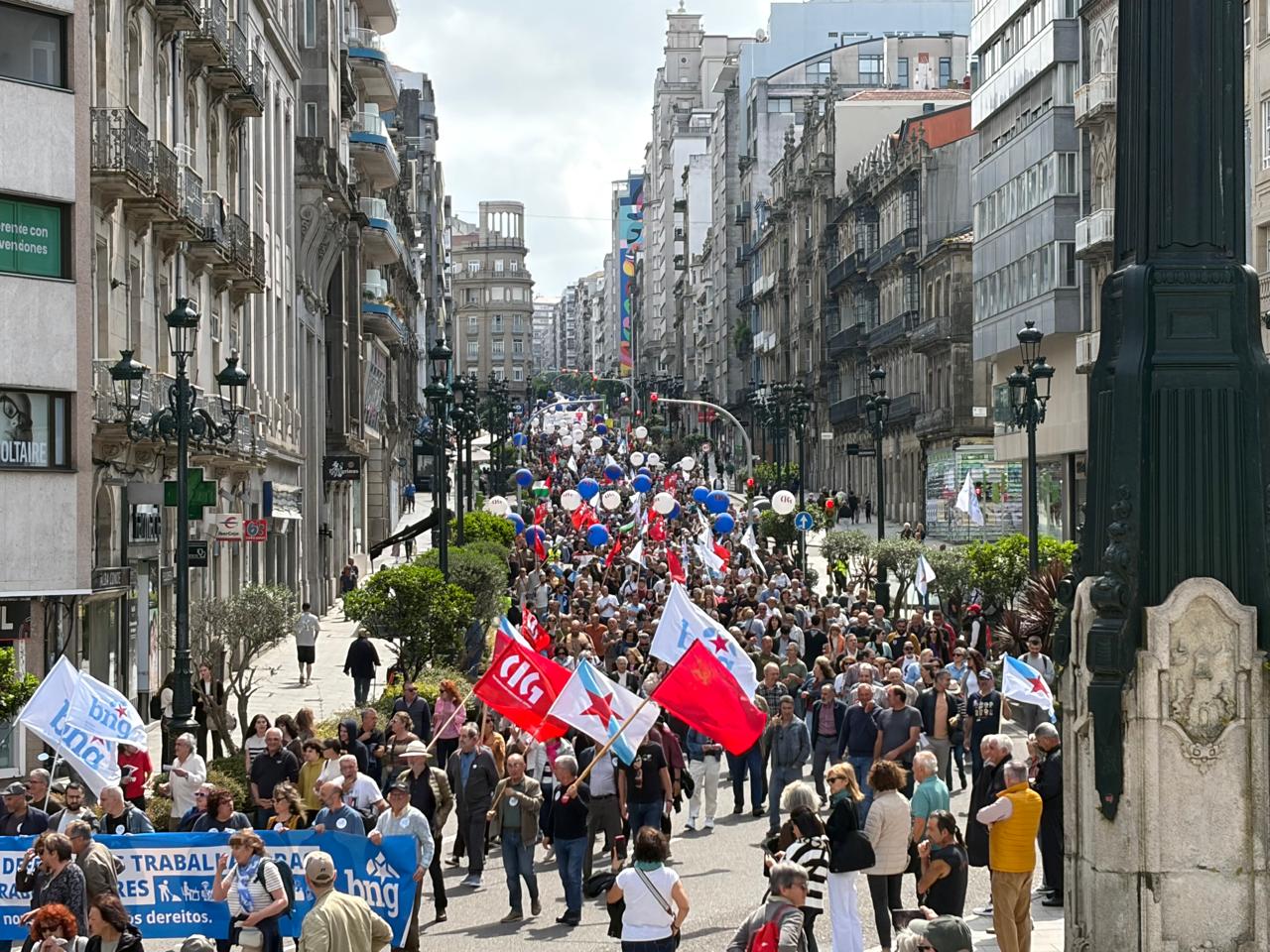
The May 1st march in Vigo brought together almost 20 thousand workers, standing out as the largest mobilization of the day in all of Spain. At the head of the procession, a large Galician flag made its way through the city’s streets, carried by protesters and visually expressing the identity of the event. The route started from Cruce da Dobrada and advanced through the center of Vigo, incorporating popular attractions along the route.
Right after the opening track, the movement was driven by the shrill sound of bagpipes, the dry beats of drums and the melody of transverse flutes, which served as the true soundtrack of the demonstration. The rhythm not only accompanied, but organized the collective movement, marking the pace of the protesters and creating an atmosphere in which culture and politics intertwined in an organic way. Along the route, blue and red balloons, with the inscription “CIG”, stood out from the crowd, composing the visual scene of the event and emphasizing its identity.
In the contemporary context, this tradition is expressed in the May 1st mobilizations. In Galicia, the so-called Galician bloc brings together unions, political organizations and social movements that articulate the labor struggle with the defense of identity and sovereignty. The Confederación Intersindical Galega (CIG) plays a central role in this process, organizing demonstrations in several cities and promoting trade unionism that combines economic demands with a broader political interpretation, such as the defense of peace.
Galicia also presents a particularity in the political field. The defense of regional sovereignty is historically linked to popular and left-wing sectors, with a strong presence in the trade union movement. Unlike other regions of the Spanish State, such as Catalonia and the Basque Country, in which independence brings together different currents, including conservative sectors, in Galicia this agenda developed mainly linked to the social struggle and the defense of the rights of the working class.
Read more: May 1st: Workers occupy the streets of Brazil due to the reduction of working hours
The presence of Galician flags throughout the mobilization did not mean political closure. On the contrary, the act demonstrated a strong internationalist dimension. Throughout the journey, several Palestinian flags were visible, carried by protesters in solidarity with the Palestinian people. Attention was drawn to the presence of a specific bloc supporting Cuba, which organized the sale of flags as a way of raising resources for the island. These elements demonstrate that the affirmation of Galician identity coexists with a global reading of the struggles, connecting the local context to international causes.
The act was also attended by Javier Alfaya, Galician by birth, Bahian by choice and member of the PCdoB Central Committee, who highlighted the personal and political significance of the act. “Returning to Galicia and participating in this moment, with workers on the streets in a demonstration of strength and joy, is especially important for me. Galicia and its culture are part of my formation. Being here and bringing the embrace of Brazil’s communists reinforces our bonds of solidarity”, he declared.
During the demonstration, the slogan “Against imperialism, peace and sovereignty. In Galicia, decent work and rights” synthesized this articulation between the local and the global, combining social demands with a critique of the international scenario marked by conflicts and the increase in military spending.
At the end of the event, the general secretary of the union center, Paulo Carril, deepened this reading in his intervention, noting “the determination to continue moving towards a society without exploitation”. In his speech, he assessed that the historical moment is marked by a military escalation that benefits big capital, while increasing social precariousness. “Not in our name”, he said, rejecting the use of public resources to finance wars, adding that “we will not allow the resources of the Galician working class to be used to support imperialist conflicts”.


The leader also highlighted the local reality, stating that “Vigo does not want tanks in its streets, it wants a workload in shipyards, it wants industry and decent employment”. When summarizing the situation of the working class, he highlighted that “they work more, pay less and live worse”, intensifying the criticism of the current economic model. When defending collective organization, he stressed that “nothing we have was given”, maintaining that rights are the result of the struggle.
The mobilization also pointed to the continuity of the struggles, with the call for a new demonstration scheduled for the end of the month, aimed at defending peace and criticizing militarism, in response to the increase in military spending and the holding of events to showcase the Armed Forces.
At the end of the activity, the historical and symbolic dimension was present with the singing of “A Internacional”, in a Galician version, followed by the Galician anthem, ratifying the cultural and political identity of the region. The moment synthesized the character of the act, in which internationalism and national affirmation were intertwined, connecting the local struggle to a broader trajectory of the working class. This tradition of resistance is expressed in symbols that span Galician history. The slogan “Better dead than a slave”, present in the memory of the struggle of the Galician people, summarizes the idea of dignity and refusal to submit that marked the presence of workers on the streets.
The strength of the mobilizations in Vigo cannot be understood just as a one-off phenomenon. It is the result of a historical trajectory that articulates territory, work and identity. In a context marked by inequalities, economic transformations and international tensions, May 1st reiterates its relevance as a moment of organization, resistance and projection of the future. In Galicia, this perspective takes concrete form in the streets, where the sea, the shipyards, culture and struggle converge in the construction of a collective identity that remains alive.
Source: vermelho.org.br