Published 05/21/2026 10:42 | Edited 05/21/2026 19:02
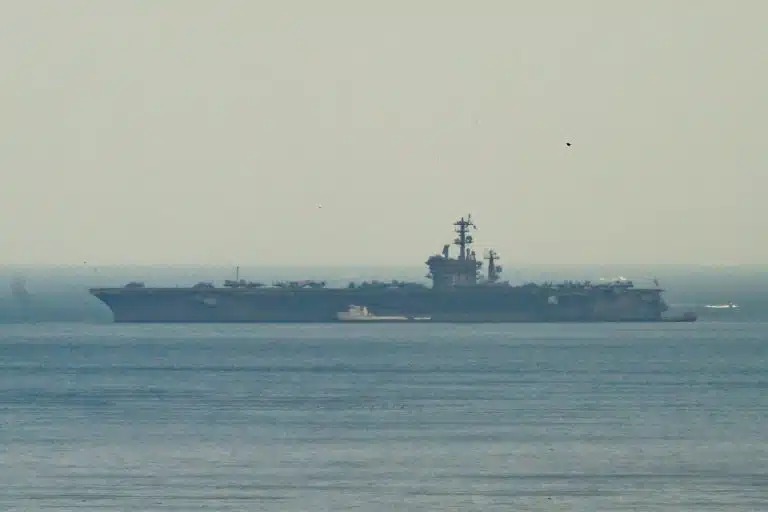
The United States moved the aircraft carrier USS Nimitz and its strike group to the Caribbean Sea this Wednesday (20), amid the escalation of threats against Cuba.
The military movement occurs on the same day that the Donald Trump administration’s Department of Justice formalized criminal charges against former president and revolutionary leader Raúl Castro.
The announcement was made by the Southern Command of the US Armed Forces, responsible for US military operations in Latin America and the Caribbean.
“Welcome to the Caribbean, Nimitz Carrier Strike Group!” Southcom posted on social media.
The fleet includes the aircraft carrier USS Nimitz, the carrier air group Carrier Air Wing 17, the destroyer USS Gridley and the supply ship USNS Patuxent. In its own description, Southern Command stated that the array represents “the epitome of readiness and presence, unparalleled range and lethality, and strategic advantage.”
The arrival of the naval group in the Caribbean raises the alarm in Havana, which was already denouncing the United States’ attempt to construct a political and legal narrative to justify new aggressions against the island.
Cuban President Miguel Díaz-Canel stated this week that Cuba has “the absolute and legitimate right” to defend itself against any military attack and warned that an aggression would provoke “a bloodbath with incalculable consequences.”
The Cuban government interprets the combination of military pressure, judicial accusations and tightening of the economic blockade as part of a coordinated US offensive against the island.
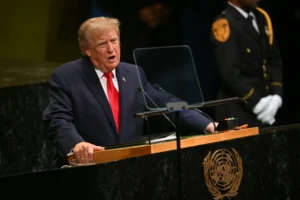
The escalation also comes after recent statements by Donald Trump about Cuba. The North American president stated that the USA is “liberating Cuba” and declared that he could not say “what will happen next” with the island.
In another statement, he classified Cuba as a “pariah state” and stated that Washington will expel “the forces of illegality, crime and foreign invasion” from the region.
Read also: Cuba reacts to accusations against Raúl Castro and denounces US escalation
Read also: US moves nuclear aircraft carrier to the Caribbean amid new tension
Nuclear aircraft carrier leads military operation in the Caribbean
The USS Nimitz is one of the main symbols of the power of North American imperialism.
Commissioned in 1975, the nuclear-powered ship is around 333 meters long and capable of carrying between 60 and 90 aircraft, including fighters, helicopters and military support planes.
The vessel is accompanied by the destroyer USS Gridley and the supply ship USNS Patuxent, forming a strike group capable of air combat, sea combat and blockade operations.
According to Southern Command, the deployment is part of the Southern Seas 2026 operation, aimed at expanding the US military presence in Latin America and the Caribbean.
The Nimitz has participated in some of the main US military operations of recent decades, including actions in the Persian Gulf, Afghanistan, Iraq and the Middle East. Southern Command itself stated that the aircraft carrier “has proven its combat capability around the world, ensuring stability and defending democracy from the Taiwan Strait to the Arabian Gulf.”
Before heading to the Caribbean, the naval group carried out joint exercises with the Brazilian Navy off the coast of Rio de Janeiro. The sequence of military movements, from the South Atlantic to the Caribbean region in the midst of the crisis with Havana, raised fears of escalation.
Also read: China condemns US accusations against Raúl Castro and Cuba
Accusations against Raúl Castro increase fear of intervention
The arrival of the USS Nimitz in the Caribbean comes hours after Washington formalized criminal charges against Raúl Castro for an episode that occurred in 1996, when aircraft from the anti-Castro organization Hermanos al Rescate were shot down after successive incursions into Cuban airspace.
The Cuban government denounced the case as an attempt to criminalize the island’s sovereignty and create political justifications to increase pressure against Havana.
Vice Chancellor Carlos Fernández de Cossío classified the accusations as a “scoundrel act” and stated that the movement is part of the US’ “aggressive escalation” against Cuba.
The fear gained strength after the Venezuelan precedent. Before Nicolás Maduro’s capture in January this year, Washington had also opened criminal proceedings against the Venezuelan president.
For Havana and its allies, the repetition of the script — judicial accusations, economic pressure and military demonstration — represents a warning sign for the entire region.
The offensive takes place amidst the worsening of the Cuban economic crisis, deepened by the tightening of the economic blockade and the energy embargo imposed by the USA.
Washington began to threaten countries and companies that supply fuel to the island, causing blackouts and increasing shortages.
Even within the United States, the escalation faces resistance. Democratic Party parliamentarians presented proposals to prevent the use of the Armed Forces against Cuba without authorization from Congress.
Senator Adam Schiff stated that Trump “does not have the legal authority to invade or attack another sovereign nation” without parliamentary approval or a proven imminent threat.
Source: vermelho.org.br