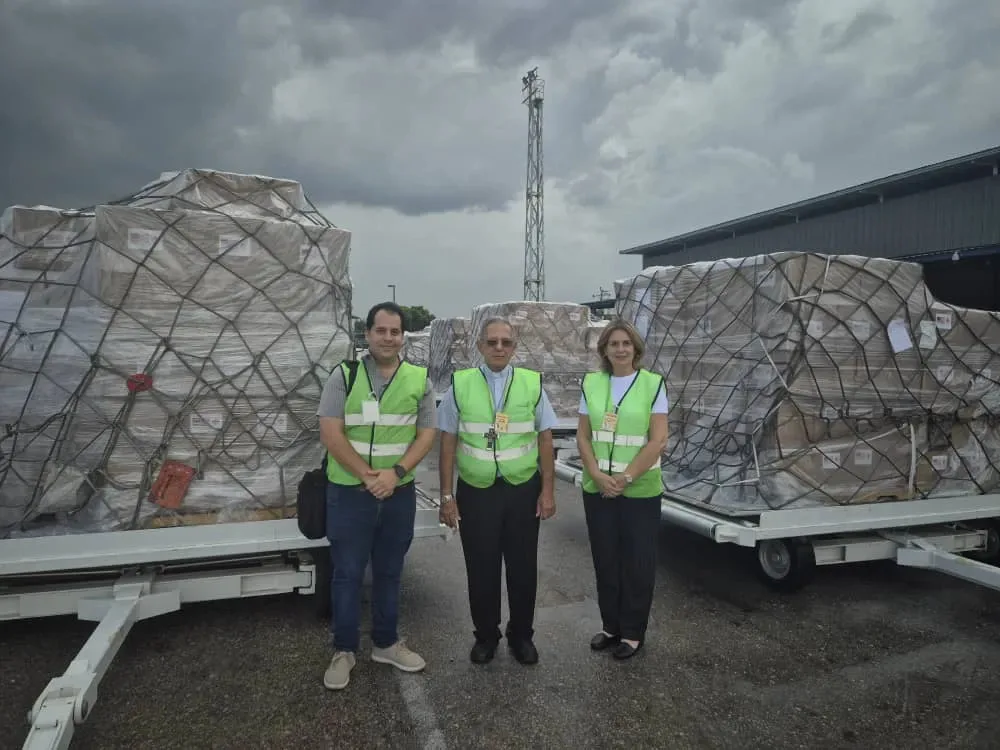
The first shipment of humanitarian aid promised by the United States government in mid-May arrived in Havana this Tuesday (21). This is an initial shipment of 18 tons, referring to the humanitarian assistance program of up to 100 million dollars, the resources of which will be shared by the Catholic Church.
The allocation will be the responsibility of Cáritas Cuba, which said in a statement that “the initial shipment includes food and hygiene kits that will benefit 700 families in the Archdiocese of Havana, whose distribution will be carried out according to the vulnerability criteria defined for this type of aid.”
Furthermore, the organization explained that the delivery “will be carried out by volunteers from parish communities, who are already organized to guarantee the efficiency of the process”.
Present at the ceremony to receive the donation were Cardinal Juan de la Caridad García Rodríguez, archbishop of Havana; the director of Cáritas Cuba, Carmen María Nodal Martínez; the director of Cáritas Havana, Ángel Miguel Gutiérrez Valdivia; in addition to representatives of government authorities.
According to the United States Under Secretary of State for Foreign Assistance, Humanitarian Affairs and Religious Freedom, Jeremy Lewin, the program is expected to benefit 196,000 families with future shipments by air and sea.
For its part, in a statement, the Ministry of Foreign Trade and Foreign Investment (Mincex) stated that, although “Cuba is not opposed to this type of aid, as long as it benefits its people”, Havana considers that “this assistance contrasts with the reality of collective punishment” imposed by the United States blockade.
Economic suffocation and humanitarian crisis
The arrival of the first shipment occurs in a context of intensification of Washington’s economic aggression against Cuba, which has caused a serious deterioration of the social situation in the Caribbean country.
The lack of energy largely paralyzed Cuban economic activity. According to estimates by the Economic Commission for Latin America and the Caribbean (ECLAC), the country’s Gross Domestic Product (GDP) is expected to fall by 6% this year.
The situation has deteriorated practically all aspects of social life. In homes, the shortage of electricity supply results in blackouts that, in some regions, last more than 48 hours.
In the health area, according to official data, the survival rate of children with cancer fell from 85% to 65%, a reduction of 20 percentage points in relation to the levels recorded before the energy asphyxiation. This means that two in every ten children who were previously able to overcome the disease with appropriate treatment are now no longer able to do so, due to a lack of resources in hospitals.
The energy blockade against Cuba intensified at the end of January, when the United States government issued an executive order through which it threatened to impose sanctions on any country that sells or supplies oil to the island. Since then, Cuba — which produces only about 35% of the oil it needs to generate electricity — has been unable to import enough fuel to keep the national electrical system running.
In parallel with the energy asphyxiation — denounced by UN human rights experts as a serious violation of human rights — Washington increased the so-called secondary sanctions against non-US entities and companies that maintain commercial relations with the Cuban State. These measures led to the withdrawal of companies linked to strategic sectors, such as tourism and mineral exploration, generating millionaire losses for the already fragile Cuban economy.
Along with the escalation of economic aggression, the United States government also reiterated threats of a possible military incursion on the island.
In early June, independent human rights experts from the United Nations (UN) stated that the pressure exerted by the United States against Cuba reproduces practices associated with the colonial period, violates fundamental principles of international law and represents a threat to the island’s sovereignty.
Source: www.brasildefato.com.br