Published 04/29/2026 11:54 | Edited 04/29/2026 18:57
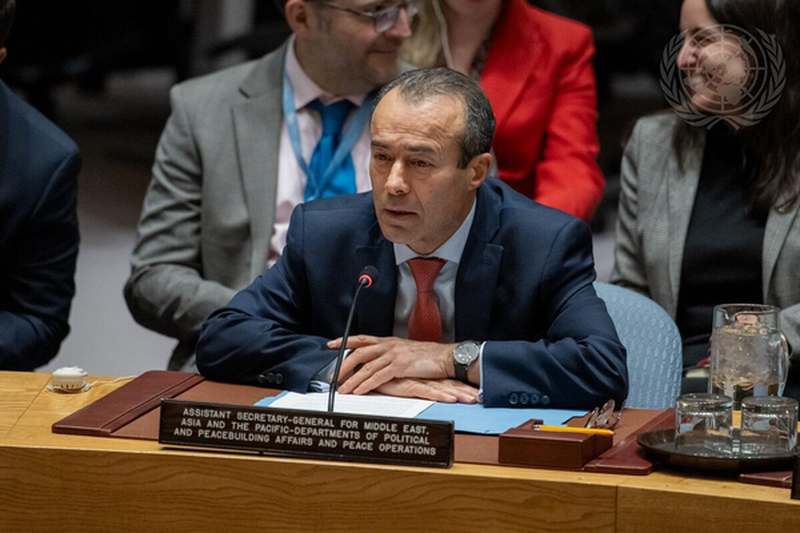
The UN Deputy Secretary-General for Political Affairs, Khaled Khiari, warned this Tuesday (28), at a Security Council meeting, that the ceasefire in Palestine is “increasingly fragile”, given the continuation of Israeli attacks and the worsening of humanitarian conditions in the territory.
According to the United Nations representative, hundreds of Palestinians have been killed in Gaza and the West Bank since the beginning of the truce, while around 1.8 million people remain displaced.
“In Gaza, the ceasefire is increasingly fragile as Israeli attacks and armed activities by Hamas and other groups continue,” warned Khiari.
Despite the false equivalence between Zionist aggression and Palestinian resistance, Khiari, in his speech in New York, gave centrality to the impact of Israeli attacks on the civilian population, highlighting the number of deaths and the worsening of living conditions in the territory.
“Civilians continue to bear the brunt of the ongoing violence. According to the Ministry of Health in Gaza, since the start of the ceasefire, approximately 800 Palestinians, including more than 200 children, and seven aid workers have been killed as a result of Israeli airstrikes, shelling and gunfire,” he said.
“The tensions and hostilities that have rocked the Middle East in recent weeks have diverted attention from the situation in the Occupied Palestinian Territory. Out of the spotlight, the situation in Gaza and the West Bank, including East Jerusalem, is steadily deteriorating,” warned the representative.
According to the Gaza Ministry of Health, since the start of the ceasefire, approximately 800 Palestinians, including more than 200 children and seven aid workers, have been killed in Israeli attacks.
Cynically, the Israel Defense Forces declared that its attacks targeted Hamas militants and facilities.
Khiari said that despite multiple diplomatic efforts, negotiations on the disarmament of Hamas and other armed groups have so far not resulted in any agreement.
According to the latest data, around 1.8 million people, almost the entire population of Gaza, are displaced and living in camps, depending on aid amid crossfire, devastated infrastructure and growing health risks.
The director of the World Health Organization Regional Office, WHO, for the Eastern Mediterranean, Hanan Balkhy, said she was “deeply concerned” about what health and humanitarian workers are reporting at displacement sites in Gaza.
A rapid assessment carried out in more than 1,600 locations found that 80% have a frequent and visible presence of rodents and pests, affecting 1.45 million people.
More than 80% reported skin infections, including scabies, lice and bedbugs, with more than 70,000 cases recorded this year.
Israel continues attacks on Gaza and expands offensive in southern Lebanon
New Israeli attacks recorded in the last few hours reinforce the UN warning about the fragility of the ceasefire in Gaza.
This Wednesday (29), a Palestinian was killed and two others were injured after bombings with drones and firing by Israeli forces in different areas of the territory, including Gaza City, Beit Lahia and Khan Younis.
Witnesses also reported the destruction of houses and residential buildings, hit by artillery and air strikes, even with the truce in force since October 2025.
The escalation also extends beyond Gaza. In southern Lebanon, Israeli attacks continue to be recorded even after the ceasefire was announced on April 16.
On Tuesday night (28), aerial bombing destroyed a residence in the Nabatieh region and killed five members of the same family, including two children. The episode was classified by Lebanese Prime Minister, Nawaf Salam, as a “heinous crime” and a flagrant violation of international law.
Lebanese authorities denounce that Israel has maintained almost daily attacks, using drones, heavy artillery and aerial bombardments against villages in the south of the country.
Since the escalation began on March 2, more than 2,500 people have been killed and thousands injured, while entire communities have been displaced and civil infrastructure — including schools and educational centers — has been destroyed.
Source: vermelho.org.br