Published 15/05/2026 14:19 | Edited 05/15/2026 14:46
Donald Trump left China this Friday (15) saying he had achieved “fantastic” trade deals and an offer of help from Chinese leader Xi Jinping to unblock the Strait of Hormuz. Aboard Air Force One, the President of the United States took off from Beijing in the early afternoon (morning in Brazil), ending a 48-hour visit marked by geopolitical symbolism.
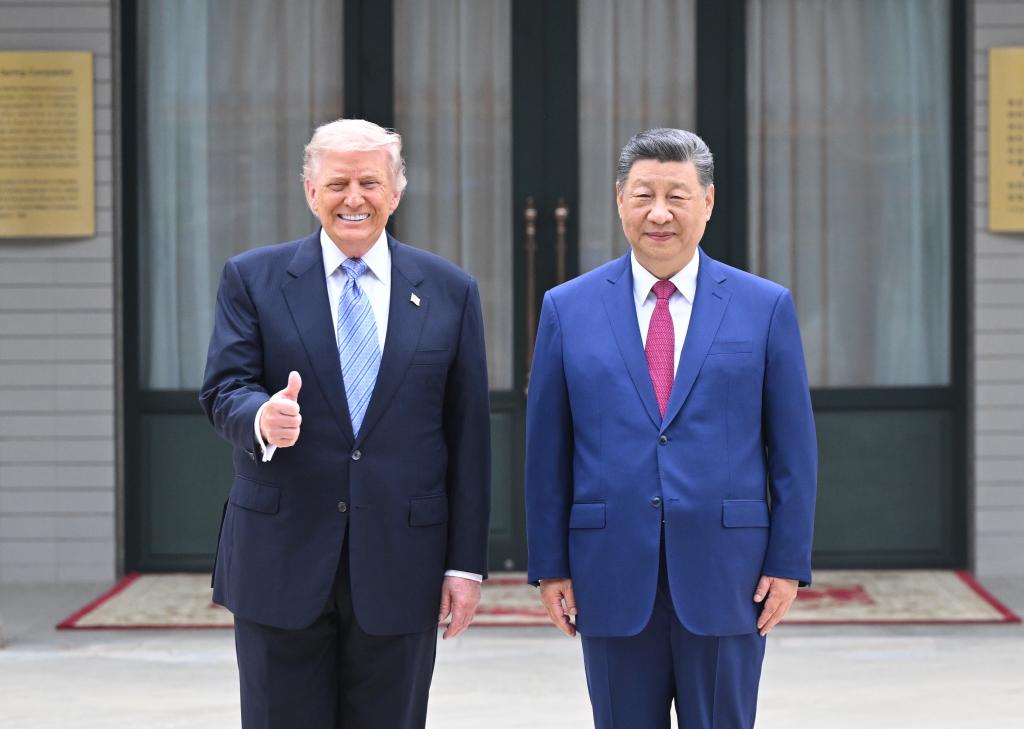
On Thursday (14), Trump was received by Xi at the Grand Palace of the People, where they participated in a banquet and formal meetings. This Friday, the Republican visited Zhongnanhai, a complex that houses the Chinese leadership next to the Forbidden City. The two walked together through the imperial garden.
It was in Friday’s images that, for the first time during the visit, Trump smiled as he was photographed by the Chinese press. The detail was widely commented on by observers of the bilateral relationship as a gesture of diplomatic significance.
The White House seeks to expand the presence of North American companies in the Chinese market and ease its agenda in the Middle East. China, in turn, needs predictability to sustain its development and preserve access to Western markets and technologies. What unites Trump and Xi, paradoxically, is pragmatism: a rupture would be too expensive for both.
Without transformative announcements or detailed agreements, the visit appears to have achieved its main objective: reducing tensions and managing rivalry between the planet’s two largest powers, despite differences on issues such as Taiwan, Iran, artificial intelligence and energy security.
Diplomacy in the face of uncertainty
According to the state agency Xinhua, Xi and Trump had an “in-depth exchange of opinions” on central issues on the bilateral and international agenda, reaching “new common understandings”. Beijing described the trip as a “milestone” in Sino-US relations, while Xi defended a “constructive, strategic and stable” relationship.
Trump insisted on the rhetoric of great economic results. He said he had reached “fantastic trade deals” and said his personal relationship with Xi could produce advances that other presidents had failed to achieve.
For Xi, the visit also had strategic utility. According to the Washington Postthe summit reinforced China’s attempt to present itself as a power equivalent to the US in global governance. Trump even used the expression “G-2” to refer to the two countries. Amid the war in Iran, tensions in the Indo-Pacific and economic uncertainty, Beijing is trying to consolidate its image as a predictable and indispensable actor in the international order.
Taiwan, Iran and Hormuz
The most sensitive topic was once again Taiwan. On Thursday, Xi warned that mistakes on this issue could lead to “confrontations and even conflicts”, reiterating that the island remains “the most important issue” in bilateral relations.
According to the New York TimesTrump revealed that he discussed “in detail” with Xi the sale of arms to Taiwan, without stating conclusions. The joint silence was interpreted by analysts as an attempt to manage tension without worsening it.
Another important aspect of the visit was the crisis involving Iran and the Strait of Hormuz. Trump said he and Xi agreed that the strait “must remain open” to ensure the global flow of energy. China, the main buyer of Iranian oil, depends on this route. The US is trying to avoid an energy shock amid the military escalation in the Middle East.
China’s Foreign Ministry called for “a comprehensive and lasting ceasefire” and called for the immediate reopening of shipping routes. Trump also stated that Xi promised not to provide military equipment to Iran, something Beijing has not publicly confirmed.
The episode exposed a frequent pattern of Trumpist diplomacy: while the US president tends to present diplomatic conversations as immediate personal victories, China prefers gradual and institutionally controlled formulations.
Commerce, AI and political symbolism
On the economic front, Trump tried to sell the trip as a commercial success, although details of the announced agreements were not disclosed. US officials mentioned Chinese purchases of agricultural products, oil and Boeing planes, as well as discussions about access to the Chinese market. According to Treasury Secretary Scott Bessent, security mechanisms for the use of artificial intelligence were on the agenda.
In an interview with Fox News, Trump said that China will “invest a lot in soybeans” and buy American oil. It also stated that Xi agreed to acquire 200 planes from Boeing. Analysts and the company’s CEO, however, were expecting up to 500 aircraft, and Boeing shares fell after the comments.
Despite this, the simple fact that the two powers prioritized economic dialogue was interpreted positively by the market and the international press. Deutsche Welle highlighted the favorable impact of the visit, especially due to the effort at diplomatic containment.
The two leaders exchanged public praise. Trump called Xi a “great leader” and declared he had “tremendous respect” for the Chinese people; Xi responded by saying that Trump is his “old friend” and that the relationship between the two countries “will certainly improve.”
A side comment from Trump perhaps sums up the political significance of the visit. The US president said Xi described the US as a country in decline – “in an elegant way”. For a leader whose slogan is “Make America Great Again,” the remark sounded like a rare symbolic concession.
The trip comes amid a trade détente that began in October 2025, when Washington agreed to reduce tariffs on Chinese products and Beijing lifted restrictions on the export of rare earths. The summit sought to preserve this truce. Trump arrived in China trying to reaffirm his international negotiating capacity. Xi took advantage of the visit to reinforce his image of stable and central leadership in global politics.
The main result of the meeting was the sign that Washington and Beijing still see political value in maintaining open dialogue channels, even in a scenario of growing rivalry. Trump said he looked forward to welcoming Xi to the US in September. If the meeting happens, it will be the next chapter in a relationship that, for now, has chosen tense coexistence over open confrontation.
Source: vermelho.org.br