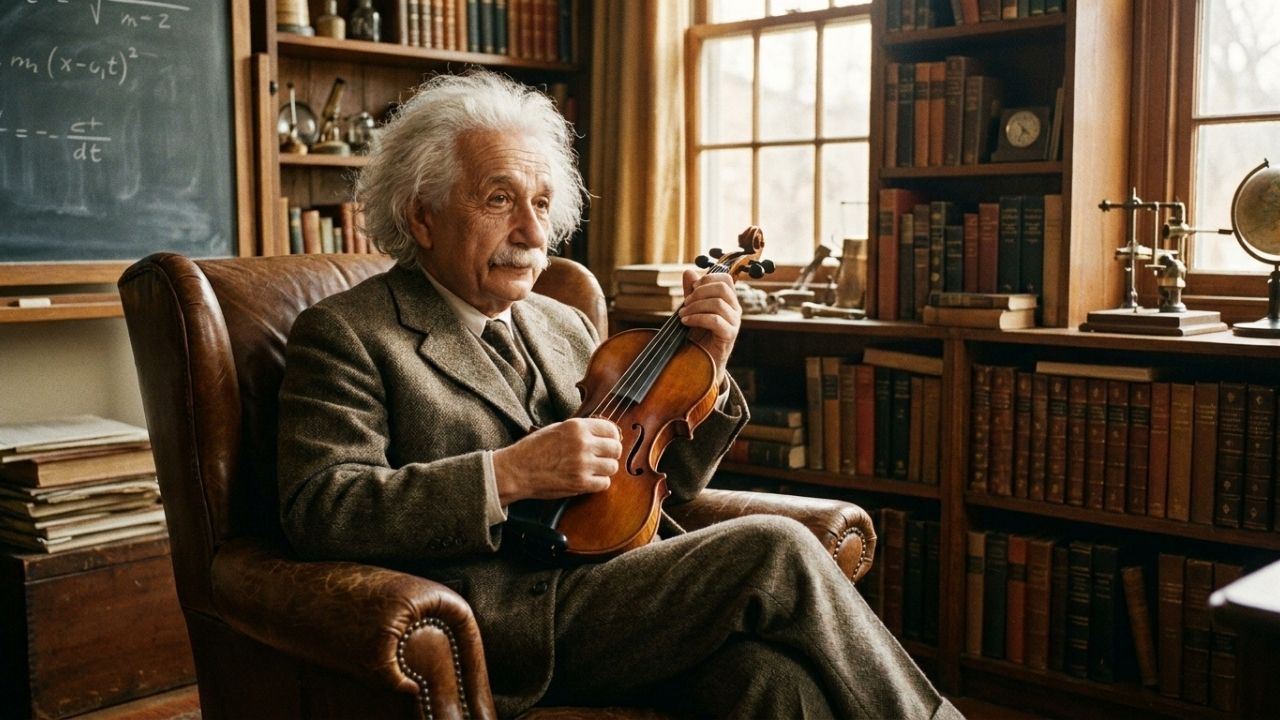
When we think of Albert Einstein, certain images immediately come to mind. The wild, unkempt hair. The thoughtful gaze. The tongue sticking out in that famous photograph. These visual cues have cemented Einstein as the quintessential “mad scientist” in popular culture. But behind this caricature lies a man of profound complexity, contradiction, and humanity whose personal life was far more intricate than his public persona suggested.
The Man Behind the Equations 👨🔬
Born in Ulm, Germany, in 1879, Albert Einstein would go on to revolutionize our understanding of space, time, and gravity. His annus mirabilis, or “miracle year,” of 1905 produced four groundbreaking papers that changed physics forever. Yet while his scientific contributions are well-documented and celebrated, his personal struggles, relationships, and private thoughts remain less explored by the general public.
Einstein was not merely a brain in a jar, disconnected from human emotion and social reality. He was a passionate advocate for civil rights, a devoted father (though a complicated one), a lover of music, and a man who grappled with the moral implications of his own discoveries. To understand Einstein fully, we must look beyond the equations and examine the person who wrote them.
A Complicated Personal Life 💔
Einstein’s first marriage to Mileva Marić, a fellow physicist and the only woman in his graduating class at the Zurich Polytechnic, was both intellectually stimulating and personally turbulent. They met as students and shared a deep connection through their mutual love of physics. Some historians argue that Marić contributed significantly to Einstein’s early work, though this remains a subject of debate among scholars.
The couple had three children: Lieserl, whose fate remains mysterious, Hans Albert, and Eduard. Einstein’s relationship with his children was strained, particularly after he left Mileva for his cousin Elsa Löwenthal. His letters reveal a man torn between his devotion to science and his responsibilities as a husband and father. He once wrote that marriage was an “amateur attempt” at something he was too busy to pursue properly.
This pattern repeated itself in his second marriage to Elsa, which lasted from 1919 until her death in 1936. While more stable than his first marriage, it too was marked by Einstein’s frequent absences and his inability to fully commit to domestic life. He traveled extensively, lecturing around the world and collaborating with other physicists, often leaving his family behind for months at a time.
The Refugee Scientist 🌍
The rise of Nazism in Germany forced Einstein, who was Jewish, into exile. In 1933, he renounced his German citizenship and eventually settled in the United States, taking a position at the Institute for Advanced Study in Princeton, New Jersey. This displacement profoundly affected him, transforming him from a European academic into a global humanitarian figure.
In America, Einstein became increasingly vocal about political and social issues. He spoke out against racism, corresponding with African American intellectuals and supporting civil rights causes. He visited historically black colleges, condemned lynching, and worked with Paul Robeson and W.E.B. Du Bois. For Einstein, the fight against racial prejudice was inseparable from his broader commitment to human dignity and justice.
His status as a refugee also made him acutely aware of the plight of displaced persons worldwide. He advocated tirelessly for those fleeing persecution, using his fame to draw attention to humanitarian crises. This aspect of his life is often overlooked in favor of his scientific achievements, yet it reveals a man deeply engaged with the moral questions of his time.
Music as Solace 🎻
Few people know that Einstein was an accomplished violinist. He began playing at age six and continued throughout his life, often stating that music helped him think. “If I were not a physicist,” he once said, “I would probably be a musician. I often think in music. I live my daydreams in music. I see my life in terms of music.”
He frequently played chamber music with friends and colleagues, finding in Mozart and Bach a kind of order and beauty that complemented his scientific worldview. Music provided Einstein with emotional release and intellectual stimulation, serving as a counterbalance to the abstract nature of theoretical physics. Friends recalled evenings spent in informal concerts, where Einstein would lose himself completely in the music, his face transformed by joy and concentration.
This passion for music reveals another dimension of Einstein’s personality: his appreciation for aesthetics and harmony. Just as he sought elegant solutions to physical problems, he found satisfaction in the structured beauty of classical compositions. Music was not merely a hobby but an integral part of how he experienced and understood the world.
The Moral Dilemma of Nuclear Power ☢️
Perhaps the most troubling aspect of Einstein’s legacy concerns his indirect role in the development of nuclear weapons. In 1939, he signed a letter to President Franklin D. Roosevelt warning that Nazi Germany might be developing atomic bombs and urging the United States to begin its own nuclear research program. This letter helped initiate the Manhattan Project, which ultimately produced the bombs dropped on Hiroshima and Nagasaki.
Einstein later expressed deep regret about this involvement. He had not participated directly in the Manhattan Project, having been deemed a security risk due to his pacifist views, but he felt responsible for having set events in motion. After the war, he became a passionate advocate for nuclear disarmament and international cooperation. “The unleashed power of the atom has changed everything save our modes of thinking,” he warned, “and thus we drift toward unparalleled catastrophe.”
In his final years, Einstein worked closely with Bertrand Russell and other intellectuals to promote peace and prevent nuclear proliferation. He saw clearly that scientific progress without ethical guidance could lead to destruction rather than enlightenment. This moral awakening transformed him from a pure scientist into a public intellectual concerned with the societal implications of scientific discovery.
Private Thoughts and Public Persona 📝
Einstein’s personal writings, including his travel diaries from the 1920s, have sparked controversy in recent years. These documents contain passages that appear prejudiced against various ethnic groups, contradicting his public stance against racism. Scholars debate how to reconcile these private reflections with his public advocacy for equality and justice.
Some argue that these writings reflect the casual prejudices common in Einstein’s era and social circle, which he later outgrew. Others suggest they reveal a more complex and contradictory figure than the saintly image often portrayed. What seems clear is that Einstein evolved over time, learning from his experiences and expanding his circle of empathy.
His public persona was carefully cultivated. The disheveled appearance, the refusal to wear socks, the playful photographs all contributed to an image of the eccentric genius unconcerned with convention. Yet this image masked a shrewd understanding of media and public relations. Einstein knew how to use his fame to advance causes he believed in, from Zionism to pacifism to civil rights.
Legacy Beyond Physics 🌟
Today, Einstein’s name is synonymous with genius itself. Yet his true legacy extends far beyond relativity theory and the equation E=mc². He demonstrated that scientists have a responsibility to engage with society, to consider the ethical dimensions of their work, and to use their platforms for positive change.
His life reminds us that great minds can also be flawed humans, capable of both extraordinary insight and ordinary failings. He struggled with relationships, held prejudices he later rejected, and made decisions he came to regret. Yet he also showed remarkable courage in standing up for his beliefs, compassion for the suffering of others, and an unwavering commitment to truth and justice.
As we continue to grapple with the implications of artificial intelligence, genetic engineering, and climate change, Einstein’s example remains relevant. He showed us that scientific brilliance must be paired with moral wisdom, that knowledge without ethics is dangerous, and that even the most abstract thinkers have a duty to engage with the human condition.
The secret life of Albert Einstein teaches us that behind every icon is a complex human being, shaped by contradictions and capable of growth. His story is not just one of scientific triumph but of personal evolution, moral struggle, and the ongoing quest to understand both the universe and our place within it.
In honoring Einstein, we should celebrate not just his equations but his humanity, not just his intellect but his conscience. For in the end, it is this combination of brilliant mind and caring heart that makes his legacy truly enduring.