For millennia, humanity has gazed at the night sky with a mixture of wonder and existential dread. We have mapped the stars, measured the expansion of space, and decoded the cosmic microwave background radiation that echoes from the dawn of time. Yet one question remains stubbornly elusive, haunting both scientists and philosophers alike. How will it all end? The universe, vast and seemingly eternal, is not immune to change. In fact, current cosmological models suggest that everything we see, from the smallest atom to the largest galaxy cluster, is destined for a final transformation. While the timeline stretches far beyond human comprehension, the mechanisms of cosmic demise are being pieced together through rigorous observation and theoretical physics. Here are seven scientifically grounded scenarios for how the universe could reach its ultimate conclusion.
The Big Freeze: Entropy’s Ultimate Victory
The most widely accepted theory for the end of the universe is known as the Big Freeze, or Heat Death. This scenario is rooted in the second law of thermodynamics, which states that entropy, or disorder, in an isolated system always increases over time. The universe is effectively an isolated system, meaning its total energy is fixed, but its usable energy is constantly diminishing.
As stars burn through their nuclear fuel, they will eventually exhaust their supply of hydrogen and helium. New star formation will cease as gas clouds dissipate or become too diffuse to collapse under gravity. The existing stars will die, leaving behind white dwarfs, neutron stars, and black holes. Over trillions of years, even these remnants will cool and fade. White dwarfs will become black dwarfs, cold spheres of degenerate matter that emit no light. Black holes will dominate the cosmos, but even they are not eternal. Through a process known as Hawking radiation, black holes slowly lose mass and energy, eventually evaporating into nothingness.
In this cold, dark future, the universe will reach a state of maximum entropy. Temperature differences will vanish, and no work can be performed. There will be no life, no light, and no movement. Just a uniform, lukewarm sea of particles drifting endlessly in the void. This is not a violent end, but a slow, quiet fading into oblivion. It is the ultimate triumph of entropy, where order gives way to chaos, and energy becomes uniformly distributed and useless.
The Big Rip: Tearing Reality Apart
While the Big Freeze assumes a gradual cooling, the Big Rip proposes a far more violent conclusion. This scenario depends on the nature of dark energy, the mysterious force driving the accelerated expansion of the universe. If dark energy grows stronger over time, a phenomenon known as phantom energy, it could eventually overcome all other forces holding matter together.
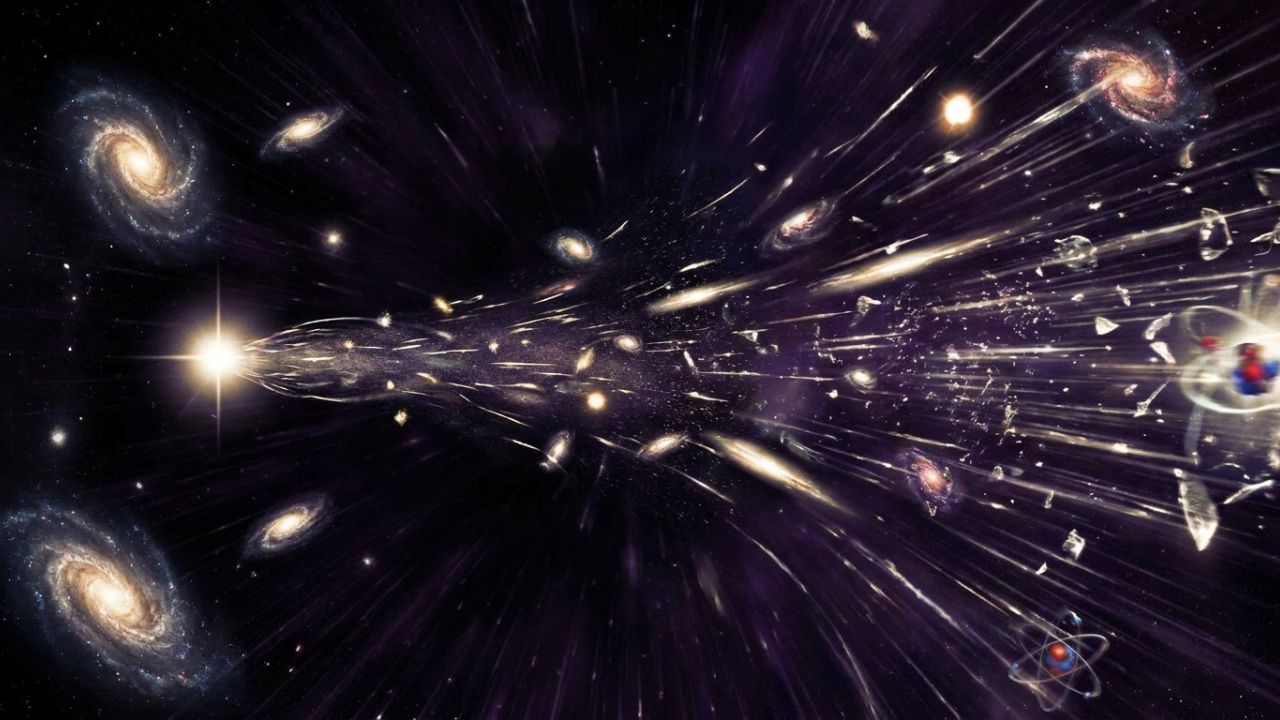
Initially, the accelerating expansion would tear apart galaxy clusters, separating galaxies from one another. As the force intensifies, it would rip apart individual galaxies, scattering stars into the void. Then, the fabric of solar systems would unravel, with planets being flung away from their host stars. The destruction would continue on smaller scales, tearing apart stars, planets, and eventually atoms themselves. In the final moments, even subatomic particles would be ripped apart, leaving nothing but a soup of fundamental particles disconnected from each other.
The Big Rip is a terrifying prospect because it implies that no structure, no matter how small or tightly bound, can survive. It is a complete disintegration of reality, driven by an ever-increasing repulsive force. Current observations suggest that dark energy is relatively constant, making the Big Rip less likely than the Big Freeze, but it remains a plausible outcome if our understanding of dark energy evolves.
The Big Crunch: A Cosmic Reversal
For much of the twentieth century, the Big Crunch was considered a leading candidate for the universe’s end. This scenario posits that the expansion of the universe will eventually slow down, stop, and reverse due to the gravitational pull of all the matter within it. If the density of the universe exceeds a critical value, gravity will win out over expansion.
Galaxies would begin to move closer together, colliding and merging in a chaotic dance. The cosmic microwave background radiation would heat up, turning the sky from black to red, then to white, as temperatures soared. Stars would collide, and black holes would merge, growing ever larger. Eventually, all matter would be compressed into a single point of infinite density and temperature, similar to the conditions at the beginning of the Big Bang.
This cyclical model suggests that the universe could bounce back from the crunch, initiating a new Big Bang and starting the cycle anew. However, recent discoveries about the accelerated expansion of the universe, driven by dark energy, have made the Big Crunch seem unlikely. Unless dark energy changes its behavior dramatically, gravity does not appear strong enough to halt the expansion.
Vacuum Decay: The False Ground State
One of the more unsettling theories involves the stability of the Higgs field, which gives particles their mass. According to quantum field theory, the universe might exist in a false vacuum state, meaning it is not in its lowest possible energy level. If this is true, the universe is metastable, like a ball resting in a shallow dip on a hillside rather than at the bottom.
A quantum fluctuation could nudge the Higgs field into its true vacuum state, creating a bubble of lower energy that expands at the speed of light. Inside this bubble, the laws of physics would be different. Particles might have different masses, and chemical bonds might not form. The bubble would destroy everything in its path, rewriting the fundamental rules of reality as it goes.
Because this bubble expands at the speed of light, there would be no warning. One moment, everything would be normal, and the next, existence as we know it would cease. This scenario is purely theoretical and depends on precise measurements of the Higgs boson mass and other particle properties. Current data suggests the universe is likely stable, but the possibility of vacuum decay cannot be entirely ruled out.
The Big Slurp: Black Hole Dominance
In this scenario, black holes become the dominant structures in the universe, slowly consuming everything else. As stars die and galaxies drift apart, black holes will continue to grow by accreting matter and merging with other black holes. Over immense timescales, they could consume entire galaxies, leaving behind a cosmos populated only by supermassive black holes.
Eventually, even these black holes will evaporate via Hawking radiation, but the process will take googols of years. During this era, the universe will be dark and cold, punctuated only by the occasional burst of energy from black hole mergers or evaporation. This is a variation of the Big Freeze, but with a focus on the role of black holes as the last standing structures before the final fade.
Proton Decay: The Dissolution of Matter
Standard models of particle physics suggest that protons, the building blocks of atomic nuclei, might not be stable forever. If protons decay, all matter in the universe will eventually dissolve. This process is incredibly slow, with a half-life estimated to be far longer than the current age of the universe.
If proton decay occurs, atoms will break apart, releasing positrons and photons. Stars, planets, and even black holes will disintegrate into subatomic particles and radiation. The universe will become a thin gas of leptons and photons, drifting in an ever-expanding void. This scenario leads to a similar end state as the Big Freeze, but through the dissolution of matter itself rather than just the exhaustion of energy.
The Big Bounce: Cyclical Cosmology
Some theories propose that the universe undergoes endless cycles of expansion and contraction. In this model, the current expansion will eventually reverse, leading to a Big Crunch, which then triggers a new Big Bang. This cyclic universe avoids a definitive end, instead proposing an eternal recurrence of cosmic birth and death.
Modern versions of this theory, such as conformal cyclic cosmology, suggest that information from one aeon can influence the next. While speculative, these models offer a philosophical alternative to a final end, implying that the universe is eternal in a different sense. However, evidence for such cycles remains elusive, and the mechanism for bouncing from a crunch to a bang is not well understood.
Conclusion: Embracing the Unknown
The fate of the universe remains one of the greatest mysteries in science. Each of these scenarios offers a different vision of the end, from the quiet fade of the Big Freeze to the violent tear of the Big Rip. While current data favors the Big Freeze, our understanding of dark energy, quantum mechanics, and gravity is still evolving. New discoveries could shift the balance toward a different outcome.
Regardless of which scenario proves correct, the timeline is so vast that it has no immediate impact on human existence. Yet, contemplating the end of the universe serves a profound purpose. It reminds us of the fragility and preciousness of the present moment. In the face of cosmic inevitability, our lives, our achievements, and our connections gain meaning precisely because they are temporary. The universe may end, but for now, it burns bright, offering us the chance to explore, understand, and appreciate the magnificent cosmos we call home.