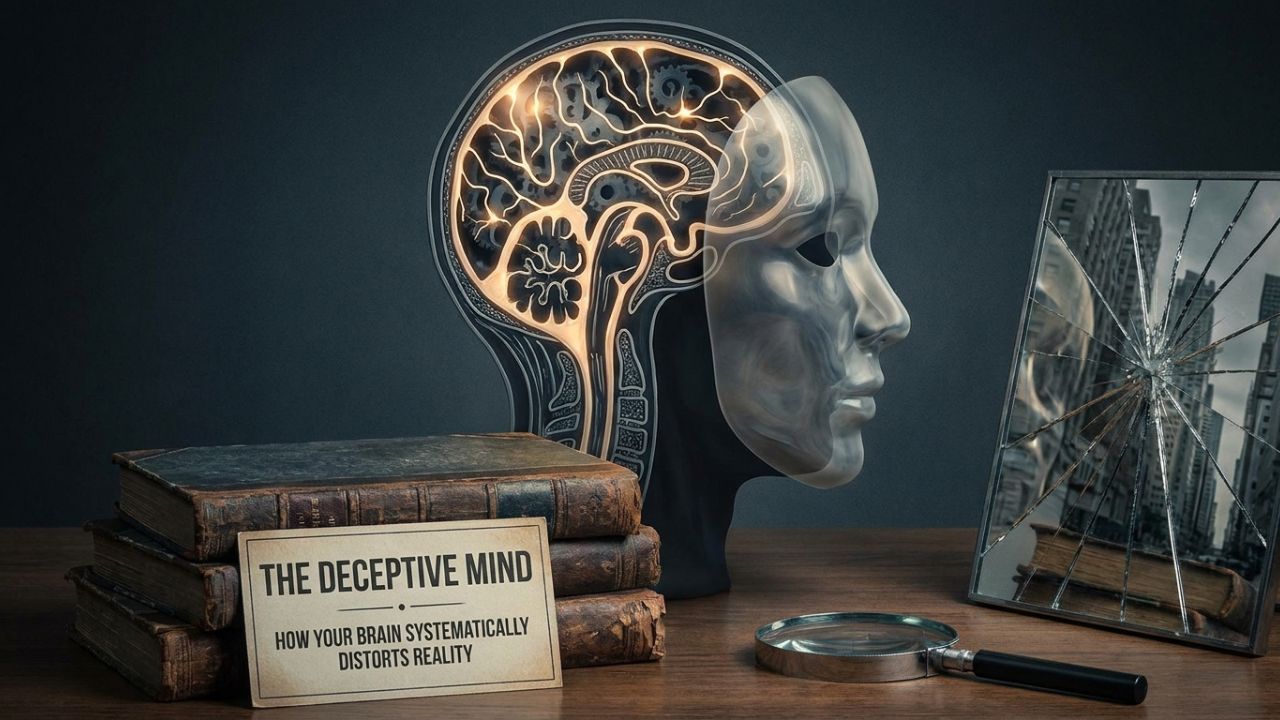
Your brain is not a passive recorder of reality. It is an active constructor, constantly filtering, interpreting, and sometimes fabricating the world around you. Every day, without your conscious awareness, your mind takes shortcuts, fills in gaps, and makes assumptions that can lead you far from objective truth. This phenomenon is not a flaw but a feature of human cognition evolved for survival, yet in our modern world, these mental shortcuts often work against us, creating systematic distortions in how we perceive information, make decisions, and interact with others.
The human brain processes approximately 11 million bits of information per second, yet our conscious awareness can only handle about 40 to 50 bits per second. To manage this overwhelming disparity, our minds have developed sophisticated filtering systems known as cognitive biases. These are mental shortcuts that allow us to process information quickly, but they come at the cost of accuracy. From confirmation bias that leads us to seek information supporting our existing beliefs, to the availability heuristic that makes recent or vivid events seem more probable than they actually are, our brains are constantly engaged in a subtle deception of ourselves.
Why This Matters
Understanding how your brain deceives you is not merely an academic exercise. It has profound implications for every aspect of your life, from personal relationships to professional decisions, from financial choices to political beliefs. In an era of information overload and sophisticated manipulation techniques, recognizing these cognitive patterns is essential for maintaining intellectual autonomy and making sound judgments.
The stakes have never been higher. Social media algorithms exploit our cognitive biases to keep us engaged, often by feeding us content that confirms our preexisting views. Political campaigns use psychological insights to craft messages that bypass rational analysis and appeal directly to emotional responses. Marketing strategies are built on understanding how consumers’ brains process information and make purchasing decisions, often leading people to buy things they do not need based on manufactured urgency or social proof.
Moreover, these cognitive distortions affect how we remember our own experiences. Memory is not a video recording but a reconstruction, influenced by our current emotions, beliefs, and subsequent information. This means that two people can witness the same event and genuinely remember it differently, each believing their version is accurate. In legal contexts, this has led to wrongful convictions based on faulty eyewitness testimony. In personal relationships, it creates conflicts where both parties sincerely believe they are correct about what happened.
The ability to recognize when your brain is misleading you is perhaps the most important critical thinking skill you can develop. It allows you to question your first impressions, seek out contradictory evidence, and make decisions based on a more complete picture of reality rather than a curated subset designed for cognitive efficiency.
Concrete Case Studies with Specific Data
Case Study 1: The Financial Crisis and Overconfidence Bias
The 2008 global financial crisis provides a stark example of how cognitive biases can have catastrophic consequences. Research published in the Journal of Behavioral Finance found that over 90 percent of fund managers exhibited overconfidence bias, believing they could consistently beat the market despite evidence showing that the vast majority cannot sustain such performance over time.
A specific study by Barber and Odean analyzed trading records of 66,500 households and found that those who traded most frequently earned annual returns of 11.4 percent, compared to 17.9 percent for those who traded least frequently. The excessive trading was driven by overconfidence in their ability to predict market movements, resulting in significantly lower returns due to transaction costs and poor timing decisions.
Furthermore, credit rating agencies suffered from confirmation bias, continuing to rate mortgage-backed securities as safe investments even as evidence mounted that the underlying mortgages were increasingly risky. Standard & Poor’s rated 91 percent of AAA-rated collateralized debt obligations issued between 2002 and 2007, yet by 2008, over 80 percent of these had been downgraded to junk status. The agencies’ analysts had become so invested in their initial assessments that they systematically discounted contradictory information.
Case Study 2: Medical Diagnosis and Anchoring Bias
In healthcare, anchoring bias can have life-or-death consequences. A study published in JAMA Internal Medicine examined diagnostic errors in internal medicine and found that cognitive biases contributed to approximately 75 percent of diagnostic mistakes. Anchoring bias occurs when clinicians fixate on initial information and fail to adjust their diagnosis adequately as new information emerges.
Researchers at Harvard Medical School conducted an experiment where physicians were presented with patient cases. When given an initial suggested diagnosis, even if it was incorrect, doctors were significantly more likely to stick with that diagnosis despite contradictory symptoms appearing later. In one trial, 40 percent of physicians maintained their initial incorrect diagnosis even when presented with clear evidence pointing to an alternative condition.
The data becomes even more concerning when examining specific conditions. A review of misdiagnosed cancer cases found that anchoring on benign explanations for symptoms delayed proper diagnosis by an average of six months, during which time many cancers progressed to more advanced stages. This delay reduced five-year survival rates by approximately 15 to 20 percent for several common cancer types.
Case Study 3: Hiring Decisions and the Halo Effect
Corporate hiring practices reveal how the halo effect distorts judgment. The halo effect occurs when one positive trait influences our overall perception of a person. Research from the Society for Human Resource Management analyzed hiring decisions across multiple industries and found that interviewers spent an average of just 5 to 7 minutes forming their initial impression of a candidate, yet this brief assessment influenced their final decision in over 80 percent of cases.
A controlled study by psychologists at Stanford University demonstrated this effect dramatically. Participants evaluated identical resumes except for the candidate’s name and photograph. Resumes with attractive photos received 30 percent more callbacks than those with less attractive photos, despite identical qualifications. Even more troubling, when evaluators were explicitly told to ignore physical appearance, the bias persisted, suggesting these cognitive distortions operate largely outside conscious control.
The economic impact is substantial. McKinsey Global Institute estimates that biased hiring practices cost the U.S. economy approximately $450 billion annually in lost productivity from suboptimal talent placement and reduced diversity of thought in organizations.
Expert Perspectives on Cognitive Deception
Dr. Daniel Kahneman, Nobel laureate and author of Thinking, Fast and Slow, explains the dual-system nature of human cognition. Our fast, intuitive system operates automatically and is prone to biases, while our slow, analytical system requires effort and is better at logical reasoning but is lazy and often defers to the faster system. Kahneman notes that even experts in their fields are susceptible to these biases because the intuitive system operates regardless of expertise.
According to Dr. Cass Sunstein, professor at Harvard Law School and co-author of Nudge, these cognitive limitations are not individual failures but universal human characteristics. He argues that understanding these biases should inform the design of institutions, policies, and choice architectures that help people make better decisions without restricting freedom. Sunstein emphasizes that acknowledging our cognitive vulnerabilities is the first step toward building systems that compensate for them.
Dr. Elizabeth Loftus, a leading researcher on memory distortion at the University of California, Irvine, has demonstrated through decades of research that memories are malleable and can be altered by suggestion. Her famous studies showed that simply asking leading questions could implant false memories in participants, with some individuals developing detailed recollections of events that never occurred. Loftus warns that confidence in a memory is not correlated with its accuracy, challenging our fundamental assumption that vivid, detailed memories must be true.
How This Impacts Your Life
The implications of cognitive deception extend into every domain of human experience. In personal finance, loss aversion causes people to hold onto losing investments too long and sell winning investments too early, systematically reducing portfolio returns. Studies show that individual investors underperform market indices by an average of 4 to 6 percent annually due to emotionally driven trading decisions.
In relationships, the fundamental attribution error leads us to attribute others’ negative behaviors to their character while attributing our own similar behaviors to circumstances. This asymmetry creates persistent conflicts and prevents empathy. Research indicates that couples who understand and actively counteract this bias report 40 percent higher relationship satisfaction scores.
In the workplace, groupthink suppresses dissenting opinions and leads organizations to make poorly vetted decisions. The Challenger space shuttle disaster exemplifies this, where engineers’ concerns about O-ring performance in cold weather were dismissed due to organizational pressure to launch. Post-incident analysis revealed that multiple team members had reservations but failed to voice them adequately due to perceived consensus.
On a societal level, the backfire effect makes people double down on incorrect beliefs when presented with corrective information, particularly on politically charged topics. This phenomenon helps explain why fact-checking often fails to change minds and may even strengthen misconceptions. Understanding this dynamic is crucial for effective communication and public policy implementation.
Recognizing that your brain lies to you is not cause for despair but empowerment. By understanding these mechanisms, you can develop strategies to counteract them. Seek diverse perspectives, slow down important decisions, create checklists for complex tasks, and cultivate intellectual humility. The goal is not to eliminate cognitive biases entirely, which is impossible, but to build awareness and systems that mitigate their most harmful effects.