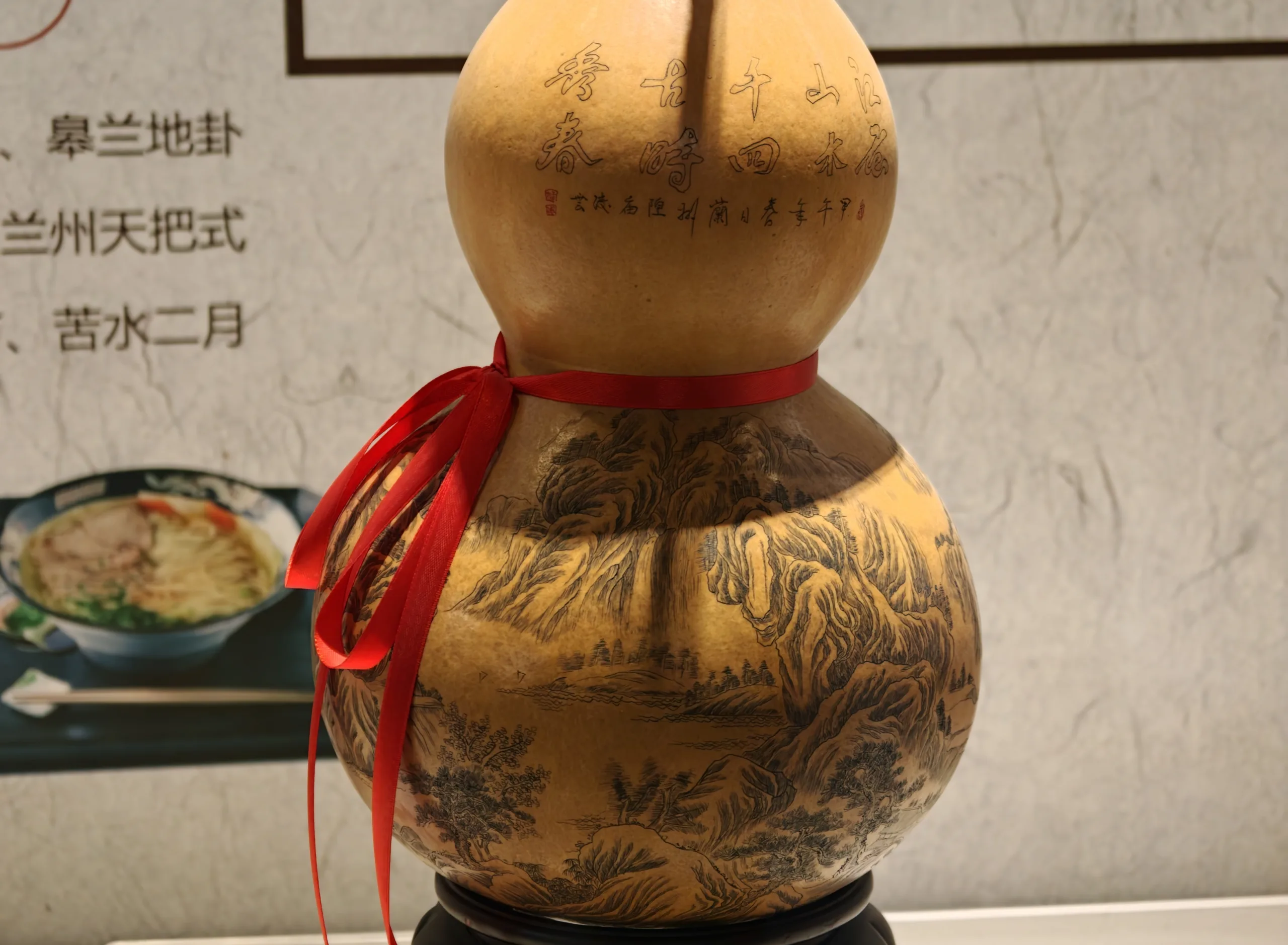
The technique of engraving gourds has been practiced in the capital of Gansu province for more than 1,600 years. The origins date back to the Wei-Jin period (220-420 AD), when artisans from Lanzhou began engraving patterns on the gourds arriving via the Silk Road. In 2006, the practice was inscribed on the first list of intangible heritage in Gansu Province. Today it is considered one of the region’s three cultural treasures, alongside beef noodles and sheepskin rafts.
Lanzhou gourd engraving uses precision needles and styluses to make low-relief lines on the dried skin of the fruit. Artist Ruan Lin is the fourth generation of a family that has kept this art since 1936.
“The cultivation of gourds dates back to Antiquity,” explains Lin. “Farmers planted them at home. After harvesting, they saved the seeds, ate the pulp, cut the larger ones to use as water vessels or grain pots. They tied the smaller ones to their waist to carry water to the field. Since ancient times, they have carved simple decorations into the gourds they carried. This craft was passed down from generation to generation and became the art we see today.”
Ruan Lin today holds the title of Master of Arts and Crafts of Gansu and Provincial Heir of Intangible Heritage, granted by the Gansu Department of Culture and Tourism. The journey to this recognition began in childhood.
“I started practicing calligraphy and painting when I was four or five,” she says. “At eight, I first tried copying patterns on gourds with a needle. After my father approved my work, I began creating independently at fifteen. It took me a whole decade to master the entire process: from calligraphy and painting to gourd carving.”
Works by older masters from the same family lineage are part of the national collection. Ruan Wenhui, the first artist from Gansu to receive the national title of Master of Arts and Crafts of China, produced sets of microprints that include 204 Tang Dynasty poems on gourds, recognized as national treasures.
In the studio, Ruan Lin moves between the classic and the contemporary. “The most experienced craftsmen mainly carve traditional cultural motifs, ancient tales and stories from the Four Great Classical Novels,” he explains. “Younger creators choose more personal themes: landscapes, poems from the Tang and Song dynasties, tigers, tomb fresco patterns, zodiac animals and constellations. I am the fourth generation of gourd carvers in my family, following my grandfather and father. We carve both classical and modern themes: gourds with traditional patterns are coveted by collectors; gourds with modern themes are popular among young people as ornaments for personal use.”
Ruan Lin has worked with Zheng Yinglan for more than twenty years; Both have been friends since childhood. Zheng talks about some conditions for mastering the art.
“To learn gourd carving well, you need to have a solid foundation in painting and calligraphy, a genuine passion for the craft, and perseverance,” she says. “If you stay dedicated and interested, it will take about a year before you can create complete pieces independently. It usually takes five to ten years of continuous practice to reach a high standard.”
The transmission is now advancing to the fifth generation. Ruan Xiyue, Ruan Lin’s daughter, conducts her own training programs at the studio. One of her apprentices was recognized as Lanzhou Municipal Master of Arts and Crafts. Children from schools in the capital also participate in initiation courses.
“This craft has a history of hundreds of years, and we want to pass it down from generation to generation,” says Zheng. “We call the carved gourds ‘auspicious gourds’. The Chinese character for gourd (葫芦, húlú) has a similar pronunciation to ‘blessing and fortune’ (福禄, fúlù), which symbolizes good luck and prosperity. We want to keep this art alive forever,” he concludes.
Source: www.brasildefato.com.br