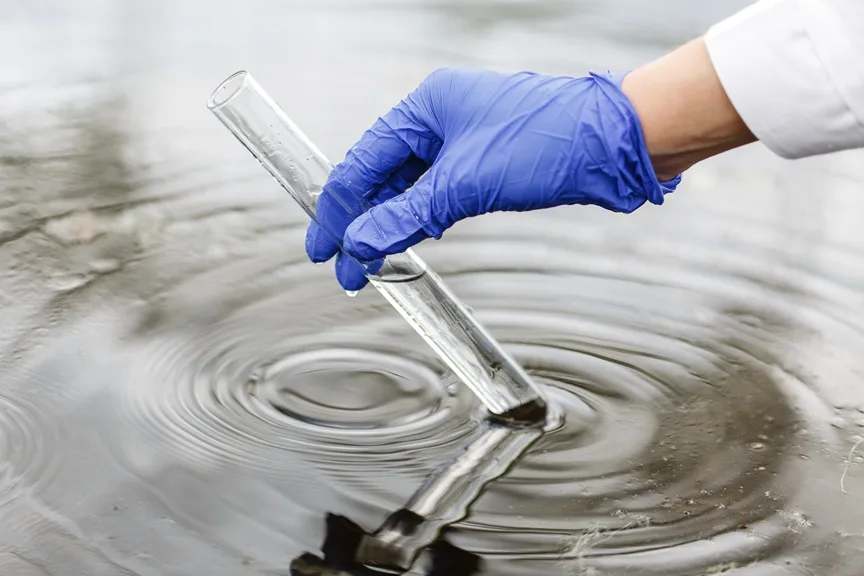
Researchers from the Scientific and Educational Center of the South Ural State University, a partner of TV BRICSdeveloped, together with colleagues from other countries, a continuous flow electrochemical reactor to remove a persistent textile dye from water. The information was published on the university website.
The equipment was designed to decompose dye molecules that remain for long periods in the environment and can cause damage to aquatic organisms. Scientists proposed treating contaminated water using electrical current.
During the process, water passes through the reactor, while active particles form on the surface of a special electrode and decompose the dye molecules.
“The main difference in our development is the continuous flow format. The water does not just remain in a laboratory container, but circulates through the reactor. This brings the system closer to real industrial effluent treatment conditions”, said Vladislav Fadeev, a young researcher at the institution.
To operate the reactor, the researchers used a multilayer electrode. One of its active layers was modified with holmium, a rare earth element. The incorporation of this material helped to increase treatment efficiency and preserve electrode activity after successive cycles of use.
In laboratory tests, the solution containing the Reactive Black 5 dye completely lost its color within 90 minutes. Even after 15 treatment cycles, the system’s efficiency remained practically unchanged.
The technology could be used to develop compact systems designed to remove persistent organic pollutants from water.
Reactive Black 5 is one of the dyes used in fabric coloring. These substances adhere well to fibers, a characteristic that favors their use in industry. However, when it reaches the effluents, the dye changes the color of the water, makes it difficult for light to pass through and can harm aquatic organisms.
Current treatment methods, such as filters, adsorbent materials, ozone and membrane technologies, have limitations. Some require replacement materials, complex maintenance, high energy consumption or the subsequent disposal of contaminated waste.
The next stage of the research will be to test the reactor in real effluents and further optimize its structure.
Source: www.brasildefato.com.br