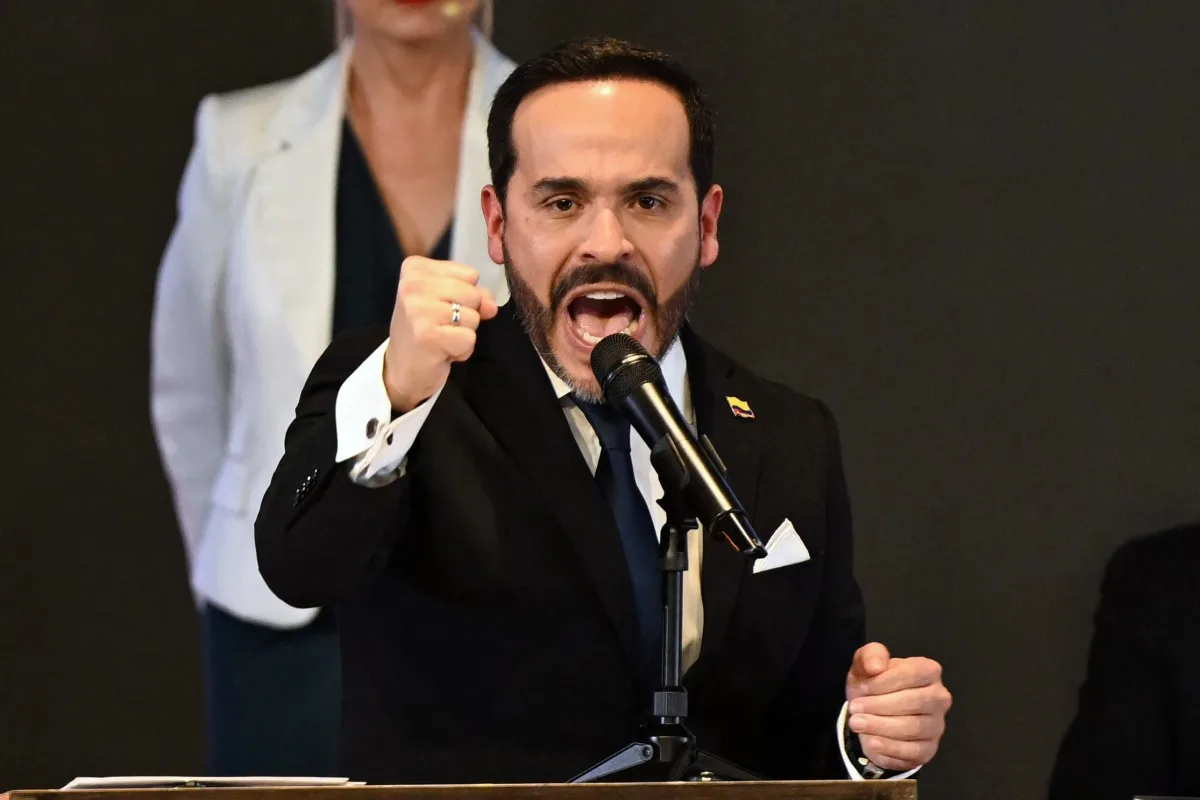
The election for the Presidency of the Colombian Senate was the first defeat for the newly elected far-right president, Abelardo de La Espriella, on Monday (20). He had nominated Alfredo Deluque for the presidency of the Senate. But, without a majority in the House, he saw Senator Honorio Henríquez, from the Democratic Center, being elected to the position.
Henríquez obtained 56 votes, surpassing the 45 obtained by his opponent. Linked to former president Álvaro Uribe, Deluque belongs to a political group that has already shown support for Abelardo’s government program. The elected president of the Senate will hold the position until 2030.
In an interview with BdF Connectionyes Radio Brasil de FatoGustavo Menon, professor at the Catholic University of Brasília (UCB) and at the Interunit Postgraduate Program in Latin American Integration (Prolam-USP), assesses that Espriella’s defeat was resounding. “The Historic Pact achieved a majority in the Senate given the renewal of the Senate election in 2026 and opposition sectors are betting beyond this institutional route”, he states, in reference to the moves that current president Gustavo Petro has made.
“Resistance must be carried out not only in parliament, but also on the streets”, argues Menon.
“Petro has called for a series of demonstrations to be led by social movements, student groups, unions, a group of workers and Colombians who come out in defense of exactly this complaint that, in the current Colombian situation, what is being created is a kind of Plan Colombia 2.0, with a clear association of Colombian foreign policy with the interests of the White House”, he highlights.
Plan Colombia was a bilateral cooperation agreement signed in the late 1990s between the governments of Colombia and the United States, with the justification of combating drug trafficking, but whose main action was to undermine the activities of the Revolutionary Armed Forces of Colombia (FARC) and the National Liberation Army (ELN).
Gustavo Menon also analyzed the arrival of the president of Argentina, Javier Milei, to Brazil, and that he does not have an agenda with President Lula (PT), but will meet with the governor of São Paulo, Tarcísio de Freitas (Republicans), and monitor the officialization of Flávio Bolsonaro’s (PL-RJ) candidacy.
For the analyst, this movement is an indication that the presidential election in Brazil has already begun. “I dare say that, in this scenario, in this atmosphere in Latin America as a whole, of political fragmentation and economic disintegration, see that there is an attempt to form an extreme right-wing project in the region very connected with Trumpism”, he warns.
“This activity, let’s say, in a network of projects, of right-wing and extreme-right parties in Latin America, ends up being associated with this tide, this wave of extreme right in the region, which ended up taking shape in the election of Keiko Fujimori, in Peru, Abelardo de La Espriella, in Colombia, and the performance of Milei in Argentina”, he adds.
To listen and watch
The newspaper BdF Connection airs in two editions, from Monday to Friday: the first at 12pm and the second at 5pm, on Radio Brasil de Fato98.9 FM in Greater São Paulo, with simultaneous transmission also on YouTube do Brasil de Fato.
Source: www.brasildefato.com.br