Published 04/12/2026 17:31
Hungarian Prime Minister Viktor Orbán admitted defeat in Hungary’s parliamentary elections this Sunday (12). Speaking to supporters, Orbán stated that the result is clear and that he has already congratulated the winning party.
With 45.7% of the votes counted, the National Electoral Council projected that the center-right Tisza party should win 135 of the 199 seats in parliament.
Viktor Orbán’s admission of defeat marks the end of a 16-year cycle in power, a period in which the prime minister consolidated a political model he described as “illiberal democracy”. The victory of the Tisza party, led by Peter Magyar, indicates a significant change in the country’s political balance.
With a projected qualified majority in Parliament — around two-thirds of the seats — the new government will have the institutional capacity to promote constitutional reforms, which expands the scope of the ongoing transformations.
Hungarian, agora
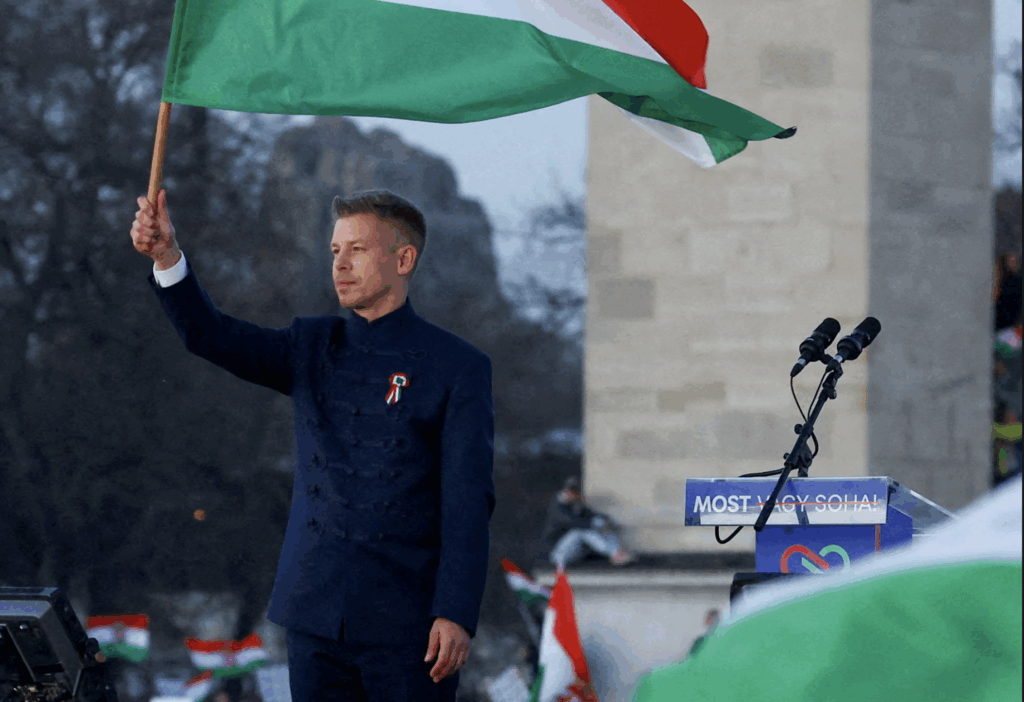
“Now or never”, Péter Magyar had been telling Hungarians during his tireless campaign across the country heading into this Sunday’s elections. Magyar’s slogan comes from the call made by a 19th century Hungarian revolutionary poet for people to mobilize in defense of the homeland. After more than 100 campaign events, his message was shortened to “Now.” The urgency led to the suppression of the expression “or never”.
Orbán describes him as a “puppet” of the European Union and Ukraine. Therefore, Magyar was careful not to get too close to Brussels. “We are the true party of peace,” he promised voters.
Until February 2024, Magyar was part of the Fidesz family. He joined the party at university and married one of its rising stars — Judit Varga, with whom he had three children. President Katalin Novák granted a pardon to a man who had helped cover up sexual abuse in a Hungarian state-run children’s home. She resigned and so did Magyar’s now ex-wife. Varga had been Minister of Justice and was one of the signatories of the pardon.
Magyar realized that this was his moment. “It wasn’t a planned move,” he said later. “Everyone knew the situation in Hungary. It’s not very safe to go against the government.” Magyar reinforced his accusations of corruption by releasing a secret recording of a conversation with his ex-wife in 2023, in which she talks about an important trial. Judit Varga stated that she was shocked by Magyar’s actions. She accused him of abuse, which he denies.
Magyar became a diplomat at Hungary’s permanent mission in Brussels. He later headed Orbán’s team at the European Parliament and was also a director of state-owned companies.
Magyar is not liberal. He openly ridiculed the liberal opposition that tried to oust Orbán in the past, empowering the Fidesz leader. Magyar took over the weak Tisza party and won 29.6% of the vote and seven seats in the European Parliament.
Magyar also had to defend himself against a scandal that he says was set up by Orban’s intelligence. He was allegedly lured into a sexual relationship with an ex-girlfriend, in a scene filmed in which drugs were laid out on a table.
The weight of internal wear
Fidesz’s defeat cannot be understood simply as a one-off electoral setback. The result reflects the accumulation of internal dissatisfaction, especially related to economic stagnation, allegations of corruption and deterioration of public services, such as health.
Furthermore, the concentration of power over the years — with recurring criticism of the limitation of the press and the reduction of institutional brakes — contributed to the government’s erosion among broader sectors of society.
Campaign marked by external polarization
During the campaign, Viktor Orbán focused on the international agenda as a mobilizing axis, reinforcing his proximity to conservative leaders such as Donald Trump and adopting critical positions towards the European Union and Ukraine.
This strategy, however, showed its limits in the face of an election strongly influenced by domestic issues. The attempt to shift the debate to geopolitical issues was not enough to contain the opposition’s advance.
Tisza and the promise of reconnection with the West
The rise of Peter Magyar represents not just an alternation of power, but a strategic reorientation. The leader of Tisza defends rapprochement with the European Union, the unlocking of frozen financial resources and the reduction of energy dependence on Russia.
At the same time, the discourse of “pragmatic relations” with Moscow indicates that the change will not be one of total rupture, but of recalibration in foreign policy.
Regional and global impacts
Viktor Orbán’s defeat has repercussions that go beyond Hungary’s borders. Considered a reference for populist and nationalist movements, its weakening could impact the articulation of these currents in Europe and other regions.
For the European Union, the result opens space for greater internal cohesion, reducing the blocking capacity exercised by Budapest on strategic issues, such as sanctions on Russia and support for Ukraine.
Transition and uncertainties
Despite the significant victory, Tisza will face structural challenges. The Hungarian political system, shaped over the years by Fidesz, can pose obstacles to quickly implementing change.
Even so, the electoral result points to a relevant inflection: Hungary begins a new political cycle, with expectations of institutional recomposition and redefinition of its role in the European scenario.
Source: vermelho.org.br