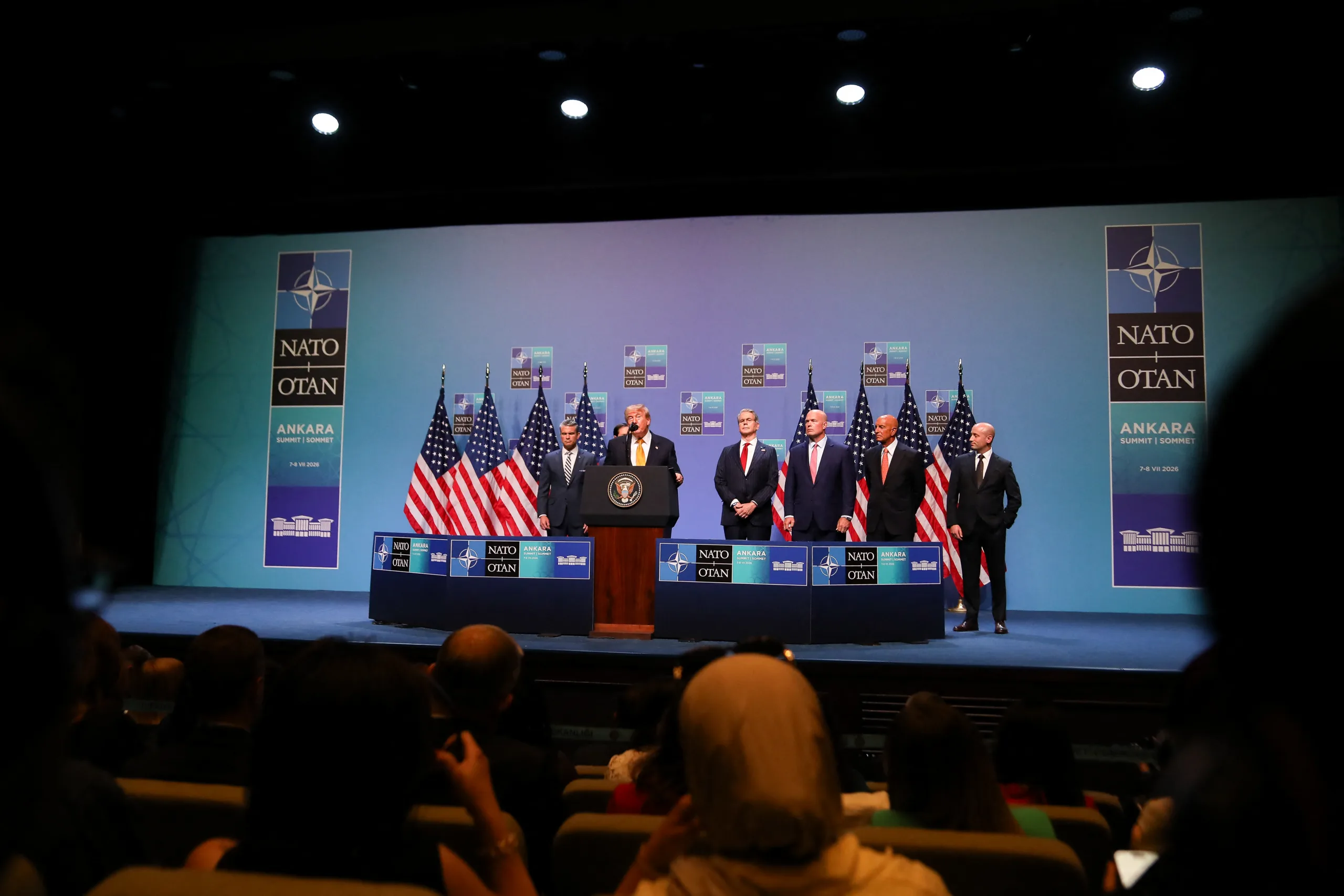
The NATO Summit, held this week, had the war in Ukraine as one of the main topics, amid the escalation of the conflict with Russia. During the event, Volodymyr Zelensky managed to secure more military and financial support from the Western military alliance, while Moscow warned of the risks of an intensification of the conflict in the event of external interference in the war.
In the joint declaration of the summit, on July 7th and 8th, in Ankara, Turkey, the countries of the Western military alliance highlighted that Russia represents a “long-term threat to Euro-Atlantic security and stability” and stated that they “remain united in their unwavering support for Ukraine”, confirming the supply of 70 billion euros in military equipment, assistance and training to Kiev.
In an interview with Brazil in factthe professor of International Relations at UFRJ, Fernando Brancoli, points out that, on a discursive level, the main objective of the summit was to seek to support an idea of “integration” of the group amid the oscillating movements of US President Donald Trump in relation to the bloc.
“Both Donald Trump and the leaders of Germany and Italy reinforced that it would be a good moment, in which there is a certain confluence of objectives, something that differs greatly from what we have seen in recent months, in which the United States mainly accused European countries of not contributing enough to the alliance”, he stated.
One of the main results of the meeting was precisely a sign of greater US inclination towards Ukraine’s interests in the context of the war with Russia. In particular, Donald Trump promised to grant Ukraine a license to produce interceptor missiles for the Patriot air defense system, something Kiev had been seeking for months.
Commenting on the White House’s position, Kremlin spokesman Dmitry Peskov stated that the fact that the US supports Ukraine is nothing new. However, he highlighted that Trump sends mixed signals about the conflict.
“The US continues to supply Ukraine with weapons and technology, as well as military personnel. This is true, we know. We are not being naive; President Putin knows this perfectly well. But at the same time, there is a certain ambiguity in the United States’ position. At the same time, the United States, unlike the Europeans, maintains the desire to facilitate the peace process. They may be mistaken at times, but this desire seems sincere to us,” he said.
Russia’s perception of Donald Trump’s wavering regarding the Ukrainian conflict is also not new. The summit in Anchorage, Alaska, between Vladimir Putin and Donald Trump, in August 2025, gave rise to the expression “spirit of Anchorage” in the Russian political and media space, to express optimism about the negotiations – and possible intentions more favorable to Moscow on the part of Trump.
However, talks between Putin and Trump on resolving the conflict did not bring concrete results and what was seen subsequently was the adoption of new US sanctions against Russia, and, now at the summit in Ankara, a positive nod from Trump to the Ukrainian leader, Volodymyr Zelensky.
On the other hand, even with the announcement of economic and military reinforcement for Ukraine during the summit, professor of International Relations Fernando Brancoli notes that there is a practical difficulty regarding Ukraine’s ability to produce US defense systems on its territory in the short term.
According to him, Trump’s statement implies two problems: “These missiles would not be ready anytime soon, so we would have, if the US effectively replaced the shipment of ready-made weapons to guarantee production, a complication of a period, a window of at least two years in which Ukraine would be without these missiles, which are quite important.”
“And the second point is in relation to what would be the American willingness to place a sensitive industry, with very strategic material, so close to the Russian border?”, asks the analyst.
Russia alert
The increase in support for Ukraine during the NATO summit comes at a time of escalating war. On the one hand, Russia has been increasing the number of massive missile and drone attacks against the capital Kiev, and, on the other, Ukraine is increasing drone attacks against the Russian energy sector.
In Moscow’s view, NATO’s growing large-scale military aid to Ukraine “not only blocks a peaceful resolution, but also directly implicates NATO member states in the current armed conflict.”
The Russian Foreign Ministry issued a statement last Thursday (9), stating that the West’s “adventurous plans” for continued military support for Kiev “will not go unnoticed by Moscow”. According to representatives of the Russian Foreign Ministry, quoted by the Russian newspaper Izvestia, “any aggression against the Russian Federation will be met with a decisive and destructive reaction”.
Moscow’s warning tone regarding the reinforcement of Western support for Ukraine was also expressed by Kremlin spokesman Dmitry Peskov, who said that there are some “wrong ideas” in the White House regarding the developments in the Ukrainian conflict. According to him, an intensification of Ukrainian actions in the war will lead Russia to change its strategy in relation to what Moscow understands as necessary to guarantee its security.
“We’ve seen some misconceptions within the White House administration. The misconception that escalation, military pressure, can facilitate a peaceful resolution […] further escalation will likely prolong the special military operation. We cannot say exactly to what extent, but this will lead to us having to create a larger safety zone, a larger buffer zone. Therefore, increasing tensions, acting in accordance with the escalation will not contribute in any way to the peace process,” he said.
The results of the NATO summit also reveal an apparent contradiction regarding the strengthening of support for Kiev and the ambiguous US position. At the same time that the Western military alliance classifies Russia as a “long-term threat”, President Donald Trump removed Russia from the threat classification in his latest foreign policy doctrine.
In this sense, NATO’s position remains unchanged in Moscow’s view, but the American president’s next steps remain in dispute. According to the professor of International Relations at UFRJ, Fernando Brancoli, there is a continuation of the accusations that Putin has been making in relation to the alliance over the last few years, declaring that NATO “is not a defensive collective of countries, but a coalition of states antagonistic to Russia, which continues a process of expansion”.
Source: www.brasildefato.com.br