In 2021, China launched a program to involve companies in the Rural Revitalization process, “Ten Thousand Companies Revitalizing Ten Thousand Villages”, which, in fact, is the continuation of the same program started in 2015 and which involved companies in the policy of eradicating extreme poverty.
The program was adapted to accompany the rural revitalization strategy, which aims to consolidate the achievements in combating poverty in the previous period.
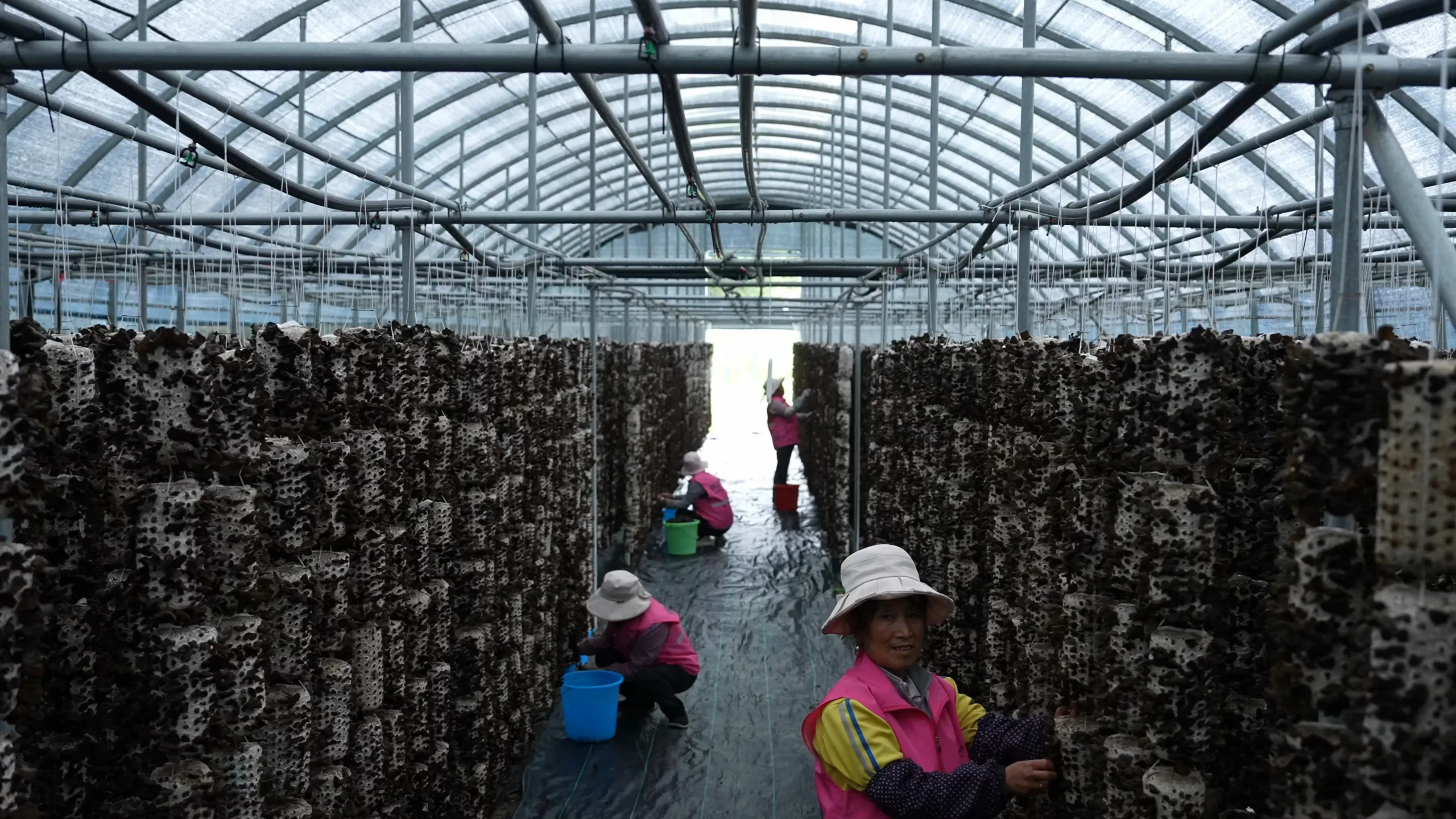
An example of the program is the “ecological” mushroom company (see definition below) Naduoduo, which is located in the Tibetan plateau region of Gannan, Gansu province.
People who left their homelands and became successful entrepreneurs abroad are among the actors that the “Ten Thousand Companies” program seeks to involve. Businesswoman Zhang Naxin is one of them. Born in Longnan, in the interior of Gansu, she spent time in the United States, where she studied, and returned to the province four years ago to found Naduoduo.
“I believe that rural revitalization has brought real benefits by attracting external investors: it generates more employment opportunities and better guarantees people’s livelihoods,” Zhang tells Brazil in fact.
Through a partnership with the Tianjin College of Agriculture (in the eastern region of the country), the company developed 17 varieties of mushrooms adapted to the altitude of Gannan Tibetan Autonomous Prefecture, which ranges from 1,100 meters to 4,900 meters above sea level.
Zhang Naxin says there was a technical training process for the cultivation of edible mushrooms and “primary processing services” for around 100 workers. More than 95% of workers are women, according to company data.
Tibetan heritage
The majority of Zhuoni’s population is Tibetan, which is why it is an autonomous province of this ethnic group. The cultural tourism that the county has been developing also relies on the intangible heritage of these communities.
Teng Li Ping cites two national-level intangible heritages: the Balang Drum Dance and the Sange Mao clothing.
Guide Yu Cai Xia is of Han and Tibetan descent, Zhuoni Tourism Office and often sings local songs for visitors. At the Fenda do Céu waterfall, in the Dayu valley, the reporter asked Yu to sing a traditional song. She chose “Lindo Zhuoni,” a song that celebrates the county where she lives. Listen to the song in the video report:
Ecological production
The cold and humid climate of the Tibetan plateau favors the cultivation of the mushroom known as Judas ear. As it is in an environmental preservation area, production needs to be “ecological”.
In China, agricultural products receive different certifications. The term “ecological” used by Naduoduo refers to the Green Food Level A standard, which is more rigorous than the conventional product, as it requires quality control and limits on the use of inputs, but is less demanding than organic certification, which completely prohibits the use of pesticides.
The process, explains Zhang, uses substrate bags made from sawdust and corncobs, under conditions that mimic the natural environment. After harvesting, the bags are recycled and become biomass pellets, a solid biofuel in the shape of small cylinders, made with vegetable waste compacted under high pressure. “The entire production process generates zero environmental contamination, so our production is not affected by environmental regulations”, he says.
Industry and cultural tourism
In 2020, Zhuoni County launched the “Five Crops of Ten Thousand Mu” plan (just over 666 hectares), an initiative that aims to develop five products on a large scale: edible mushrooms, barley, rapeseed, Tibetan medicinal herbs and fodder. For mushrooms, the goal is to keep the planted area above 10 thousand mu. In 2024, the county produced 2,800 tons of mushrooms, worth 208 million yuan (about R$160 million), benefiting 5,960 families, according to the county government.
Zhuoni’s development plan has mushrooms as one of its pillars, but it also focuses on ecological and cultural tourism. Teng Li Ping, vice chairman of the local Communist Party’s Art and Literature Committee, explained to Brazil in fact that the current focus has these two axes: the strengthening of agriculture and livestock and cultural tourism.
Barley, rapeseed and mushrooms, especially Judas ear, have contributed to increasing the income of peasants in the region.
On the tourism side, the region has several areas: the Dayu Valley, the Stone Gate of the Nine Heavens, the Jiudian Dam Lake, the Cheba Valley, centuries-old Tibetan houses and the Jiangdie Road, also known as “the most beautiful 100-kilometer scenic highway in China”.
Source: www.brasildefato.com.br