Published 05/20/2026 15:43 | Edited 05/20/2026 19:25
The political crisis in Bolivia entered a new phase this Tuesday (20), after leaders of the Bolivian Workers’ Central (COB) stated that the popular bases began to directly demand the resignation of President Rodrigo Paz.
Amid roadblocks, strikes and clashes in La Paz and El Alto, the government intensified repression against social movements, while reports indicate that Javier Milei’s Argentina was collaborating by sending military equipment and security agents to support the Bolivian Executive.
The general secretary of the COB, Claudio Choque, stated that the mobilized bases began to demand Rodrigo Paz’s immediate resignation, even putting pressure on the union leadership itself to adopt a tougher stance against the government.
According to him, radicalization occurs after weeks of economic crisis, fuel shortages, food inflation and police repression against protesters and union leaders.
“We are just spokespersons for the grassroots”, he declared on Rádio Éxito, when defending the suspension of arrest orders against social leaders and the release of those detained during the protests.
Choque stated that the government “has to come down from the clouds and talk sincerely with the mobilized sectors”, arguing that any negotiations take place in a “neutral place” and not at the headquarters of the Bolivian Executive.
Tension increased after the Bolivian Public Ministry issued arrest orders against COB leaders and peasant movements.
Among the targets is Mario Argollo, the main leader of the union center. The Bolivian vice-president, Edmand Lara, publicly asked Rodrigo Paz to suspend the arrests and call for a “real and unconditional” dialogue, recognizing that the repressive strategy deepens the crisis.
Protests spread and government mobilizes repressive apparatus
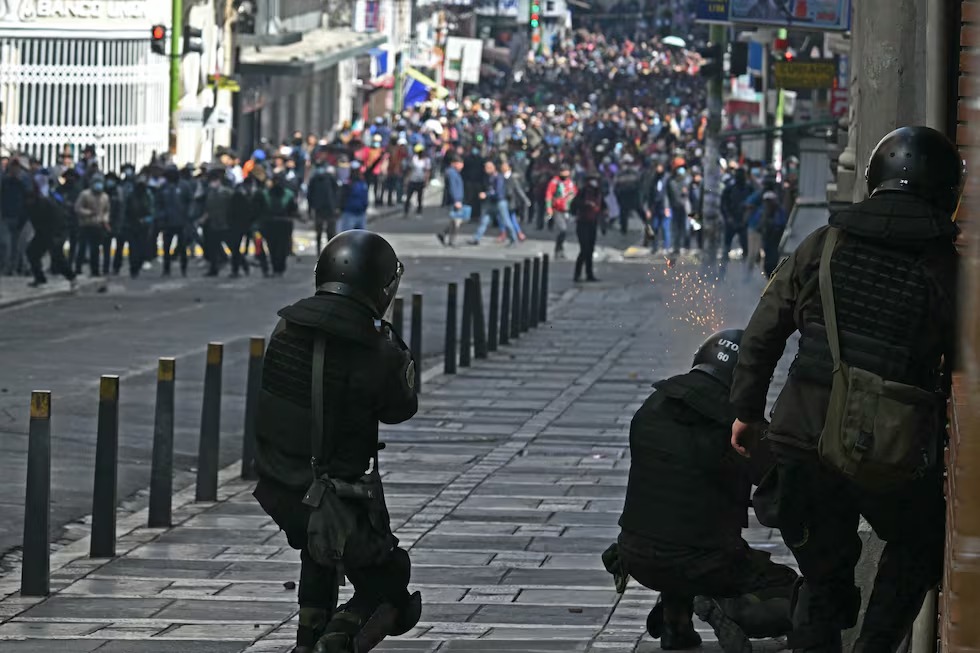
The mobilizations reached the political center of the country. In La Paz, thousands of protesters faced police near Murillo Square, where the Presidential Palace and Congress are located.
Security forces used tear gas to stop the protests from progressing, while blockades maintained for more than two weeks have interrupted the supply of food, fuel and medical oxygen in the Bolivian capital.
According to Bolivian police, more than 127 people have been arrested or detained in recent days.
The government deployed around 2,500 agents between La Paz and El Alto and announced legal proceedings against protesters accused of “terrorism” and “public instigation”. Bolivian analysts interviewed by the local press state, however, that the strategy recalls moments before the authoritarian escalation in the country.
Former Bolivian vice-minister Emilio Rodas told Page12 that repression tends to deepen the political crisis. “Historically, the greater the repression, the more radicalized the mobilizations,” he said.
Lawyer Gabriel Villalba Pérez classified the government’s actions as a “governmental sicariate” — a term used in Latin America to refer to practices of violence by armed groups or executors serving political and economic interests — and denounced that the Executive was offering financial rewards to police officers involved in repressive actions against the protests.
The demonstrations also exposed the degree of deterioration in Rodrigo Paz’s governability just six months after his inauguration.
A significant part of the groups that today block roads and march in the streets were decisive for his election in 2025, especially popular and indigenous sectors unhappy with the internal crisis of MAS following the dispute between Evo Morales and Luis Arce.
Economic crisis and neoliberal agenda fuel revolt
Bolivia is experiencing its worst economic crisis since the 1980s. After taking office, Rodrigo Paz eliminated fuel subsidies, causing increases of 86% in the price of gasoline and 163% in diesel.
Annual inflation reached 14%, while the country faces dollar shortages and fuel shortages.
Among the factors that triggered the current wave of protests is the so-called “basura gasoline [lixo]”, adulterated fuel that would have damaged private vehicles, tractors and agricultural machinery in several regions of the country.
Another focus of revolt is Law 1720, which paved the way to transform small peasant properties into medium-sized properties subject to credit and embargo, a measure interpreted by indigenous and rural movements as a direct threat to Bolivia’s historic agrarian reform.

Furthermore, teachers’ unions, mining cooperatives, peasant organizations and neighborhood councils accuse the government of deepening a neoliberal program based on privatization, reduction of the role of the State and economic opening aimed at large business groups.
Analysts linked to social movements claim that Rodrigo Paz quickly broke the political pact that guaranteed his electoral victory.
Complaints involve Milei and external support for the Bolivian government
The crisis gained a regional dimension after complaints made by Evo Morales about the Argentine government’s participation in logistical support for Bolivian security forces.
According to the former president, two Hercules planes sent by Argentina officially to transport humanitarian aid were carrying “tear gas and rubber bullets” to reinforce the repression.
Morales also accused Milei’s government of collaborating with the deployment of military and police personnel to La Paz.
“Argentina, through its president, is helping to repress the Bolivian people,” he said in an interview with Futurock radio. To date, Buenos Aires has not presented a detailed public response to the accusations.
International support for the Bolivian government also came from the United States. The US Deputy Secretary of State, Christopher Landau, classified the protests as “a coup d’état in progress”.

In parallel, right-wing governments in the region, including Argentina, Chile and Ecuador, released a joint statement in defense of the “democratic order” in Bolivia.
Evo Morales described the demonstrations as “an uprising of the people” against the neoliberal model implemented by Rodrigo Paz and against what he called the “neocolonial State”.
The former president stated that social discontent goes beyond individual leaders and reflects a profound reaction to the economic and political program of the current government.
Source: vermelho.org.br