Published 10/05/2026 11:20
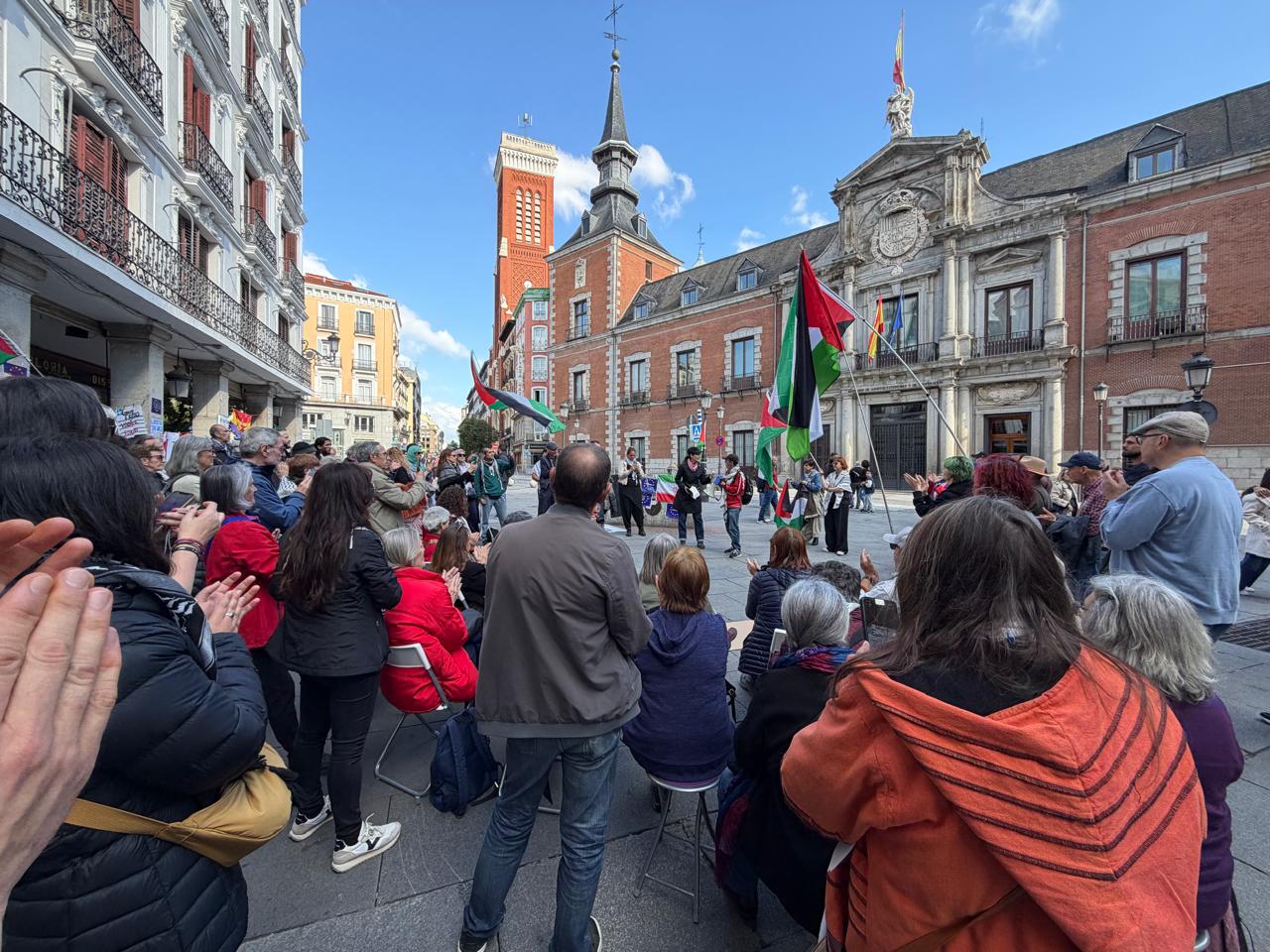
In the late afternoon, the surroundings of the Spanish Ministry of Foreign Affairs, in the center of Madrid, begin to change their atmosphere. Palestinian flags line the facade, poems are read aloud, artists perform impromptu cultural interventions and small groups gather to discuss international politics, Gaza and Europe’s role in the face of the Palestinian humanitarian crisis.
This is not exactly a great isolated act, but a permanent vigil organized by collectives such as “Madrid con Palestine”, internationalist networks, unions, political organizations, students and social movements that, a few days ago, transformed the space in front of the Spanish chancellery into a continuous point of solidarity with Palestine.
Amid public readings, posters and political speeches, two names appear repeatedly, the Brazilian Thiago Ávila and the Spanish-Palestinian activist Saif Abu Keshek, members of the international humanitarian flotilla intercepted by Israel in international waters while trying to reach Gaza. The mobilization in Madrid gained even more strength after the international repercussion of the arrest of the two activists. This Saturday morning (9), international press outlets began reporting the release of Thiago Ávila and the announcement of the release of Saif Abu Keshek by the Israeli authorities. Both remain under immigration procedures related to deportation.
According to information released by legal teams and human rights organizations, Thiago Ávila and Saif Abu Keshek remained in isolation during their period of detention. Both began a hunger strike, while Saif Abu Keshek also stopped drinking water during part of his arrest, according to defense reports. Complaints about the conditions of detention increased international diplomatic pressure and helped transform the case into a political issue in both Brazil and Spain.
For a Brazilian observer in Madrid, it is striking how the Palestinian issue today occupies a much deeper political and moral space in Spanish society than it usually appears in traditional international coverage. Solidarity with Palestine in Spain does not just emerge as a circumstantial humanitarian agenda. It appears linked to anti-fascist memory, the historical internationalism of the Spanish left and the solidarity networks built between unions, cultural collectives, universities and social movements.
Throughout the vigil, one of the most recurring themes is precisely the treatment given by the mainstream international press to the Palestinian situation. Participants criticize what they consider to be insufficient and partial coverage, often focusing only on the military and diplomatic dimensions of the conflict, without the same attention to the humanitarian crisis in Gaza, civil initiatives of international solidarity or the very interception of vessels in international waters.
Among those present, there is also the perception that the kidnapping and detention of Thiago Ávila, Saif Abu Keshek and the other members of the international mission did not receive the same space or the same intensity of coverage in major Spanish newspapers or on the country’s traditional television. For many activists present at the vigil, the international repercussion of the case only gained greater dimension thanks to the actions of independent communication networks, digital movements and alternative vehicles.
The arrest of Thiago Ávila and Saif Abu Keshek also ended up producing a diplomatic convergence between Brazil and Spain. In recent months, the Spanish government has already taken one of the most critical positions in the European Union in relation to Israeli actions in Gaza, defending the recognition of the Palestinian state and raising its diplomatic tone against Israel. In Brazil, the government of President Luiz Inácio Lula da Silva also increased criticism of the Israeli offensive and began to act diplomatically for the release of Thiago Ávila.
The situation took on an even greater dimension after the publication of a joint note between Brazil and Spain condemning the interception of the flotilla and the detention of the two activists. The governments of both countries classified the Israeli action as “blatantly illegal” and denounced the kidnapping of their citizens in international waters, demanding security guarantees, consular access and the immediate release of Thiago Ávila and Saif Abu Keshek. The note significantly increased the diplomatic weight of the case and helped transform the flotilla’s situation into an issue of international repercussion.
According to reports from legal teams and organizations involved in the mission, the humanitarian flotilla was intercepted by Israeli forces in international waters while trying to head towards Gaza. Following the operation, foreign activists were detained and transferred to Israeli custody.
Thiago Ávila and Saif Abu Keshek were not released along with the rest of the mission participants and ended up transferred to Israel, where they remained detained in isolation. Complaints about the case began to mobilize international human rights organizations, legal networks and multilateral organizations, increasing international pressure on the Israeli government.
The current mission has also highlighted the growing international articulation of so-called humanitarian flotillas. In recent years, these initiatives have started to connect organizations from Latin America, Europe and the Middle East in solidarity actions against economic blockades, wars and humanitarian crises.
Throughout 2025, different “Freedom Flotillas” departed from cities such as Barcelona and Sicily towards Gaza. In one of the largest operations of the period, dozens of international vessels were intercepted by the Israeli navy in international waters, resulting in arrests, reports of violence and strong international repercussions.
Reports from participants in these previous missions pointed to the use of water cannons, aggressive approaches and arrests of foreign activists. The actions helped to expand the international condemnation against the blockade imposed on the Gaza Strip and strengthened international solidarity networks for Palestine.
In March of this year, Thiago Ávila participated in the “Nuestra América” mission, organized by Progressive International, which took around 30 tons of food, medicine and solar panels to Havana, Cuba. The flotilla left Mexico as a form of solidarity with the island in the face of the serious energy crisis worsened by the economic blockade imposed by the United States.
Global Sumud’s current mission has become one of the most emblematic of this new stage of internationalist mobilizations in defense of Palestine.
The growth of pro-Palestinian mobilizations has become one of the most visible elements of the current Spanish political scenario. Madrid, Barcelona, Bilbao, Santiago de Compostela and other cities began to register frequent acts involving left-wing parties, unions, social movements and cultural collectives.
In Madrid, the permanent vigil in front of the Spanish Ministry of Foreign Affairs turned into something bigger than a simple protest. There, Palestine appears as an everyday political issue. Between poems, posters, cultural interventions and improvised debates, Madrid’s public space has become a continuous meeting point between culture, internationalism and denunciation of the humanitarian crisis in Gaza.
Even after the announcement of the release of Thiago Ávila and Saif Abu Keshek, the struggle and international solidarity for Palestine continues to mobilize social movements and internationalist networks in different parts of Spain and the world.
Source: vermelho.org.br