Published 19/05/2026 16:49 | Edited 05/19/2026 17:31
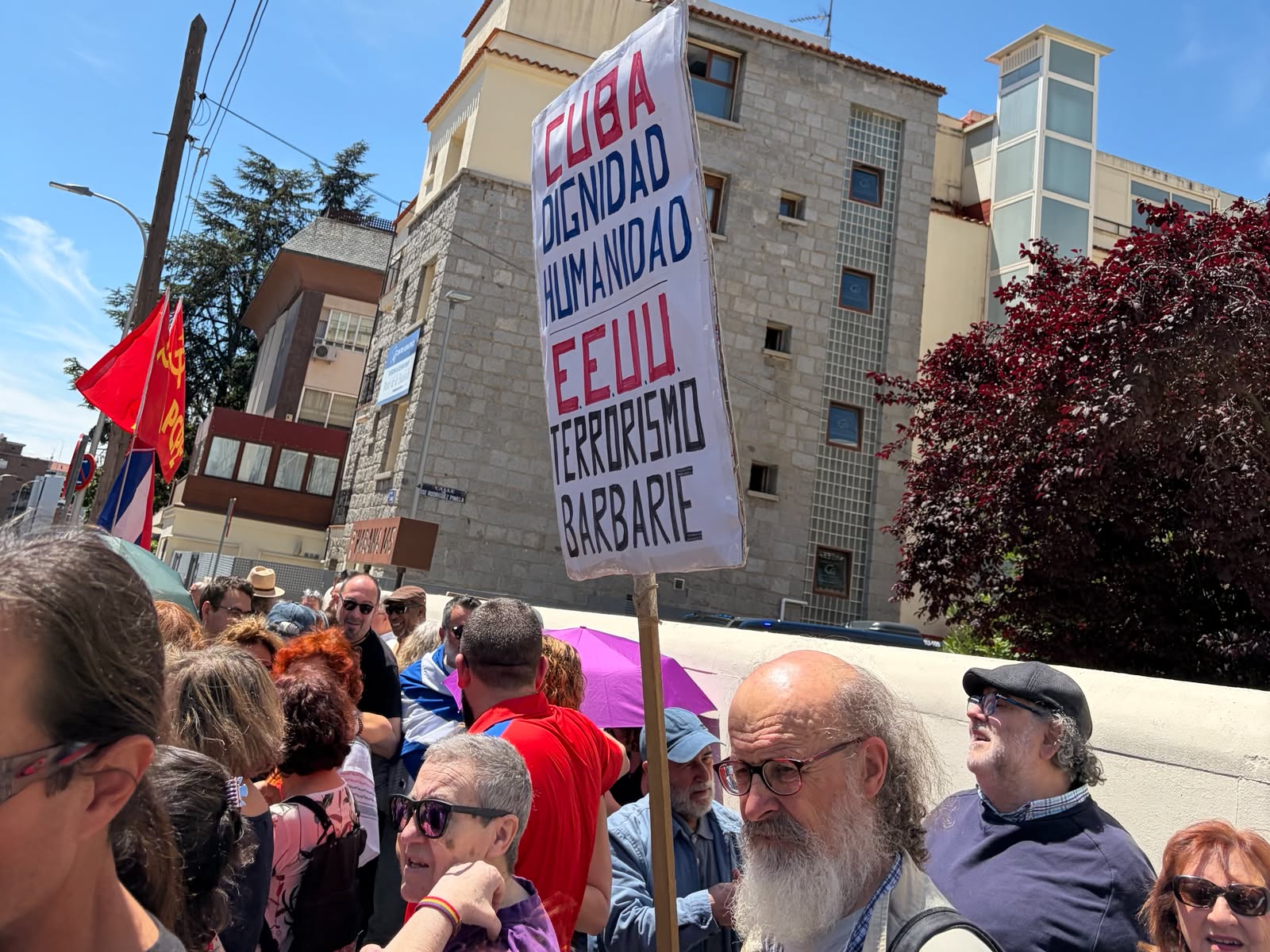
Cuban flags, banners against the economic blockade, internationalist slogans and references to the historical resistance of the Revolution marked the act of solidarity held on Sunday (17), in front of the Cuban Embassy, in Madrid. Called by international solidarity organizations, communist parties and left-wing political movements, the activity brought together Spanish and Latin American activists in defense of Cuban sovereignty.
Throughout the demonstration, slogans such as “Cuba yes, blockade no”, “Yanquis out” and “Viva Cuba socialista” crossed the Madrid afternoon in front of the embassy. At different times, the protesters responded in chorus to interventions made using the megaphone, while loudspeakers installed in front of the building echoed songs by Silvio Rodríguez, Pablo Milanés and historical songs from the Cuban Revolution. Between Cuban, Palestinian and Spanish republican flags, the atmosphere mixed political resistance, historical memory and internationalist solidarity.
Carrying out an act of solidarity with Cuba right in the heart of the former Spanish colonial power inevitably carried a profound historical and symbolic dimension. The memory of the island’s independence was constantly associated with the figure of José Martí, a central intellectual and revolutionary in the Cuban anti-colonial struggle of the 19th century. Martí defended a sovereign Latin America in the face of foreign powers and formulated an idea frequently remembered by participants in the activity. “Homeland is humanity”.
The very existence of a demonstration of solidarity with Cuba in Madrid revealed a powerful historical contradiction. More than a century after Cuban independence from Spain, activists once again gathered in front of the island’s diplomatic representation, not to defend a colonial relationship, but to denounce the economic blockade imposed by the United States 66 years ago and reaffirm the Cuban people’s right to self-determination.

The act occurred at a particularly delicate moment for Cuba. The island is facing one of the most serious economic crises in recent decades, marked by permanent blackouts, difficulties in supply and wear and tear on energy infrastructure, as a result of the prolonged effects of the North American blockade and worsened by the latest measures adopted by Donald Trmp against the island.
Still, the mobilization demonstrated that Cuba continues to occupy an important symbolic space in the international political imagination. Militants from different generations related the Cuban experience not only to institutional politics, but also to the idea of national dignity, sovereignty and popular resistance.
The activity took place a few months before the centenary of Fidel Castro’s birth, which will be celebrated in August this year. Among those present, the memory of the Cuban Revolution was frequently associated with the historical figure of Fidel and the Latin American political project built under strong international pressure since 1959.
Representatives of the Communist Party of Spain (PCE) participated in the activity and linked solidarity with Cuba to the international advance of the extreme right and contemporary geopolitical disputes. Miguel Montero, general secretary of the PCE in Madrid, stated that “the growth of the extreme right goes hand in hand with authoritarian discourses, inside and outside the borders”. According to him, these speeches also appear “in hate speeches against migrant people”, hiding forms of social exploitation and deepening inequalities.

The leader also denounced the humanitarian impacts of the economic blockade imposed by the United States against the island. For Montero, “it is essential to combat the naturalization of genocide as a form of constant pressure on Cuba”, especially given the deprivation of essential goods such as water and energy. The leader also stated that the objective of the sanctions is to “bend the sovereign will of the people” and prevent political experiments contrary to imperialist interests.
Representatives of the Communist Party of Colombia (PCC) also participated in the activity and linked solidarity with Cuba to the current Latin American political scenario and electoral disputes in the region. Olgher Santodomingo Guarín, leader of the PCC in Spain, stated that the party views the construction of the Colombian Historical Pact “with a lot of militant commitment” and defined the candidacy of Iván Cepeda and Aída Quilcué as “the only alternative in the face of the threat from the right and the ultra-right”.
The leader also warned of the risks of international interference in the Colombian electoral process and denounced threats promoted by the international extreme right. According to him, “anything can be expected from these enemies of democracy and world peace”, although he highlighted his confidence in the capacity for popular mobilization and the unity of Latin American progressive forces.
When addressing Cuba, the PCC leader stated that “solidarity with Cuba is an obligation of the people of the world” and highlighted that the island continues to resist despite more than six decades of economic blockade successively rejected by the UN General Assembly. For him, Cuba continues to be a reference for international solidarity and defense of the dignity of people.

Representatives of the Communist Party of Uruguay (PCU) also defended the need to strengthen the unity of Latin American popular forces in the face of the advance of the extreme right and global geopolitical disputes. Gustavo Álvarez, leader of the PCU, stated that the Latin American left needs to “come back better”, understanding that winning governments is important, but insufficient without progress in popular organization and political consciousness.
According to Álvarez, “there is no way to defend democracy if democracy is not radicalized”. For the Uruguayan leader, radicalizing democracy means expanding popular participation, discussing the distribution of wealth, strengthening culture and defending human dignity.
The PCU leader also defended the construction of collective alternatives in the face of the contemporary crisis. “Left-wing activists cannot just be those who describe the catastrophe. We need to find exit routes,” he stated. Álvarez also highlighted that there are no exclusively national solutions to Latin American challenges and defended regional integration and popular unity as strategic paths.
When addressing the Cuban situation, Gustavo Álvarez defined Cuba as “the lighthouse that guided Latin America and revolutionaries around the world for decades”. The leader reaffirmed unrestricted solidarity with the island in the face of the North American economic blockade and declared that supporting Cuba continues to be “a moral and revolutionary duty”.

Despite the different national experiences present at the event, the interventions converged on the same political perception. In the face of the advance of the extreme right, wars and global geopolitical disputes, international solidarity and Latin American unity continue to be seen as fundamental paths for building popular alternatives.
At the end of the activity, the protesters were invited to enter the Cuban embassy for a moment of celebration and exchange of experiences with the island’s diplomatic representatives. Between political conversations, reports on different Latin American realities and demonstrations of international solidarity, activists from different organizations remained gathered while Silvio Rodríguez’s songs continued to echo through the speakers of the diplomatic building.
The end of the event transformed the front of the embassy into a space for political and emotional coexistence, marked by hugs, songs, slogans and debates about the challenges faced by popular movements in Latin America. More than a diplomatic support activity, the demonstration reaffirmed that, decades after the Cuban Revolution, the island continues to arouse solidarity far beyond its borders.
__
Photos: Tiago Alves
Source: vermelho.org.br