Published 04/22/2026 11:32 | Edited 04/22/2026 12:00
It was an early afternoon in Istanbul, around 7 pm. The cold marked the city that, for centuries, has carried encounters and disputes between worlds. But, when walking through the doors of the Nazım Hikmet Cultural Center, it was cold outside. Inside, what was seen and felt was the lively encounter between international delegates, cross conversations in different languages, gestures of welcome and recognition between different peoples. The atmosphere was different, marked by the human warmth of people from different countries, brought together by something that cannot be measured in words alone, solidarity.
It wasn’t just any date. The activity took place on April 19, a day deeply marked in the history of Cuba and the anti-imperialist struggle. It was exactly on that date, in 1961, that mercenaries trained and financed by the United States attempted to invade the island through Playa de Girón and were defeated by the Cuban people in the historic victory of Girón. The memory of that victory crossed the night in Istanbul like a silent presence, giving even more meaning to the meeting.
The space, full of meaning, seemed to breathe history. The Nazım Hikmet Cultural Center, run by the Communist Party of Turkey, is named after one of the greatest revolutionary poets of the 20th century, whose life was marked by persecution, exile and a profound loyalty to the causes of the people. This is a concrete experience of cultural policy linked to the party, which can serve as a reference for similar initiatives in Brazil, such as Casa Augusto Buonicore, in Campinas. Its presence was not just on the walls or in the name of the place, it was in the atmosphere, in the way people met, listened to each other, recognized each other.
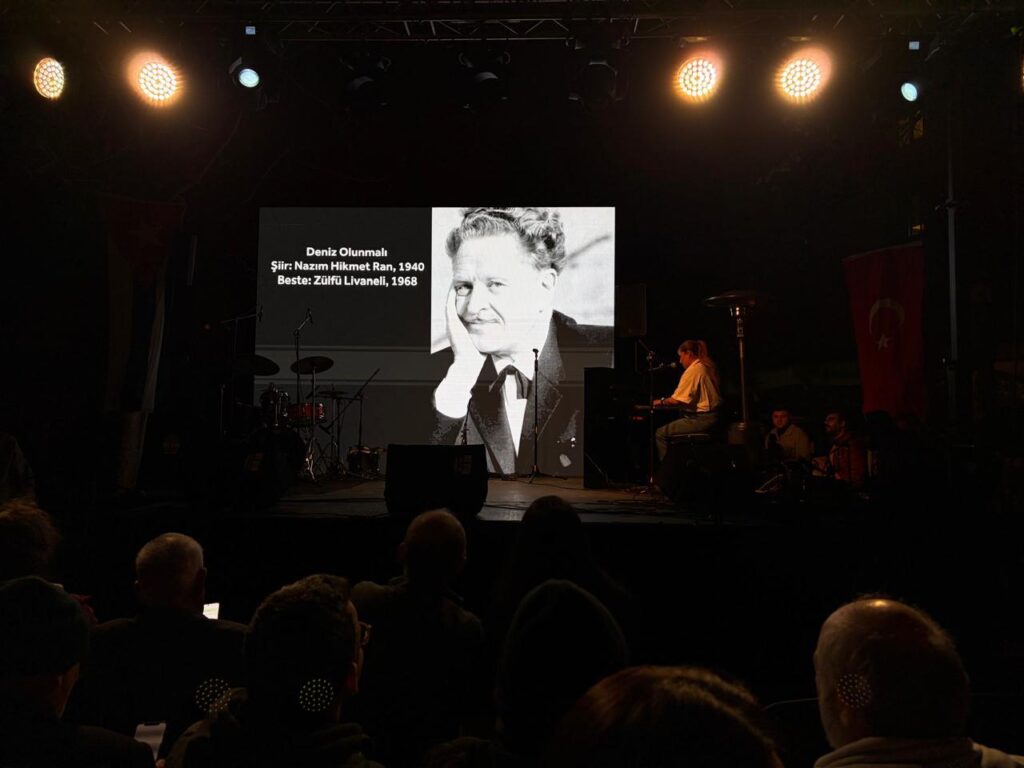
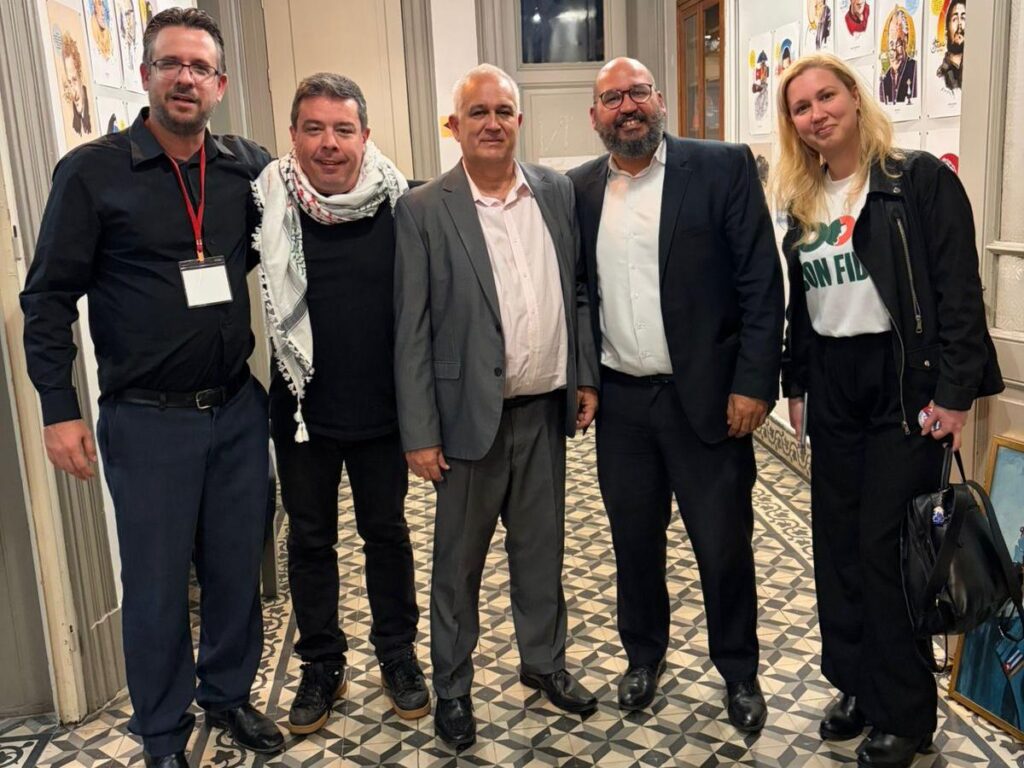
It was in this environment that the political-cultural activity in solidarity with Cuba took place, bringing together delegates from different countries in the context of the 24th Meeting of the Working Group of the International Meeting of Communist and Workers’ Parties. More than an event, it was a moment of meeting between different trajectories, united by a common understanding of the world and the need to defend it.
The cultural activity was beautiful and deeply symbolic. The night opened with an instrumental drum and piano performance playing El necio, by Silvio Rodríguez, setting the intense and sensitive tone of the meeting. Then, presentations of instrumental music and ballads formed a repertoire that spanned decades of struggle and memory. Songs such as Si me quieres escribir, by Emilio Prado, Hasta siempre, Comandante and De Cuba traigo un sing, by Carlos Puebla, echoed in the space alongside the eternal Guantanamera, by Joseíto Fernández.
In one of the most memorable moments of the night, a choir took the stage and further elevated the collective meaning of the activity. The voices, sung together, reinforced not only the aesthetic beauty of the performance, but the very idea of unity between peoples, transforming music into a living expression of international solidarity.
When Y en eso llegó Fidel, also from Puebla, and Girón, la victoria, by Sara González, sounded, Cuba’s historical memory seemed to be present in an almost physical way.
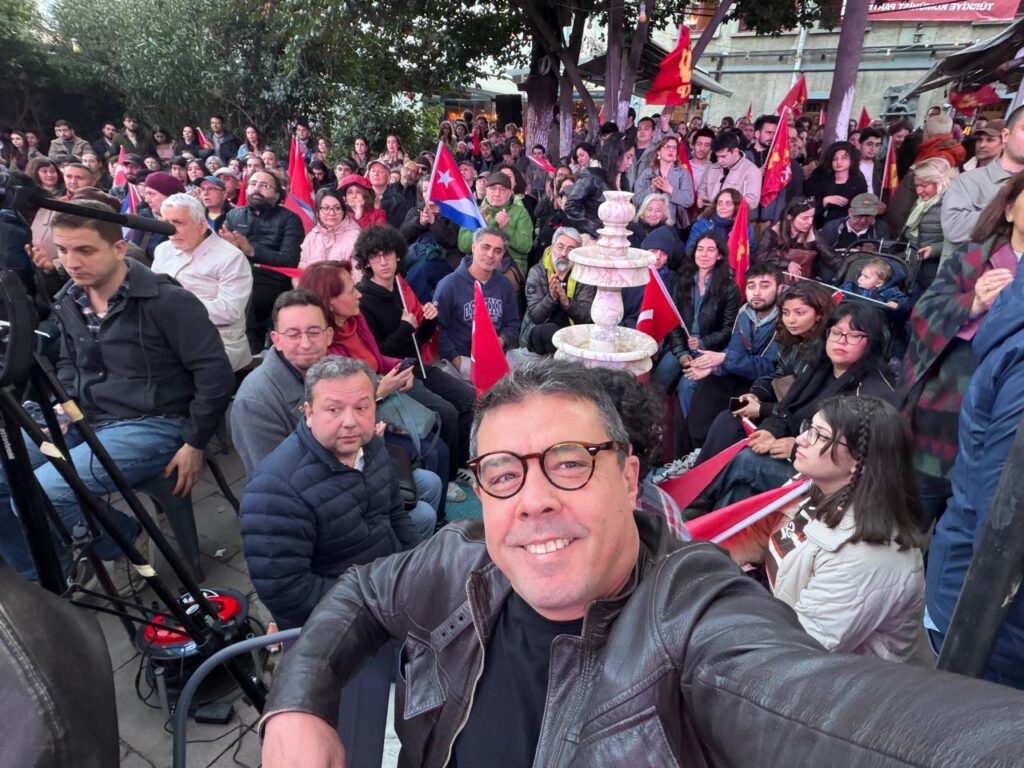
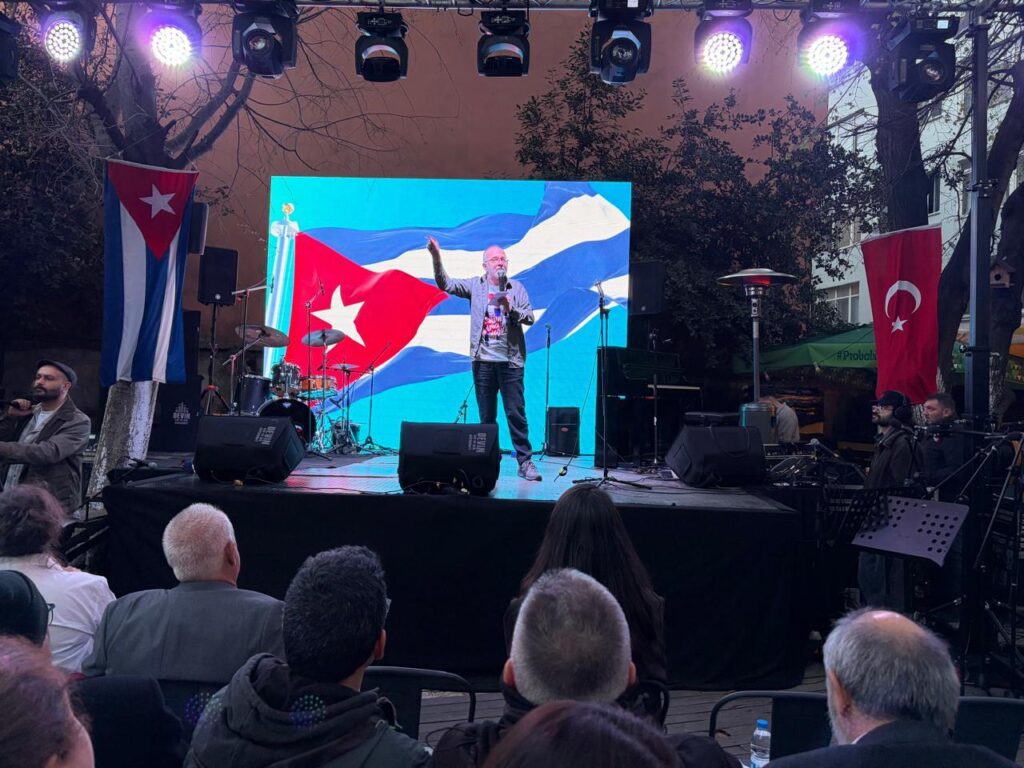
The repertoire also crossed borders. El pueblo unido jamás está won, by Sergio Ortega and Quilapayún, reaffirmed the Latin American dimension of the struggle, while One should be like the sea, by Zülfü Livaneli, brought to light the tradition of Turkish resistance. Among the songs, the poetry of Nâzım Hikmet echoed, in a version set to music and sung in Spanish, bringing Turkey and Cuba even closer.
At the edge of the sea, as in the song, a man wonders if it should be cloud, boat or fish, or if it should be the sea itself.
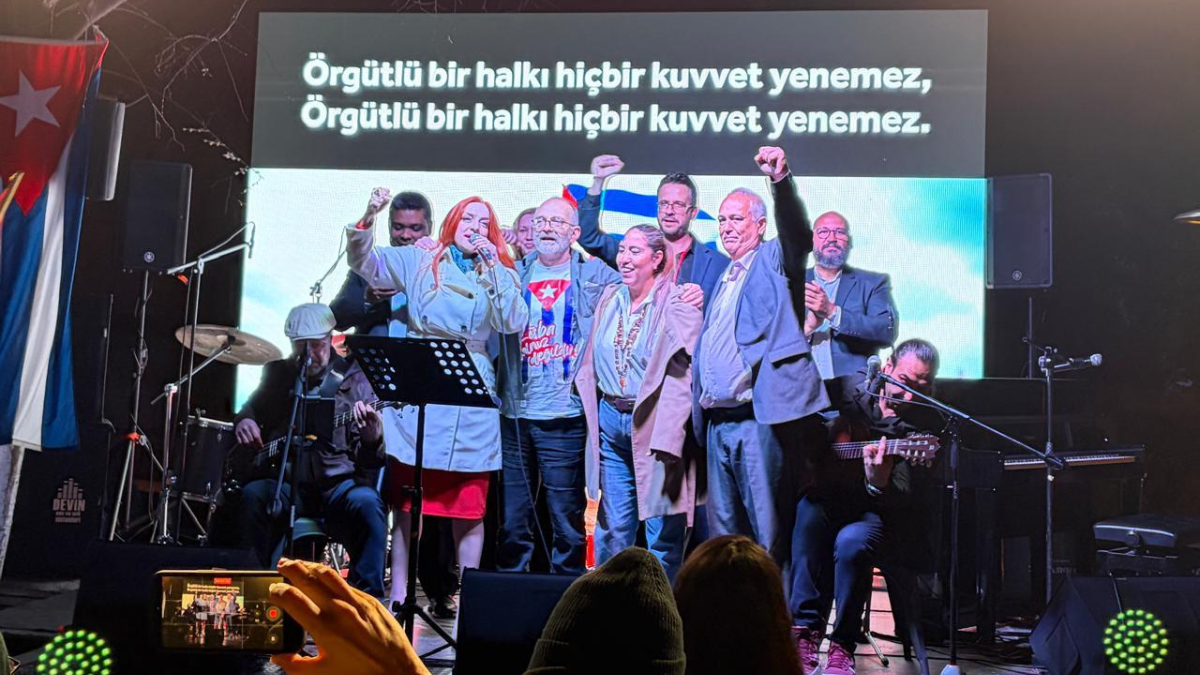
On stage, Cuban and Turkish artists shared space, sharing not only music, but history and commitment. It was a scene full of emotion, different cultures, different trajectories, but the same political and human sensitivity.
To each intervention, to each word, the public responded. The speeches were constantly interrupted by slogans shouted at the top of their lungs, in Spanish and Turkish, but with the same meaning, supporting Cuba, denouncing imperialism and affirming the people’s struggle. What was seen was not a passive audience, but a living, pulsating, participating collective.
There were young people there, gentlemen and ladies, entire families with their children, all sharing that moment as a true internationalist fraternization. The human value of that meeting was expressed precisely in the diversity of countries, cultures and trajectories present, but also, in a very special way, in the warm reception of the Turkish men and women, who welcomed the delegates with generosity, attention and a deep sense of solidarity. Solidarity was not only expressed in speeches or songs, but in the concrete presence of people, in the way they occupied space, in the way they recognized themselves as part of something common.
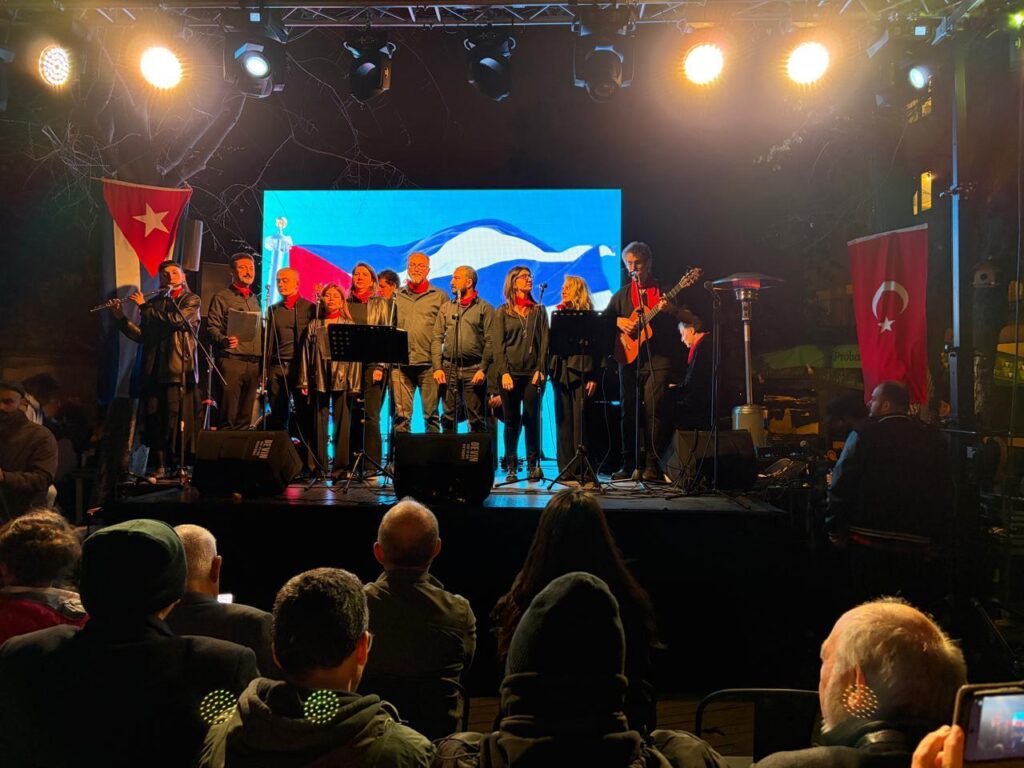
Between speeches and songs, Cuba appeared not only as a theme, but as a presence. Like an idea that resists. As a people who, despite being subjected to decades of blockade and pressure, insist on asserting their sovereignty. That night, talking about Cuba was also talking about dignity, resistance and the future.
Representing the Communist Party of Cuba, Elier Ramírez, from the Secretariat of Ideology, highlighted the significance of that moment by stating that “solidarity with Cuba is not just a political gesture, it is the concrete expression that our people remain united in defending sovereignty and the right to build their own paths”.
In the same vein, the general secretary of the Communist Party of Turkey, Kemal Okuyan, highlighted the role of internationalism in the current scenario by stating that “in times of imperialist offensive, strengthening solidarity among peoples is an urgent and necessary task for all who fight for justice and freedom”.
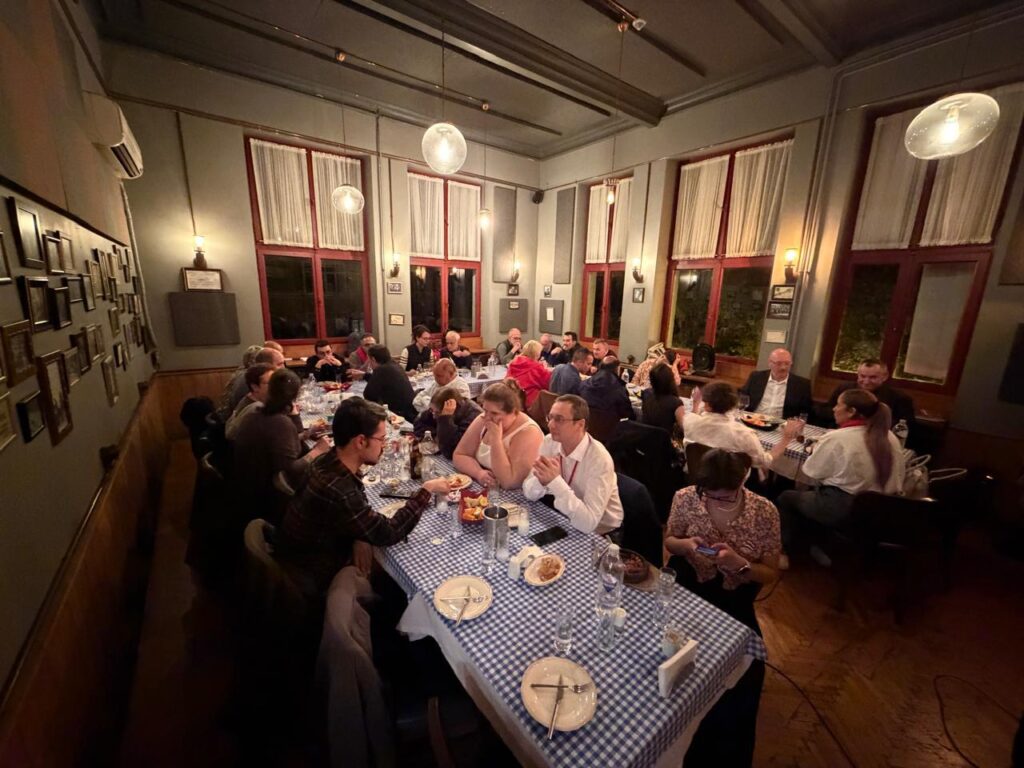
Music, words and gestures created a kind of shared territory, where internationalism stopped being a concept and became practice. At the end, in a more relaxed atmosphere, the international delegates gathered at a collective dinner, alongside the Cuban representatives in Turkey, sharing local food and drink and sharing together what had been experienced on stage and in speeches.
During the celebration, an element of local culture also gained prominence. Rakı, a traditional Turkish drink made from grapes and flavored with anise, was served and shared among those present. When mixed with cold water, the clear drink turns into a milky white color. Strong and symbolic, generally consumed together with meals and collective celebrations, Rakı accompanied the evening’s toasts, marking yet another moment of encounter between cultures.
For the Communist Party of Brazil, being present in that space also meant recognizing this deeper dimension of politics, one that is not limited to documents, but is affirmed in the living experience of the people. In culture.
Outside, Istanbul remained cold. But inside the Nazım Hikmet Center, something remained lit. A heat that didn’t just come from the bodies, but from what united them.
As in the song inspired by the poetry of Nâzım Hikmet, Bulut mu olsam?, sung that night, by the sea a man asks himself.
“Be a cloud, be a ship, be a fish
or be the algae at the bottom of the sea”
Maybe, that night, the answer was right there, in what was shared. To be sea.
To listen to the songs that marked the political-cultural activity in solidarity with Cuba, access the playlist on Spotify.
Source: vermelho.org.br