The flight of Haitian deportees coming from Florida, in the United States, scheduled to land at noon, has not yet appeared in the sky when the National Migration Office employees close their shift. Most return to their homes; There are only a few left on duty waiting for 71 fellow countrymen expelled from the USA.
It’s already night when the plane finally lands on the runway. But instead of 71, there are 82 people arriving, hungry and tired. They were handcuffed and handcuffed the whole time. Among them, men, women who don’t know each other, a sick person and a mother with a baby in her arms. There are no public lighting in the city. And no where to go.
As announced by Donald Trump’s government, one flight per week has been landing at Cap-Haitian International Airport since mid-August, bringing back more than 400 migrants. If that charter on September 10th created greater confusion, leaving the local administration completely helpless, everyone repeats the same lack of planning and respect for the fundamental rights of passengers.
In total, more than 330,000 Haitians have lost their Temporary Protection Status (TPS) and, with it, the guarantee of permanence and work in the United States, and can be deported at any time. Katia Bonté, coordinator of the Returnee and Refugee Support Group (Garr), has been following these latest events with great concern, together with a network of American organizations.
“They are arresting people on the street, at work, anywhere […]and to take them to a detention center”, he reports to the Brazil in fact. “In other words, people can’t even take their personal things! They are arrested and then deported with what they have at that moment. And we have statements from people who say they had a cell phone and that the cell phone was taken from them at the time of arrest. So, they are arriving here with nothing.”
In the United States, the persecution of migrants has become a true ideological banner of Donald Trump’s government, to the point that his administration promotes itself with images that boast the violation of rights. On August 28, the Department of Homeland Security (DHS) published a video on social media showing Haitians chained and handcuffed, with their heads down, in heavy rain, in single file, waiting to board the plane and be deported. Just days before the date that celebrates the abolition of slavery in Haiti, on September 22, 1793, the sadism behind these images has an even crueler resonance for these people’s countrymen.
A country with no structure to receive
TPS is a statute that applies, in the United States, to migrants whose country of origin is experiencing a civil war, an epidemic, an environmental disaster, or some other condition that threatens the lives of its citizens. It was in January 2010, after the earthquake that destroyed much of the capital, Port-au-Prince, causing around 300,000 deaths and leaving 1.5 million homeless, that it began to be granted to Haitians. If the 16 years that have passed since that tragedy could justify the end of a so-called “temporary” statute, the truth is that the country’s current situation continues to meet all of the TPS criteria.
“The situation has not changed in Haiti… not to say that it has gotten worse”, laments Bonté, listing not only security issues, but also economic and social ones, which are plaguing society. After the 2010 earthquake, paramilitary gangs took over a significant part of the territory, especially in the capital, emptying entire neighborhoods, attacking state institutions and exercising merciless violence against the population. So much so that today the country has an even greater number of families who have lost their homes. And, beyond Port-au-Prince, armed groups control the country’s main roads, making movement from north to south almost impossible.
Let’s go back to the case of someone who was arrested in the United States, on the street, at work or taking their child to school, in the city where they lived for five, ten years or more, leaving all their belongings there and leaving with just the clothes on their back — which they even had to exchange for a white prisoner’s coat. This citizen then disembarks on any given day at the Cape Haitian airport, at the northern end of the island, perhaps very far from the city where he has family. He receives US$80 from the Haitian government, which does not even cover half of a ticket to get to the south of the island safely. And maybe I don’t even have a home to go to anymore.
“What if there is someone from Kenskoff or Artibonite within the group?” asks Bonté, referring to two regions that have been recurring scenes of massacres against civilians in recent months. “We understand that every country has its own migration policy, just as we understand that these people are Haitians, but the current situation is really very difficult for them to return to their homes.”
If he does not have the power to reverse the decision of the American authorities, Garr expresses two urgent demands for the Haitian State. Firstly, an emergency fund must be created to be able to receive and send deported people to their homes, covering all costs and guaranteeing their safety. Second, there must be an intergovernmental dialogue between both countries to define a protocol regarding the conditions of deportation and arrival of migrants — and, perhaps, negotiate a calm in deportations so that the country can better organize itself.
The side there
The end of TPS is just one of the measures that have disrupted the lives of hundreds of thousands of Haitian migrants in the United States. In March 2025, Donald Trump already put an end to the humanitarian program “CHNV parol program”, popularly known as the “Biden program”, which made it easier for them to enter the country. In December of the same year, he ended the Family Reunion Program, which allowed US citizens or migrants with permanent residence in the territory to bring their families from Haiti.
Since November 2025, threats against the TPS have caused thousands of Haitians to lose their jobs and change their living conditions. To the point that many were eager to leave the country before falling into an irregular situation. However, many more, today, have to live on the edge of hiding, walking the streets in fear, having to work informally.
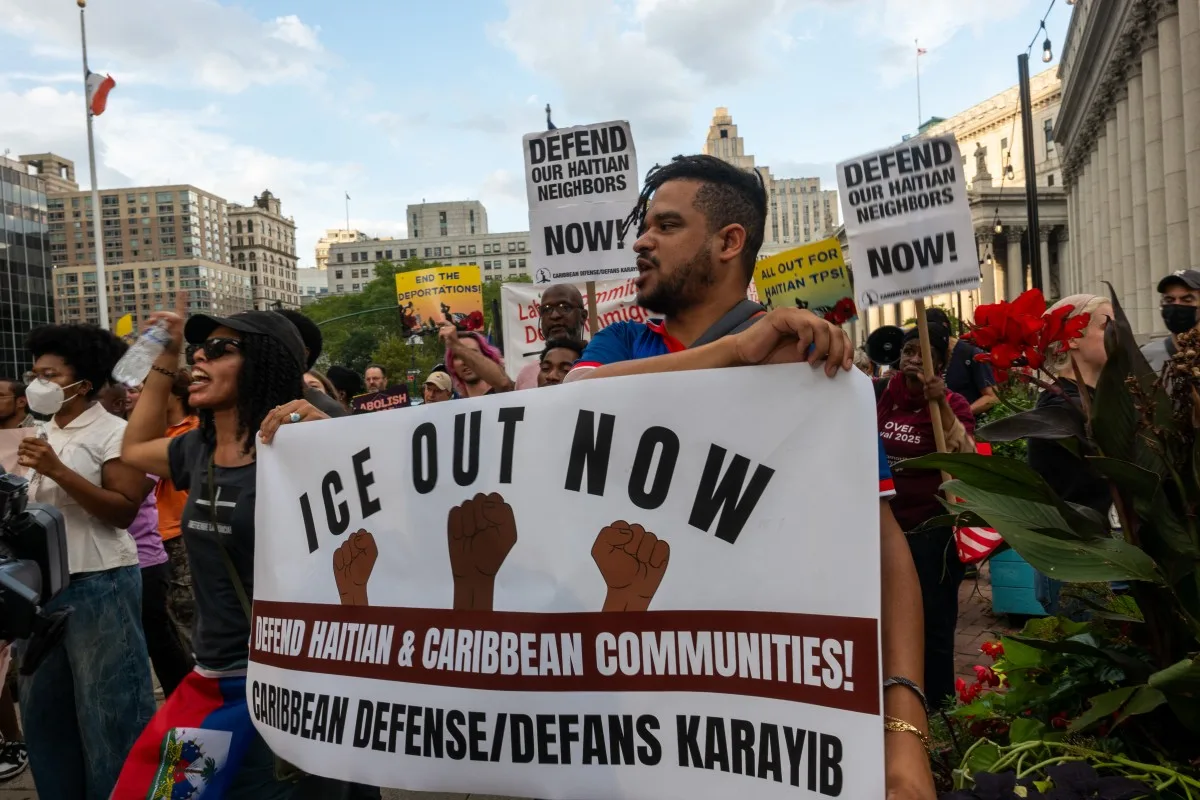
In politics and justice, the battle continues. Specialized law firms are seeking alternative solutions for staying in the country, while in Congress, Democratic deputies continue to defend the reestablishment of TPS for Haitians. The mayor of New York, Zohran Mamdani, one of Trump’s main political opponents, publicly expressed his indignation regarding the decision taken by the federal authorities and has clashed with him on the issue of migrants.
In turn, civil society associations denounce the arbitrariness and racism behind a blatantly anti-Haitian migration policy. In a long report that includes several testimonies and an abundance of data, the organization Haitian Women for Haitian Refugees (HWHR) points out the historical and ideological context of the growing repression that the community has faced.
“This rollback of status and rights takes place in a context of extreme racism and open xenophobia against Haitians, taken to the highest level of government in the first and second Trump administrations. During his first term, members of the government referred to Haiti as a ‘shit country’ or said that ‘all Haitians have AIDS’ […]. In this last presidential election, his campaign began with a new attack on Haitians, spreading the racist lie that Haitians in Springfield were eating pets”, recalls the document.
In the end, the ideological justification is the only one that can sustain the economic contradictions that the end of the TPS presents for Haitians. According to research by the organization FWD.us, the 330,000 Haitians who benefited from this status contributed around US$5.9 billion annually to the American economy, paying US$1.5 billion in local and federal taxes. The removal of this workforce is already directly affecting sectors such as food, commerce, child and elderly care, agricultural production and transportation, especially in Florida, where half of these workers are concentrated. In this sense, the authors of the research warn that the end of the TPS could “increase the cost of living for all citizens, increasing the prices of food, health and essential services”.
Source: www.brasildefato.com.br