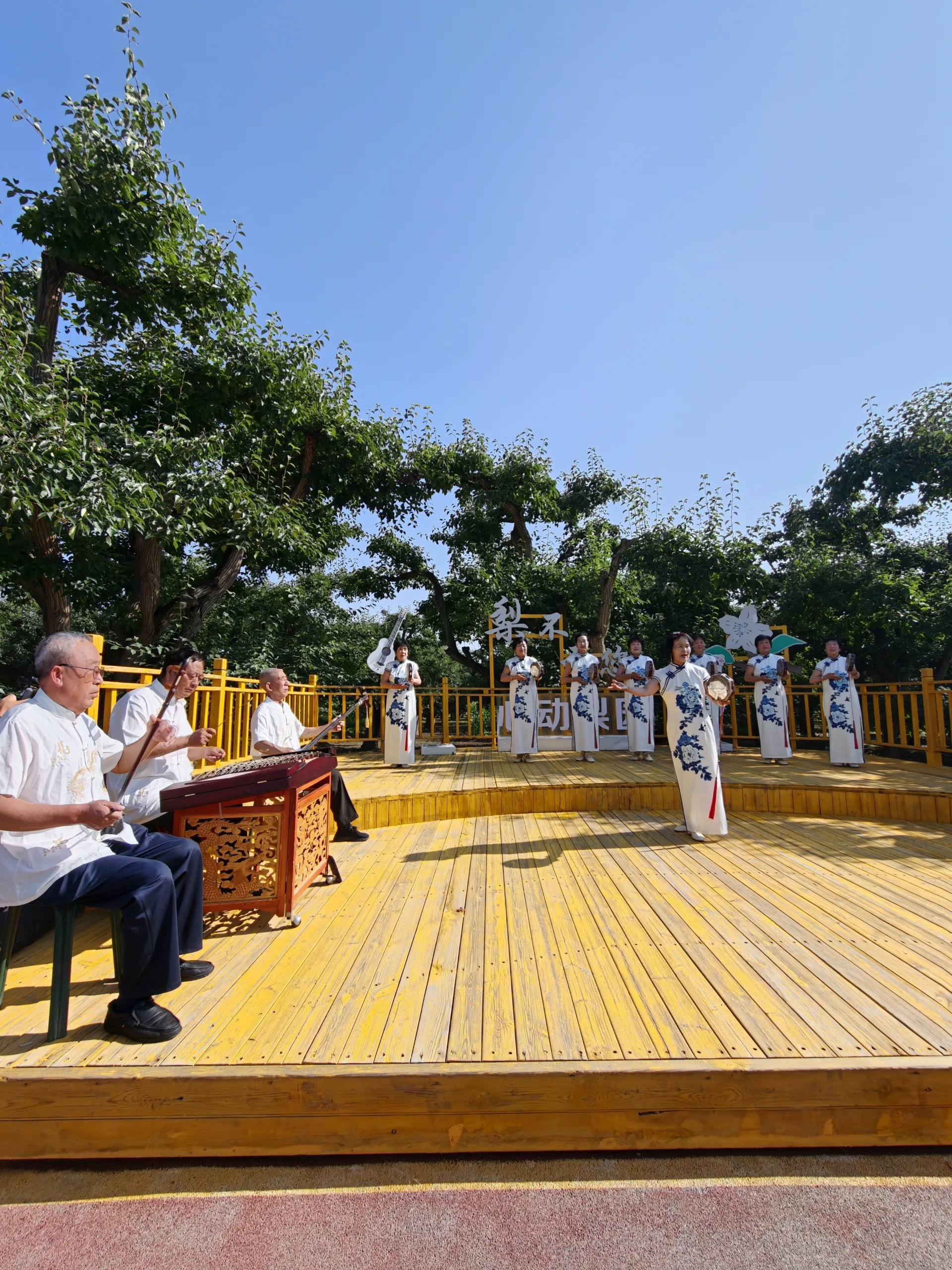
In the Chinese province of Gansu, a group of elderly peasants from Gaolan County maintain the tradition of Guzi, a type of music sung in the local dialect, with instruments such as the sanxiana type of three-stringed lute, and the yangqina type of struck zither. The name comes from “gu”, the Mandarin word for drum, which refers to the octagonal tambourine used in the songs. This style was formed in the Lanzhou region (the provincial capital) over centuries and became popular in the city’s courtyards and tea rooms. After the founding of the People’s Republic of China in 1949, artists began to create a repertoire of songs that celebrated the heroes of the revolution.
Wang Keying, singer from Gaolan’s group, talks about some songs played during the report’s visit: “We now sing Han Ying Finds His Mother. The lyrics portray the scene in which Han Ying visits his mother during detention.”
The story tells about the period of the Communist Party of China’s revolutionary armed struggle against the Kuomintang and feudal lords in the 1930s. “The story revolves around the Honghu Lake Red Guards, a group that fought alongside the Red Army,” explains Wang. “This piece pays homage to revolutionary heroes.”
“Han Ying Meets His Mother” has become one of the best-known pieces in Guzi’s newest repertoire and is regularly performed at the ancient pear orchard in Gaolan’s Shichuan district during the county’s Pear Blossom Festival, where the report was.
“We plan to cultivate new generations and recruit more young people to continue this art,” says Wang Keying.
Chinese heritage
Gaolan’s group is made up of peasants from the county. Wei Zhou Jiang is one of them and plays the yangqin as a whole. “Lanzhou Guzi has a long history, passed down from the Ming Dynasty to the present day,” says Wei. The way the style is known today was consolidated at the end of the Qing Dynasty, when it absorbed influences from Beijing drum music and Shaanxi folk opera, according to the official intangible heritage register.
According to Wei, the style “is popular in Qilihe District, Gaolan County, Yufeng and other areas.” In 2006, China included Guzi in the first national-level intangible heritage list.
Wei explains that Guzi’s repertoire brings together more than a thousand pieces, organized in different styles. “Guzi has five main types of melody. The two pieces presented during the visit illustrate this variety: Capital Garden belongs to the Ping Melody, while Huiyou is the classical Yue Melody.”
“We are committed to transmitting Lanzhou Guzi completely, preserving all vocal melodies and performance techniques,” adds Wei. “Lanzhou Guzi is much loved by locals. We are determined to pass on this art to future generations.”
Source: www.brasildefato.com.br