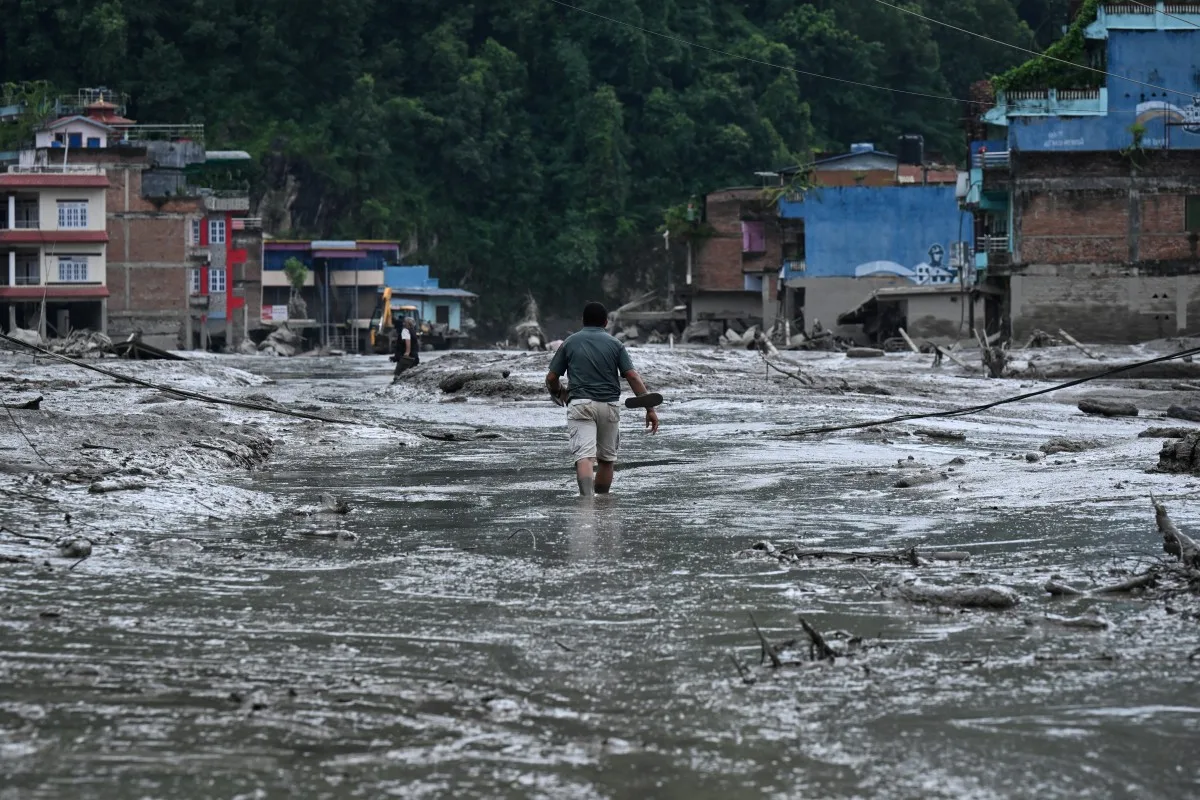
The confirmed death toll in Nepal rose to 157 after a devastating flood hit the border region with China this Wednesday (26). Furthermore, at least 579 people are still missing. The balance was released by the Nepalese police.
The Nepal Tourism Board reported that 384 travelers who were visiting the country were missing, including 341 foreigners from 28 different countries; 133 missing people are from India, 54 from the United States and 33 from the United Kingdom.
China confirmed that, in the Tibet region, there are three dead and 265 missing.
A violent avalanche of mud and debris broke the bank of a river, burying buildings and sweeping away vehicles and houses. Images released by the Nepalese police show the force of the water in the district of Rasuwa, where people were trying to escape the current, which destroyed many of the structures built on the banks of the river.
The flood hit Syabrubesi, the starting point of one of Nepal’s main trekking routes, as well as areas used by people making the Hindu pilgrimage to Kailash Mansarovar.
In Nuwakot, one of the affected locations, professor Suman Chalise reported seeing the current carry away trucks, houses and people.
“I saw when the waters swept away eight or nine trucks, as well as houses and people,” he told AFP. “It was absolutely heartbreaking. I was witness to devastation of a magnitude that I had never seen before.”
Nepalese authorities are still assessing the extent of the damage. Emergency teams are searching for survivors and missing people, while residents close to river banks have been asked to leave risk areas.
Chinese state media also reported that a landslide in the border region, on the Nepal side, caused “many victims” and left people missing in the Gyirong region, in Tibet.
Chinese President Xi Jinping ordered a large-scale rescue operation. According to the state broadcaster CCTVhe stated that the priority is to locate and remove the missing, treat the injured and reduce the number of victims.
Floods and landslides are common during the monsoon season in Nepal and other regions of South Asia. Scientists point out that climate change contributes to an increase in the intensity and frequency of extreme events.
Source: www.brasildefato.com.br