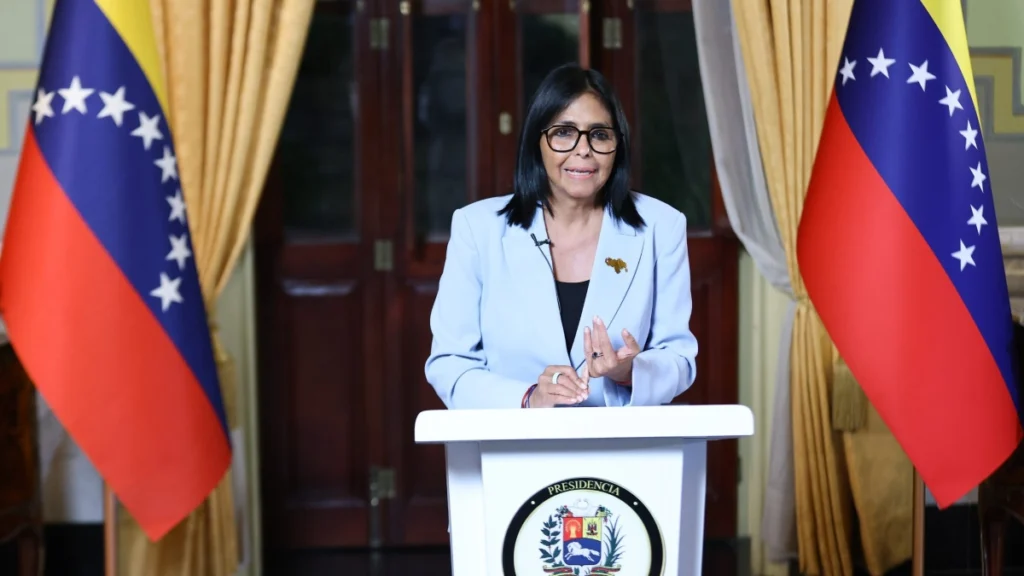
In a message to the nation on Saturday night, the interim president of Venezuela, Delcy Rodríguez, stated that the 25-year energy agreement with the United States government, announced on Friday (28), is a strategic step towards transforming the country’s immense subsoil wealth into social well-being, industrial development and long-term economic stability.
The interim president emphasized that having the largest oil reserves in the world is irrelevant if resources are reduced to mere statistics. The central objective of the national government is to transform this wealth into tangible prosperity for Venezuelans, ensuring better incomes, robust public services, health, education and infrastructure, in addition to contributing to the hemisphere’s energy security.
“It is useless to have our oil reserves underground just to appear in statistics, when we cannot convert them and translate them into development for Venezuela,” he acknowledged, emphasizing that the agreement aims to consolidate Venezuela as a global energy power, under a contractual regime that preserves state ownership over the reserves.
Rodríguez emphasized that the funds raised will be used directly for the modernization of public services, health, education and national infrastructure. “We are committed to a prosperous future for Venezuela, so that Venezuelans can look to the future in one year, five years, ten years, fifty years. We are thinking about the Venezuela of the future,” he said.
Sovereignty and ownership over resources
In his speech to the people of Venezuela, Rodríguez explained that the binational project, signed for a period of 25 years, is based on the premise of complementarity: Venezuela contributes its crude oil, its industry and the experience accumulated by its workers over more than a century, maintaining sovereignty and ownership over its resources, while the United States contributes the capital and technology necessary to recover and revitalize operational assets.
With this precision, she dispelled any notion of asset transfer. Recognizing the existence of previous differences between the two governments, he presented the energy agreement as a way to overcome them. “We chose the path of diplomacy with the USA to transform our differences into cooperation,” he stated.
This understanding, the result of diplomatic efforts to transform differences into economic cooperation, consolidates a more balanced international market and opens a horizon of certainty and prosperity for the country’s comprehensive development, emphasized the interim president.
Among the main benefits obtained by the Venezuelan State, she mentioned the increase in productivity through the creation of jobs, investments in infrastructure and links to national industry. This is in addition to the development of strategic fields covering 17 blocks, with the aim of achieving production in excess of 1.5 million barrels per day.
Energy power for the people
The economic equation of the agreement was presented in numbers. Based on the terms of the agreement, a significant fiscal and tax impact is expected. Using an estimated base price of US$65 per barrel, total revenue of up to US$209.335 billion is projected for the Venezuelan State (US$19 per barrel sold would enter directly into the country). This tax revenue would be reinvested in development and social welfare for the nation.
All of this – emphasized the interim president of Venezuela – would be supported by optimized royalties which, unlike the schemes of three decades ago, with minimums of 1%, establish a floor of 16% in blocks in the Orinoco Oil Belt.
Delcy Rodríguez also highlighted that the Executive’s vision for the future, which aims to transform Venezuela into a comprehensive exporting power, is not limited exclusively to crude oil.
The government’s objective is to consolidate the South American nation as a great energy power, also boosting gas exports and national petrochemical development.
Source: www.brasildefato.com.br